
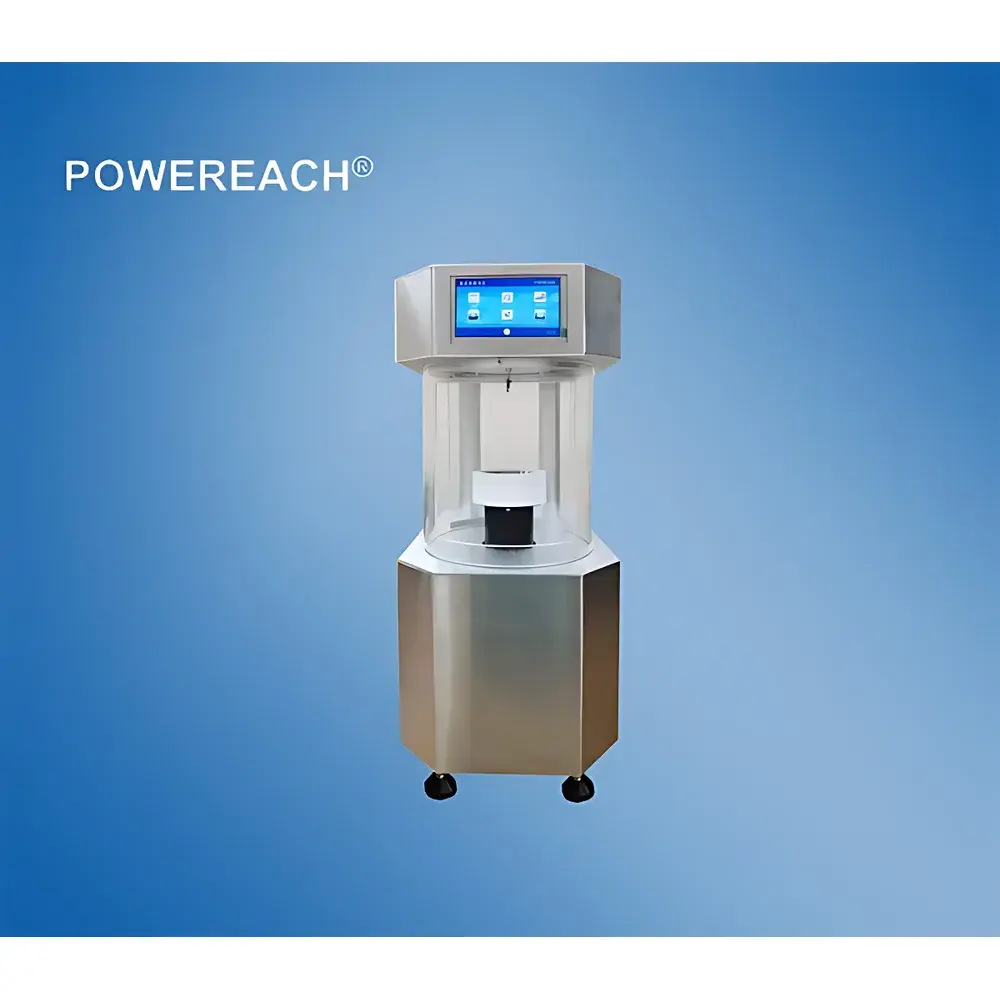
POWEREACH JK99M1 Advanced Automatic Surface & Interfacial Tensiometer
| Brand | POWEREACH |
|---|---|
| Origin | Shanghai, China |
| Model | JK99M1 |
| Measurement Range | 0–999.999 mN/m |
| Resolution | 0.001 mN/m |
| Accuracy | ±0.01 mN/m |
| Methods | Du Noüy Ring Method (40–50 mL sample volume) & Wilhelmy Plate Method (20–30 mL sample volume) |
| Sampling Interval | 1–5 s (Plate), 50–200 s (Ring) |
| Compliance | GB/T 22237–2008, GB/T 5549–2010, GB/T 6541–1986, SY/T 5370–1999 |
| Sensor | High-precision 0.1 mg electromagnetic balance (METTLER-origin system) |
| Data Acquisition Rate | 10 Hz (standard), 50 Hz (optional) |
| Temperature Sensing Accuracy | ±0.1 °C |
| Platform Vertical Travel | 0–30 mm (standard), up to 100 mm (optional) |
| Positional Repeatability | ±0.1 mm (±1 µm with optional sensor) |
| Power Supply | AC 220 V ±5%, <150 W |
| Operating Humidity | 30–85% RH |
Overview
The POWEREACH JK99M1 Advanced Automatic Surface & Interfacial Tensiometer is an engineered solution for precise, repeatable quantification of surface tension (liquid–air) and interfacial tension (liquid–liquid) based on the fundamental principles of the Wilhelmy plate and Du Noüy ring methods. These techniques rely on direct force measurement at the solid–liquid interface, where the wetting force exerted on a calibrated platinum probe is balanced against gravitational and buoyancy components. The instrument implements a high-stability electromagnetic force compensation system—sourced from METTLER-grade transduction architecture—to deliver traceable, ISO/IEC 17025-aligned measurements across a broad dynamic range (0–999.999 mN/m). Designed for laboratory environments requiring regulatory traceability and method flexibility, the JK99M1 supports both static equilibrium and time-resolved tension profiling, enabling characterization of surfactant adsorption kinetics, aging effects, and interfacial relaxation phenomena in complex formulations.
Key Features
- Dual-method compatibility: Fully automated execution of ASTM D971-compliant Du Noüy ring and ISO 1409-compliant Wilhelmy plate protocols within a single platform
- High-resolution force detection: 0.001 mN/m resolution with ±0.01 mN/m accuracy, validated using NIST-traceable calibration weights
- Intelligent platform control: Precision stepper-motor-driven vertical stage with programmable speed (0.1–2 mm/s) and positional repeatability ≤0.1 mm (≤1 µm with optional displacement sensor)
- Integrated thermal management: Circulating temperature-controlled platform with embedded Pt100 sensor; compatible with external thermostats (e.g., Julabo, Huber) for isothermal measurements from 5–80 °C
- Real-time data acquisition: Standard 10 Hz sampling rate (up to 50 Hz optional), supporting dynamic surface age studies from 15 ms to 16 s
- Zero-error mitigation: Hardware and software one-touch tare functions; built-in correction algorithms for buoyancy, meniscus geometry, and density compensation
- Modular expandability: Field-upgradable modules for CMC determination, density measurement (liquid/solid), dynamic contact angle (sessile drop/bubble), fiber/powder wettability, and adhesion force analysis
Sample Compatibility & Compliance
The JK99M1 accommodates low-to-high-viscosity liquids—including crude oils, polymer solutions, paints, inks, emulsions, and biological surfactants—without method reconfiguration. Its dual-probe design ensures robust performance across diverse interfacial systems: hydrocarbon–water, silicone–aqueous, fluorosurfactant–air, and microemulsion interfaces. All measurements comply with internationally recognized standards: GB/T 22237–2008 (surface tension of surfactant solutions), GB/T 5549–2010 (interfacial tension by ring method), GB/T 6541–1986 (petroleum products), and SY/T 5370–1999 (oilfield chemical evaluation). Instrument firmware and software support audit trails, electronic signatures, and data export formats compliant with FDA 21 CFR Part 11 requirements when operated under validated SOPs. Calibration verification is facilitated via included certified ring weights and documented procedures aligned with GLP and ISO/IEC 17025 quality frameworks.
Software & Data Management
The bundled Windows-based application provides full instrument control, real-time curve visualization, automated report generation (PDF/CSV/XLSX), and long-term trend analysis. Software features include multi-curve overlay, derivative calculation (dγ/dt), CMC identification via conductivity or tension inflection, and batch processing for concentration series. All raw data are timestamped and stored with metadata (operator ID, ambient temperature/humidity, probe type, calibration status). The system supports secure user access levels (administrator/operator/observer), change control logs, and electronic signature capture. Exported datasets maintain full traceability to instrument serial number, sensor ID, and calibration certificate reference—enabling seamless integration into LIMS or ELN platforms used in pharmaceutical QC, petrochemical R&D, and academic publishing workflows.
Applications
- Enhanced oil recovery (EOR): Screening of alkali-surfactant-polymer (ASP) formulations for ultra-low interfacial tension (<0.01 mN/m) against reservoir brines
- Colloid & interface science: Quantifying critical micelle concentration (CMC), adsorption isotherms, and Gibbs elasticity of amphiphilic molecules
- Coatings & inks: Evaluating wetting behavior on substrates, leveling agents’ efficacy, and pigment dispersion stability
- Pharmaceutical development: Characterizing liposomal membrane integrity, surfactant-mediated drug solubilization, and excipient–API interfacial interactions
- Food & cosmetics: Assessing emulsifier performance in O/W and W/O systems, foaming capacity, and texture-modifier functionality
- Materials science: Measuring fiber wettability for composite preform impregnation, powder hydrophobicity for dry powder inhalers, and nanomaterial dispersion energy
FAQ
What is the difference between the Wilhelmy plate and Du Noüy ring methods?
The Wilhelmy plate method measures force continuously during immersion and withdrawal, offering rapid (1–5 s), high-reproducibility results ideal for viscous or volatile samples. The Du Noüy ring method captures peak force at detachment (50–200 s), providing higher sensitivity for low-tension systems but requiring careful ring cleaning and alignment.
Can the JK99M1 measure interfacial tension between two immiscible liquids?
Yes—by selecting the interfacial mode and configuring the lower phase as the denser liquid (e.g., brine), the instrument automatically compensates for buoyancy and calculates interfacial tension per ISO 1409 Annex B.
Is temperature control integrated or external?
The base unit includes a Peltier-cooled circulating platform with internal Pt100 sensing; external chiller connection (e.g., ¼” tubing) is required for precise setpoint control below ambient or above 40 °C.
Does the software meet regulatory requirements for GMP/GLP environments?
When deployed with password-protected user roles, audit trail logging, and electronic signature configuration, the software satisfies core elements of 21 CFR Part 11 and EU Annex 11 for computerized system validation.
What maintenance is required for platinum probes?
Platinum rings and plates must be flame-annealed before each use to remove organic residues; periodic recalibration using certified weights (included) is recommended every 3 months or after 200 measurements.



