
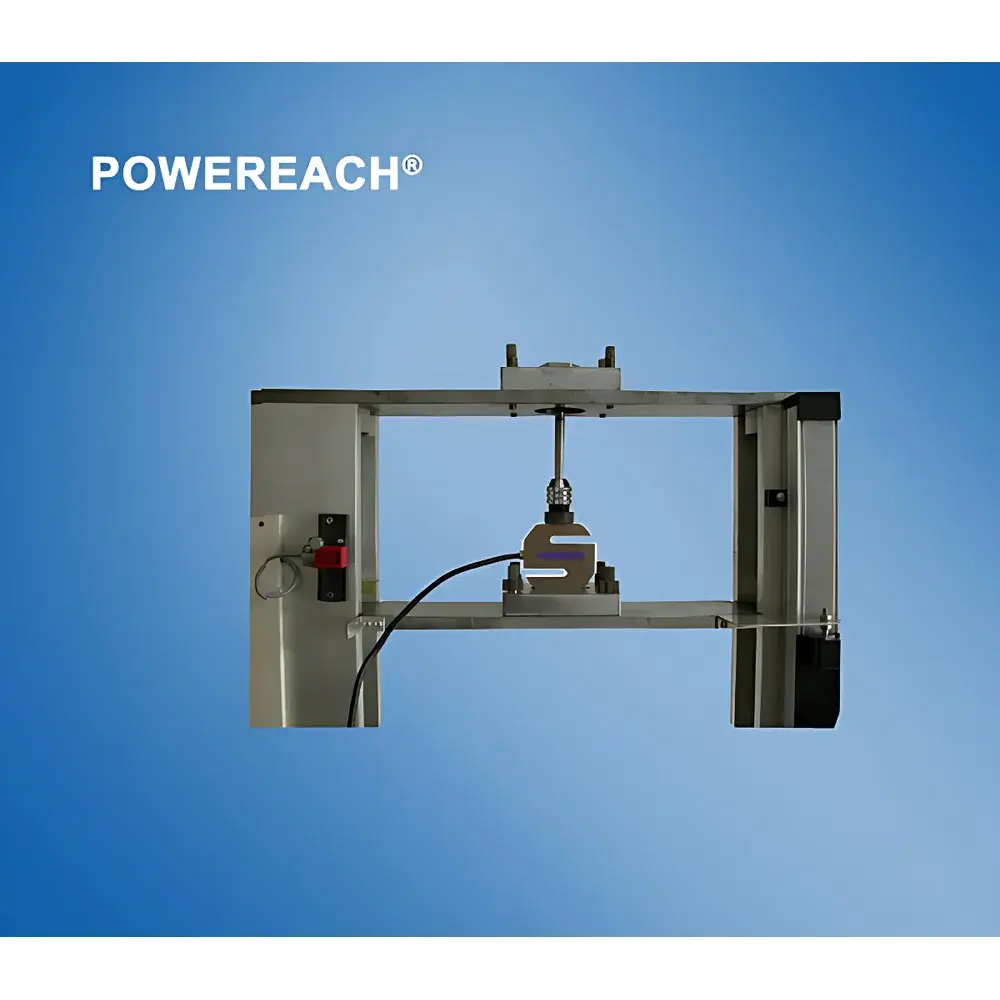
POWEREACH JMD04A Fabric Burst Strength Tester (50 kg Capacity)
| Brand | POWEREACH |
|---|---|
| Origin | Shanghai, China |
| Model | JMD04A |
| Instrument Type | Electromechanical Burst Tester |
| Maximum Burst Force | 50 kgf (490.3 N) |
| Displacement Resolution | 0.01 mm |
| Compliance | ASTM D3786, ISO 13938-1, GB/T 7742.1, BS EN ISO 13938-1 |
| Software | Windows-based control & analysis suite with real-time force-displacement curve acquisition, auto peak detection, statistical reporting (mean, SD, CV%), and export to CSV/PDF |
Overview
The POWEREACH JMD04A Fabric Burst Strength Tester is an electromechanical testing system engineered for precise determination of the bursting resistance of planar flexible materials—including woven and nonwoven textiles, technical fabrics, geotextiles, medical membranes, packaging films, and synthetic leather—under controlled spherical probe penetration. It operates on the principle of constant-rate-of-traverse (CRT) puncture, where a hemispherical steel probe (typically 38 mm diameter per ASTM D3786) is driven vertically at a defined speed into a clamped circular specimen until rupture occurs. The instrument records the maximum force required to induce failure (burst strength), along with corresponding displacement and energy absorption characteristics. Designed for routine QC labs and R&D facilities, the JMD04A delivers high reproducibility in compliance with internationally recognized textile mechanical testing standards, enabling objective assessment of structural integrity, dimensional stability under localized stress, and comparative performance across material batches or formulations.
Key Features
- Robust dual-column frame with precision-ground lead screws and high-torque stepper motor drive, ensuring stable crosshead motion and minimal mechanical hysteresis.
- Calibrated load cell with 50 kgf (490.3 N) full-scale capacity and ≤±0.5% FS accuracy per ISO 7500-1 Class 1, traceable to national metrological standards.
- Adjustable crosshead speed range from 10 to 500 mm/min, programmable in 1 mm/min increments to accommodate standard protocols (e.g., 300 mm/min for ASTM D3786) or custom test profiles.
- Modular clamping system with pneumatic or manual ring clamps (standard 113 mm inner diameter per ISO 13938-1), supporting consistent specimen pre-tension and edge constraint.
- Integrated digital displacement encoder with 0.01 mm resolution and linear error compensation, synchronized with force acquisition at 100 Hz sampling rate.
- Dedicated front-panel interface with LCD display and tactile keypad for standalone operation; also fully controllable via PC software.
Sample Compatibility & Compliance
The JMD04A accommodates specimens up to 150 mm in diameter, suitable for single-layer or multi-layer laminates with thicknesses ranging from 0.05 mm (e.g., surgical drapes) to 5 mm (e.g., reinforced industrial membranes). Its modular design allows rapid adaptation for alternative probe geometries (e.g., 25 mm or 50 mm diameter) and clamp configurations to meet specialized requirements in automotive interior testing (SAE J885), filtration media evaluation (ISO 11357-3), or biomedical barrier validation (ASTM F1670/F1671). The system conforms to essential regulatory and industry benchmarks including ASTM D3786 (Bursting Strength of Textiles – Diaphragm Method), ISO 13938-1 (Textiles – Bursting Properties – Part 1: Hydraulic Method, adapted mechanically), GB/T 7742.1 (Chinese national standard for textile bursting strength), and BS EN ISO 13938-1. All calibration certificates and verification reports are provided with initial delivery and support GLP/GMP audit readiness.
Software & Data Management
The included Windows-compatible software provides complete test sequence definition, real-time visualization of force–displacement curves, automatic burst point identification using first-derivative thresholding, and post-test statistical analysis (n ≥ 5 replicates). Data files store raw time-series measurements, metadata (operator ID, sample ID, environmental conditions), and audit trails compliant with FDA 21 CFR Part 11 requirements when configured with user authentication and electronic signature modules. Reports generate in PDF or CSV format, featuring customizable templates aligned with internal SOPs or external certification submissions. Software supports batch processing, trend charting over time, and integration with LIMS environments via ODBC drivers.
Applications
- Quality assurance of apparel and protective fabrics (e.g., flame-retardant workwear, bulletproof composites, airbag textiles).
- Evaluation of hydrostatic head resistance in waterproof-breathable laminates used in outdoor gear.
- Performance screening of filtration media subjected to particulate loading and pressure cycling.
- Mechanical durability assessment of wound dressings, surgical gowns, and implantable barrier membranes.
- Comparative analysis of biodegradable packaging films during accelerated aging studies.
- R&D of smart textiles incorporating conductive threads or phase-change materials under localized mechanical stress.
FAQ
What standards does the JMD04A support out of the box?
It is pre-configured for ASTM D3786, ISO 13938-1, GB/T 7742.1, and BS EN ISO 13938-1. Custom protocol implementation (e.g., AATCC TM135, JIS L1096) is available upon request.
Is a computer required for operation?
Yes — the instrument requires a Windows PC (32-bit or 64-bit) with one USB port and one RS-232 serial port (or USB-to-serial adapter) for firmware updates and advanced data analysis. Standalone mode supports basic start/stop and result display only.
Can the JMD04A be integrated into an automated lab environment?
Yes — it supports SCPI command set over RS-232 and offers optional Ethernet module for TCP/IP communication, enabling remote triggering and data streaming into centralized QA systems.
What maintenance is recommended for long-term accuracy?
Annual recalibration of the load cell and displacement encoder is advised; quarterly verification using certified reference weights and gauge blocks is recommended per ISO/IEC 17025 guidelines.
Does the system support multi-specimen sequential testing?
Yes — the software includes batch test mode with auto-reset between specimens, configurable dwell times, and pass/fail criteria based on user-defined burst force thresholds.



