
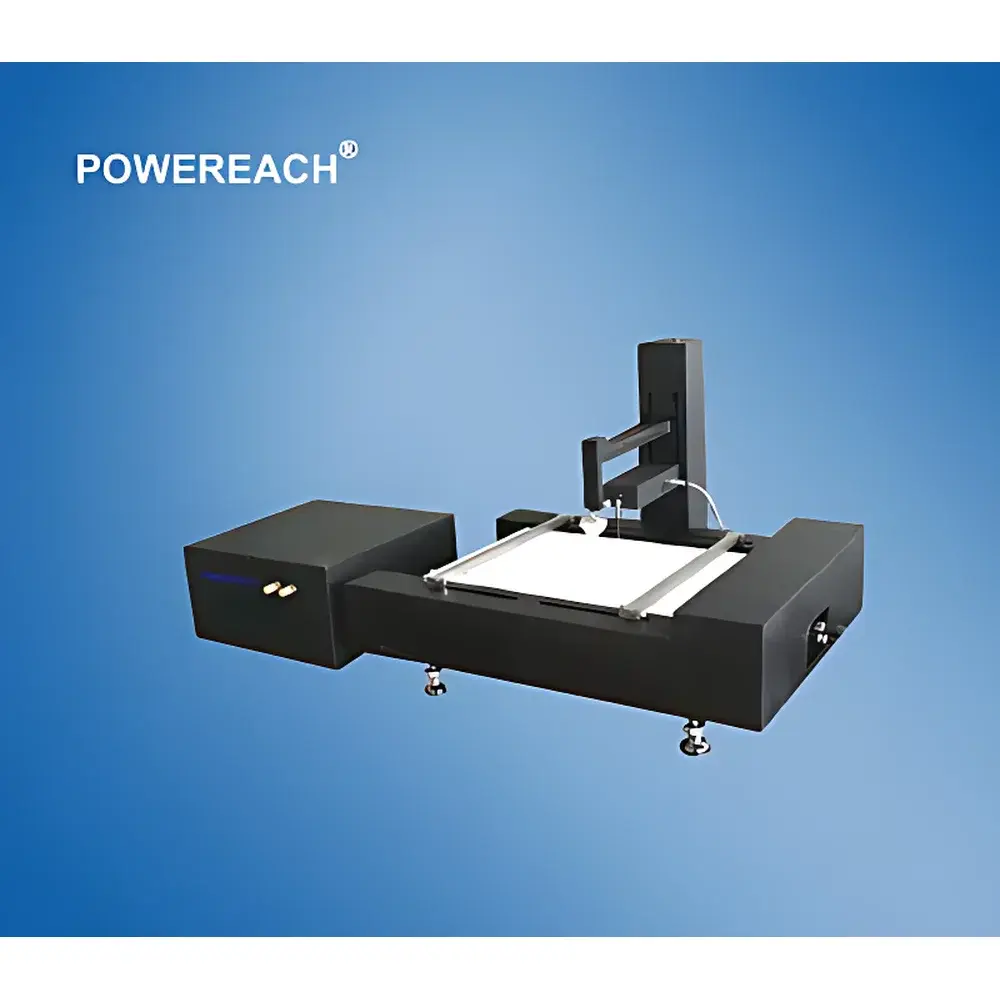
POWEREACH JML04C1 Multifunctional Langmuir-Blodgett Trough Analyzer (Film Balance / Langmuir Trough)
| Brand | POWEREACH (Shanghai Zhongchen) |
|---|---|
| Origin | Shanghai, China |
| Model | JML04C1 |
| Surface Tension Range | 0–150 mN/m |
| Resolution | < 0.05 mN/m |
| Measurement Method | Wilhelmy Plate Technique |
| Trough Material | PTFE (Full Fluoropolymer Construction) |
| Trough Dimensions | 200 mm × 80 mm |
| Compression Ratio | Up to 90% |
| Barrier Speed | 0.05–3 mm/s |
| Vertical Deposition Speed | 0.02–2 mm/s |
| Deposition Modes | Upward & Downward |
| Power Supply | AC 220 V ±10%, 50 Hz |
| Max Power Consumption | < 150 W |
| Operating Temperature | Ambient (with optional external thermostatic water bath, ≤65 °C) |
| Relative Humidity | 30–85% RH |
Overview
The POWEREACH JML04C1 Multifunctional Langmuir-Blodgett Trough Analyzer is a precision instrument engineered for quantitative characterization of monolayer films formed at the air–liquid interface. It operates on the fundamental principles of Langmuir film physics, utilizing the Wilhelmy plate method to measure surface pressure (π) and surface tension (γ) with high fidelity. By compressing amphiphilic molecules—such as phospholipids, proteins, synthetic surfactants, and block copolymers—into a laterally confined monolayer, the system enables real-time acquisition of π–A (surface pressure vs. molecular area) and γ–A (surface tension vs. molecular area) isotherms. These isotherms serve as primary thermodynamic descriptors of molecular packing, phase transitions, collapse behavior, and interfacial elasticity. The JML04C1 is widely deployed in academic and industrial research laboratories studying pulmonary surfactant biophysics, lipid raft formation, biomimetic membrane assembly, LB-film-based sensors, organic thin-film transistors (OTFTs), and nonlinear optical (NLO) material templating.
Key Features
- Fully automated operation via integrated PC-hosted software and embedded microcontroller, minimizing operator-induced variability and enabling reproducible protocol execution.
- High-precision Wilhelmy plate sensor with resolution better than 0.05 mN/m and full-scale range of 0–150 mN/m, calibrated against traceable reference standards.
- PTFE-constructed Langmuir trough (200 mm × 80 mm active area) ensures chemical inertness, ultra-low leakage (<10−7 mL/min), and minimal background contamination—critical for sensitive biological and pharmaceutical monolayers.
- Dual symmetric barrier system with independent motorized control delivers uniform compression/expansion kinetics, low mechanical noise (<35 dB(A)), and sub-micron positional repeatability.
- Programmable vertical deposition module supports both upward and downward dipping modes, with adjustable speed (0.02–2 mm/s) and force-feedback tension regulation to maintain constant surface pressure during transfer.
- Integrated temperature management interface compatible with external thermostatic baths (operational range: ambient to 65 °C), supporting thermodynamic studies under controlled thermal conditions.
- Modular hardware architecture allows customization of trough geometry, barrier configuration, and substrate holder design to accommodate specialized experimental requirements (e.g., multi-substrate deposition, in situ spectroscopy coupling).
Sample Compatibility & Compliance
The JML04C1 accommodates a broad spectrum of amphiphilic materials—including natural lipids (DPPC, POPG), recombinant pulmonary surfactant proteins (SP-B, SP-C), peptide–lipid hybrids, conjugated polymers, and functionalized nanoparticles dispersed in volatile or low-volatility subphases (e.g., Milli-Q water, buffered saline, chloroform/methanol mixtures). Its PTFE wetted path complies with ISO 8573-1 (purity class 4) for low extractables, making it suitable for GLP-regulated preclinical surfactant formulation studies. While not certified for IVD or GMP manufacturing environments, the system meets essential mechanical and electrical safety requirements per GB 4793.1–2007 (equivalent to IEC 61010-1) and supports audit-ready data logging when used with validated software configurations.
Software & Data Management
The Windows-based application provides a bilingual (English/Chinese) GUI with intuitive workflow navigation, real-time isotherm visualization, and synchronized parameter logging (time, π, A, T, barrier position, deposition speed). All raw data are stored in open-format ASCII (.txt) and HDF5 files, enabling direct import into MATLAB, Python (NumPy/Pandas), OriginLab, or JMP for advanced statistical analysis. Software features include automatic baseline correction, phase transition point detection (via first/second derivative analysis), compressibility modulus (Cs−1) calculation, and user-defined script execution for batch processing. Audit trails record operator ID, timestamp, parameter changes, and file export events—supporting alignment with FDA 21 CFR Part 11 principles when deployed in controlled validation environments.
Applications
- Biophysical characterization of pulmonary surfactant analogs in neonatal and adult respiratory distress syndrome (RDS/ARDS) research.
- Structure–function correlation of membrane-active peptides and antimicrobial agents at model lipid interfaces.
- Optimization of LB-film fabrication for gas-sensing layers, photonic crystals, and ferroelectric memory devices.
- Quantitative assessment of nanoparticle–lipid interactions and corona formation kinetics.
- Thermodynamic profiling of stimuli-responsive monolayers (pH-, light-, or ion-triggered phase transitions).
- Quality control of surfactant purity and batch-to-batch consistency in cosmetic and pharmaceutical excipient development.
FAQ
What subphase liquids are compatible with the JML04C1 trough?
Deionized water, phosphate-buffered saline (PBS), sucrose solutions, and low-volatility organic solvents (e.g., chloroform, hexane) are routinely used. Subphase pH and ionic strength must be stabilized prior to spreading; aggressive oxidizers or strong acids/bases are not recommended due to PTFE compatibility limits.
Can the system perform Brewster angle microscopy (BAM) or fluorescence microscopy coupling?
Yes—the trough’s open-top design and standardized mounting flanges support third-party optical modules. Users commonly integrate BAM systems with 633 nm He–Ne lasers or inverted epifluorescence microscopes equipped with EMCCD cameras.
Is the software compliant with 21 CFR Part 11 for regulated environments?
The base software includes electronic signature capability and audit trail logging. Full Part 11 compliance requires site-specific validation documentation, role-based access control implementation, and integration with enterprise-level identity management systems.
What maintenance is required for long-term measurement stability?
Monthly cleaning of the Wilhelmy plate with ethanol and lint-free wipes, annual recalibration using certified standard surfactants (e.g., octanol), and biannual inspection of barrier seal integrity are recommended. No consumables beyond platinum plates and PTFE trough liners are required.
Does the system support multi-layer LB deposition?
Yes—programmable Z-type (up/down) and Y-type (up-only) deposition modes enable sequential transfer of up to 200 layers with interlayer spacing control via precise speed and dwell time settings.
Related Products



