
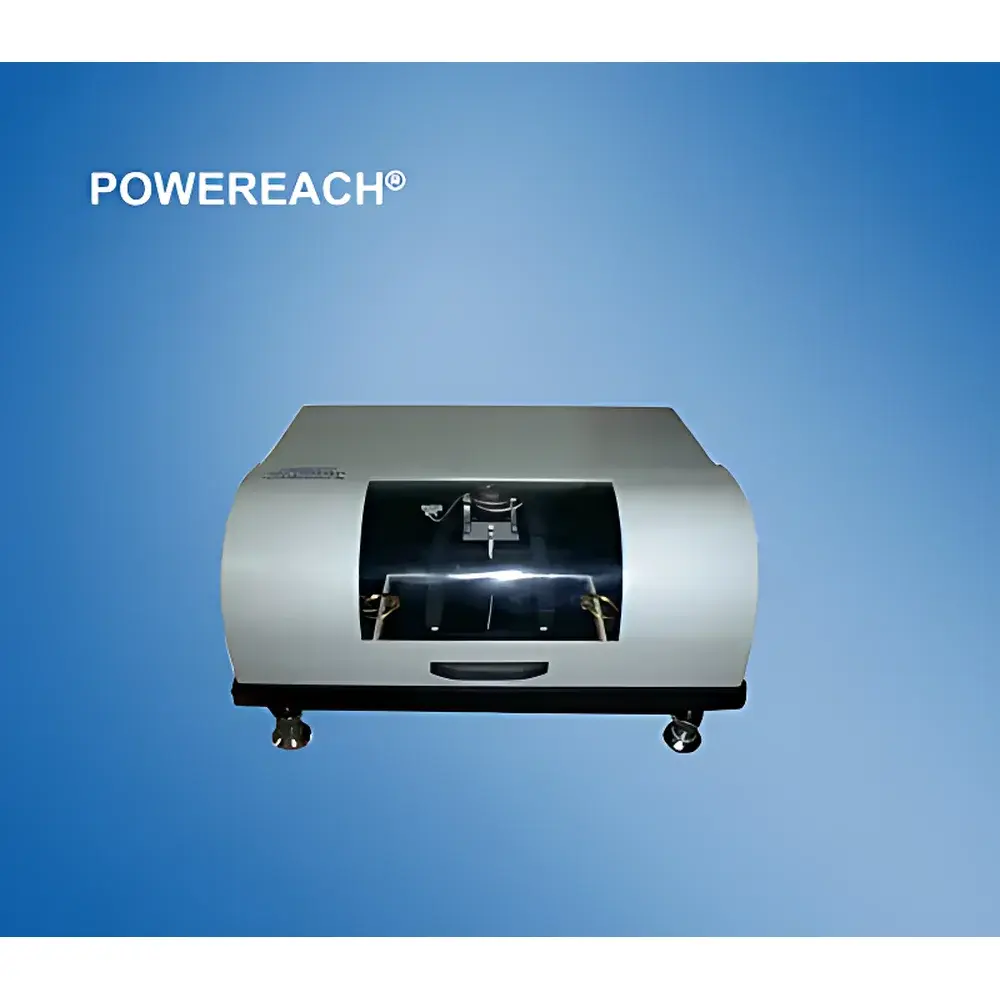
POWEREACH JMP2000A Langmuir Trough-Based Interfacial Dilatational Rheometer
| Brand | POWEREACH (Shanghai Zhongchen Digital Technology Equipment Co., Ltd.) |
|---|---|
| Origin | Shanghai, China |
| Model | JMP2000A |
| Surface Tension Range | 0–150 mN/m |
| Resolution | < 0.05 mN/m |
| Measurement Method | Wilhelmy Plate |
| Langmuir Trough Dimensions (Upper Chamber) | 70 mm × 150 mm × 8 mm (W × L × H) |
| Max Measurable Area | 96.6 cm² |
| Min Measurable Area | 19.32 cm² |
| Oscillation Frequency Range (Sinusoidal Mode) | 0.001–1 Hz |
| Area Strain Amplitude | 1–6% (relative to equilibrium area) |
| Relaxation Step Change | 5–30% area change in 1–2 s |
| Sampling Interval | 150–300 s |
| Power Supply | AC 220 V ±10%, 50 Hz |
| Max Power Consumption | <150 W |
| Operating Temperature | Ambient |
| Operating Humidity | 30–85% RH |
Overview
The POWEREACH JMP2000A Langmuir Trough-Based Interfacial Dilatational Rheometer is a precision instrument engineered for quantitative characterization of dilatational viscoelastic properties at fluid–fluid (oil/water) and fluid–gas (air/water) interfaces. It operates on the fundamental principle of controlled interfacial area modulation within a calibrated Langmuir trough, coupled with high-sensitivity Wilhelmy plate tensiometry. Unlike conventional static surface pressure–area isotherm systems, the JMP2000A implements dynamic protocols—including small-amplitude oscillatory compression, macroscopic stepwise deformation, and interfacial relaxation—to extract complex dilatational moduli (ε* = ε′ + iε″), phase angle (Φ), Gibbs elasticity (ε), and steady-state dilatational viscosity (K). These parameters are essential for understanding molecular rearrangement kinetics, film stability, and energy dissipation mechanisms in surfactant monolayers, protein films, polymer-lipid mixtures, and responsive amphiphilic assemblies under non-equilibrium conditions.
Key Features
- Computer-controlled dual-barrier Langmuir trough with leak-proof barrier design, enabling precise and reproducible area modulation across a wide dynamic range (19.32–96.6 cm²).
- High-resolution Wilhelmy plate tensiometry system with <0.05 mN/m resolution and low mechanical noise—optimized for stable baseline acquisition during extended dynamic experiments.
- Three programmable deformation modes: sinusoidal oscillation (0.001–1 Hz, 1–6% strain), exponential compression (constant dlnA/dt), and rapid relaxation steps (5–30% area change in ≤2 s).
- Dual-stage motorized barrier drive with fine-tuned speed control (150–300 s sampling interval), ensuring smooth motion profiles and minimal hydrodynamic disturbance.
- Integrated Windows-based control software (jmp.exe) with real-time data visualization, BMP-format image export, and ASCII-compatible data output for post-acquisition analysis in MATLAB, Origin, or Python.
- Modular hardware architecture featuring dedicated single-board microcontroller for real-time sensor interfacing, USB/RS232 communication, and robust electromagnetic shielding for laboratory-grade signal integrity.
Sample Compatibility & Compliance
The JMP2000A supports a broad spectrum of interfacial systems relevant to colloid and interface science, including synthetic surfactants (e.g., SDS, CTAB), biosurfactants (e.g., phospholipids, bile salts), proteins (e.g., β-lactoglobulin, lysozyme), polymers (e.g., PEO-PPO-PEO triblocks), and hybrid nanoparticle–surfactant films. Its operational design conforms to standard practices outlined in ISO 4311 (surface-active agents – determination of surface tension by the ring method) and ASTM D1331 (surface and interfacial tension of solutions), with adaptations for dynamic dilatational measurements. While not certified for GLP or FDA 21 CFR Part 11 out-of-the-box, the system’s audit-ready data logging (timestamped, user-annotated, non-editable raw files) and deterministic control architecture support validation workflows required in regulated R&D environments—particularly for formulation development in pharmaceuticals, cosmetics, and food emulsion science.
Software & Data Management
The native jmp.exe application provides intuitive graphical configuration of experimental parameters—including oscillation frequency, amplitude, ramp rate, and relaxation dwell time—via point-and-click interface. All raw force and area signals are acquired synchronously at user-defined intervals and stored in structured ASCII format (.txt), facilitating traceable reprocessing and statistical evaluation. The software enforces strict metadata tagging (operator ID, date/time stamp, sample ID, protocol version), enabling alignment with internal SOPs and quality management systems. Exported data include surface pressure (π), relative area change (ΔA/A₀), phase lag (Φ), storage modulus (ε′), loss modulus (ε″), and complex modulus magnitude (|ε*|). No cloud dependency or proprietary binary formats are used; all outputs are fully interoperable with third-party curve-fitting tools for Maxwell, Voigt, or generalized Kelvin–Voigt model fitting.
Applications
The JMP2000A serves as a critical tool in academic and industrial research where interfacial rheology governs functional performance:
- Emulsion and foam stabilization mechanism studies—correlating ε′/ε″ ratios with droplet coalescence resistance and foam drainage kinetics.
- Biological membrane mimetics—quantifying lateral compressibility and relaxation timescales of pulmonary surfactant analogues under breathing-mimetic oscillations.
- Responsive monolayer design—evaluating pH-, temperature-, or light-triggered changes in dilatational elasticity for smart coating development.
- Quality control of surfactant batches—detecting subtle variations in molecular packing density or impurity-induced heterogeneity via frequency-dependent ε″ peaks.
- Fundamental validation of interfacial constitutive models—providing benchmark datasets for numerical simulations of Marangoni-driven flows and interfacial instability onset.
FAQ
What interfacial systems can be measured with the JMP2000A?
The instrument is validated for air/water and oil/water interfaces using insoluble monolayers formed from surfactants, lipids, proteins, and polymeric amphiphiles. Soluble surfactants may be studied via continuous injection protocols, though interpretation requires careful correction for bulk diffusion effects.
Is the Wilhelmy plate compatible with organic subphases?
Yes—standard platinum or filter paper plates may be used with chloroform, hexane, or octanol subphases, provided compatibility with trough materials (PTFE-coated stainless steel) and proper vapor containment.
Can the system be integrated into automated lab workflows?
While the base configuration uses RS232/USB serial control, the open ASCII data format and documented command protocol enable integration with LabVIEW, Python (pySerial), or custom SCADA systems for unattended multi-sample runs.
What maintenance is required for long-term calibration stability?
Annual verification of force transducer linearity using certified weights and periodic cleaning of barriers, trough walls, and Wilhelmy plate with ethanol and ultrapure water are recommended. No recalibration is needed between routine experiments if environmental drift remains within ±0.5 mN/m over 24 h.
Does the system support temperature control of the subphase?
The JMP2000A does not include built-in thermostating; however, the trough design accommodates external Peltier or water-jacketed temperature control units (not supplied), with dimensional clearance for standard immersion circulators.



