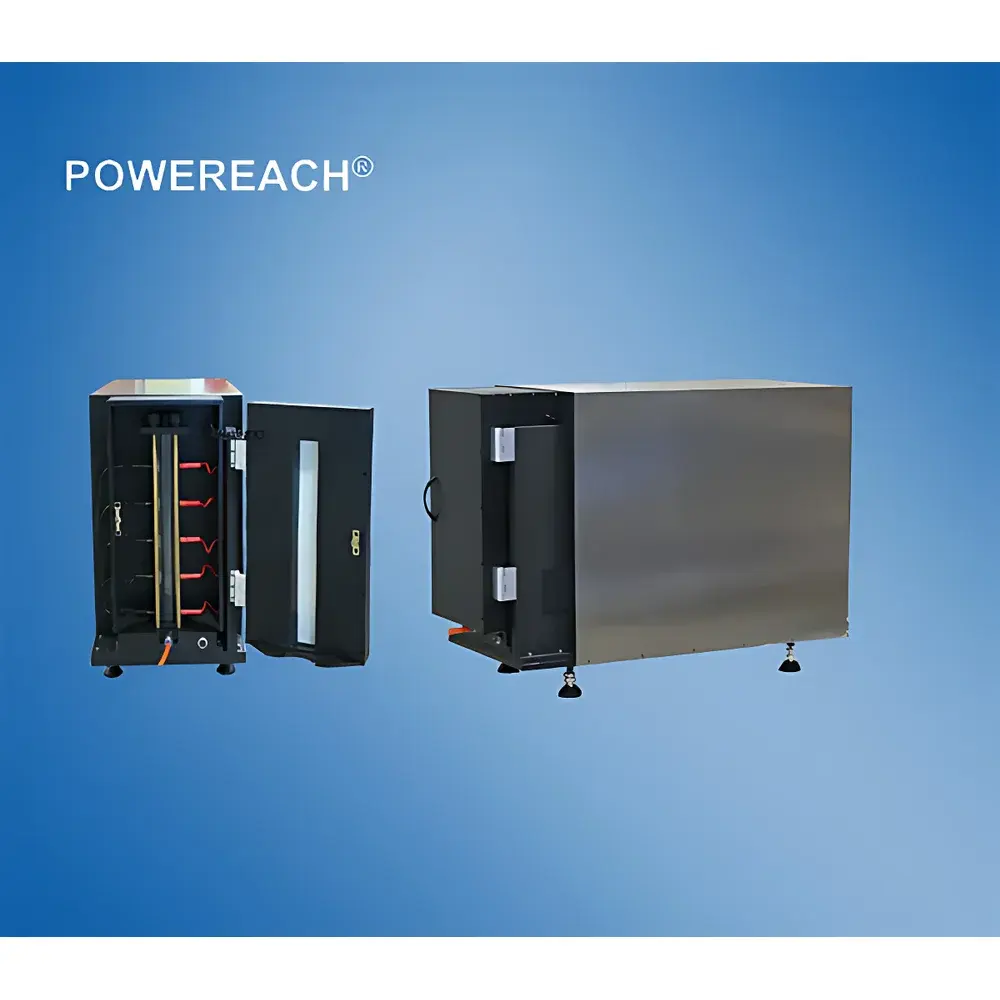
POWEREACH JMZP2010 Fully Automated Foam Analyzer
| Brand | POWEREACH (Shanghai Zhongchen) |
|---|---|
| Origin | Shanghai, China |
| Manufacturer Type | Authorized Distributor |
| Regional Classification | Domestic (PRC) |
| Model | JMZP2010 |
| Pricing | Upon Request |
| Dimensions | 690 × 310 × 480 mm |
| Gas Flow Range | 0–500 mL/min (±0.5% accuracy), Max Pressure: 1.5 MPa |
| Stirring Speed | 5000 rpm |
| Foam Height Measurement | 0–300 mm (video-based, 1300K-pixel camera, 25 fps, 8× telecentric lens) |
| Minimum Sample Volume | 20 mL |
| Conductivity Sensing | 5-channel inline electrodes, resolution 0.01 µS/cm |
| Temperature Control | Ambient to 85 °C (optional integrated heating rod) |
| Foam Generator Orifice Diameters | 1.0–1.6, 10–16, 16–40, 40–100, 100–160, 160–250, 250–500 µm |
| Measured Parameters | gas flow rate, foam volume, liquid drainage volume, foam conductivity, liquid fraction |
| Derived Metrics | foam density, Bikerman index, foam volume stability, liquid phase stability, expansion ratio, foaming capacity, head retention value |
| Power Supply | 220 V AC, 300 W |
| Control System | PC-based automation (no calibration factor required), RS232 + USB interface |
Overview
The POWEREACH JMZP2010 Fully Automated Foam Analyzer is an engineered platform for quantitative, time-resolved characterization of foam macrostructure and dynamic evolution under controlled gas introduction. It operates on a dual-mode generation principle—gas sparging through calibrated orifices or mechanical agitation—enabling rigorous evaluation of both foaming capacity (foamability) and foam stability across diverse formulations. Unlike traditional conductometric foam analyzers limited to aqueous systems, the JMZP2010 employs non-contact optical monitoring via high-frame-rate digital imaging coupled with multi-point conductivity profiling, allowing simultaneous assessment of gas-phase distribution, liquid drainage kinetics, and interfacial ionic behavior in both polar and non-polar media. This architecture supports reproducible measurement of foam height, liquid fraction decay, and structural heterogeneity—critical parameters in reservoir engineering (e.g., enhanced oil recovery foams), formulation development (e.g., personal care, fire suppression agents), and quality control of industrial surfactant systems.
Key Features
- Non-invasive, high-resolution video metrology: 1300K-pixel camera with 8× telecentric optics captures foam column dynamics at 25 frames per second, enabling pixel-accurate height tracking from 0 to 300 mm.
- Modular, cleanable glass sample chamber: Removable borosilicate cylinder facilitates rapid cleaning and cross-contamination avoidance—essential for GMP-compliant labs handling high-value or regulated formulations.
- Integrated compressed air supply: Onboard oil-free diaphragm pump delivers stable gas flow (0–500 mL/min, ±0.5% full-scale accuracy) at up to 1.5 MPa, eliminating external compressor dependencies.
- Multi-orifice foam generation system: Seven interchangeable sintered stainless-steel frits (1.0–500 µm pore size range) permit systematic study of bubble nucleation sensitivity to interfacial rheology and capillary pressure.
- Minimal sample consumption: Validated operation with as little as 20 mL of test solution reduces reagent cost and enables high-throughput screening of scarce or expensive formulations.
- Thermal regulation option: Integrated resistive heating rod enables temperature-controlled testing from ambient to 85 °C—supporting accelerated aging studies and viscosity-dependent foam behavior analysis.
Sample Compatibility & Compliance
The JMZP2010 accommodates a broad spectrum of liquid phases, including aqueous surfactant solutions, hydrocarbon-based foaming agents, polymer dispersions, and low-surface-tension solvents—without reliance on bulk conductivity. Its optical-electrochemical hybrid sensing strategy ensures robust data acquisition regardless of ionic strength or dielectric constant. The instrument’s mechanical design conforms to IEC 61010-1 safety standards for laboratory electrical equipment. Data acquisition and reporting workflows support audit-ready documentation aligned with GLP principles; raw image sequences, conductivity time-series, and derived metrics are timestamped and stored in structured binary formats compatible with long-term archival. While not pre-certified for FDA 21 CFR Part 11, the software architecture allows integration with validated electronic lab notebook (ELN) systems via CSV/JSON export and metadata tagging.
Software & Data Management
Control and analysis are executed via dedicated Windows-based software with intuitive graphical workflow configuration. Users define gas flow profiles, agitation sequences, temperature setpoints, and acquisition durations prior to run initiation. All measurements—including real-time foam height, conductivity gradients across five axial positions, and liquid drainage volume—are synchronized and logged at configurable intervals (100 ms minimum). The software computes 13 standardized foam descriptors (e.g., Bikerman index, expansion ratio, head retention value) using ISO 697/ASTM D1173–17–derived algorithms. Export options include CSV for statistical analysis in JMP or Python, TIFF stacks for third-party image processing, and PDF reports with embedded traceability metadata (operator ID, instrument serial, environmental conditions). No empirical calibration factors are required—the system relies on geometrically referenced pixel-to-mm conversion and factory-traceable flowmeter certification.
Applications
- Oilfield chemistry: Evaluation of foam quality and stability under simulated reservoir temperatures and salinities for EOR applications.
- Personal care formulation: Quantitative comparison of surfactant blends for shampoo, shaving foam, and facial cleansers—correlating foam volume persistence with consumer sensory attributes.
- Fire suppression R&D: Benchmarking AFFF and FFFP concentrates against NFPA 11 and UL 162 performance thresholds.
- Food science: Characterizing protein- or polysaccharide-stabilized foams (e.g., meringue, whipped cream analogs) under shear and thermal stress.
- Paints & coatings: Screening defoamer efficacy and predicting microfoam-induced defects in cured films per ISO 15236.
- Pharmaceutical excipient development: Assessing foam formation during lyophilization cycle design or inhalation aerosol formulation.
FAQ
What sample volume is required for a single test?
A minimum of 20 mL of liquid phase is sufficient for full-height foam characterization and drainage analysis.
Can the instrument operate without a connected PC?
No—real-time control, image capture, and data computation require continuous USB/RS232 communication with the host computer running the proprietary software.
Is temperature control standard or optional?
Heating capability (ambient to 85 °C) is an optional hardware module; base configuration operates at ambient temperature only.
How is foam height measured without physical contact?
Through machine-vision analysis of high-contrast side-view images captured by a telecentric lens system, with sub-millimeter spatial resolution validated against NIST-traceable gauge blocks.
Are foam generator frits supplied with the system?
Yes—the standard configuration includes all seven pore-size frits (1.0–500 µm range), individually labeled and certified for nominal pore diameter tolerance.
Related Products