
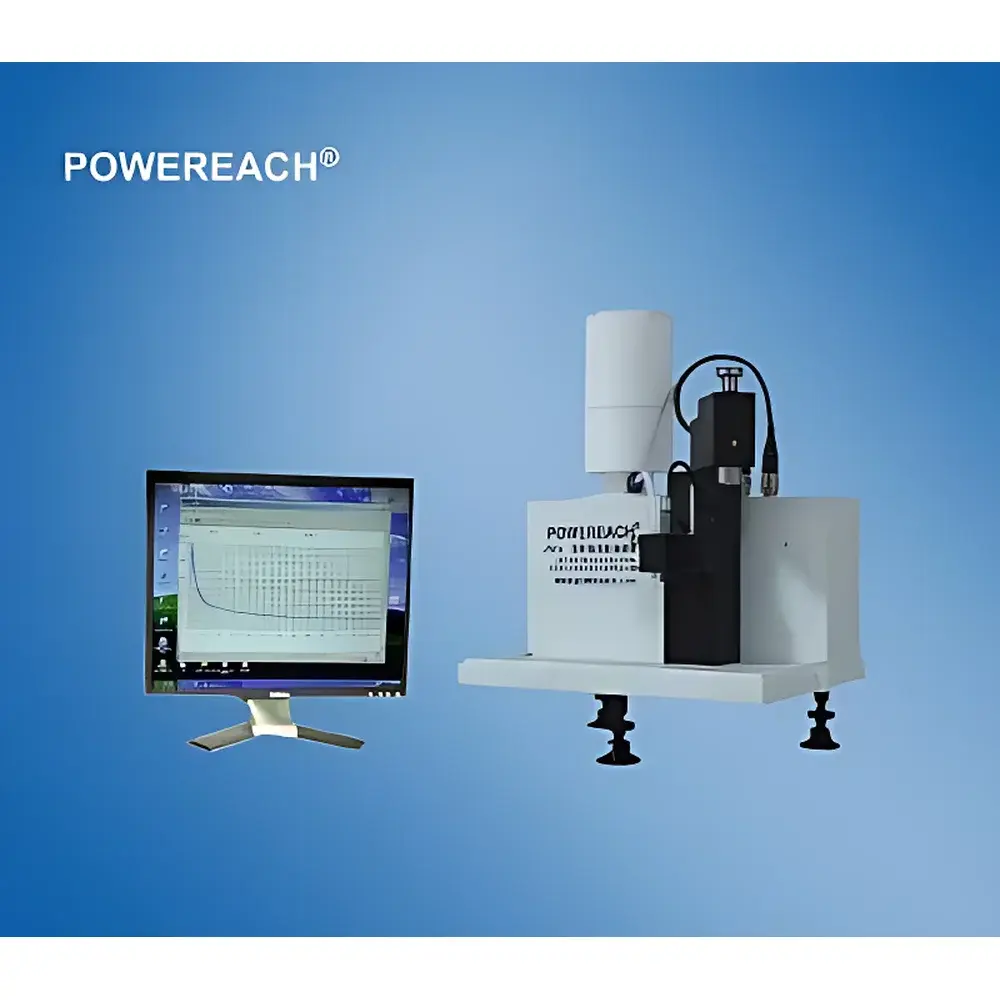
POWEREACH JN01A Concentrated Slurry Electrophoretic Analyzer
| Brand | POWEREACH (Shanghai Zhongchen Digital Technology Equipment Co., Ltd.) |
|---|---|
| Origin | Shanghai, China |
| Model | JN01A |
| Zeta Potential Measurement Principle | Mass-Exchange Electrophoresis |
| Sample Concentration Range | High-concentration dispersions (undiluted, slurry-state) |
| pH Range | Not specified |
| Compliance | Designed for ASTM D4187, ISO 13099-2, and GLP-compliant workflows requiring raw-state dispersion analysis |
| Interface | RS232 (COM port) + USB |
| Software | JN01.exe (Windows XP / 32-bit Windows 7 compatible) |
Overview
The POWEREACH JN01A Concentrated Slurry Electrophoretic Analyzer is a specialized instrument engineered for direct Zeta potential measurement in high-solids, undiluted colloidal dispersions—where conventional laser Doppler electrophoresis (e.g., standard microelectrophoresis systems) fails due to opacity, multiple scattering, or sedimentation artifacts. Unlike optical methods relying on particle velocity tracking under an electric field, the JN01A employs a mass-exchange principle: charged particles migrate electrophoretically toward oppositely charged electrodes integrated into a rotating sample cell; their net deposition mass is quantified indirectly via real-time transmittance monitoring of electrolyte displacement. This method eliminates observer bias, avoids resolution limits inherent to optical sizing, and delivers bulk-averaged Zeta potential values representative of the entire particle size distribution—including coarse and submicron fractions—without dilution-induced surface charge perturbation. The system is particularly suited for industrial process control where dispersion stability must be assessed under native formulation conditions, such as drilling muds, paper coating slurries, mineral flotation pulps, and wastewater flocs.
Key Features
- Mass-exchange-based Zeta potential determination—bypasses optical limitations of turbid, high-concentration systems (up to 40% w/w solids typical)
- Rotating sample chamber (motor-driven) prevents gravitational settling during measurement, ensuring uniform particle exposure to the electric field
- Transmittance-to-concentration calibration eliminates direct microgram-level weighing; accuracy relies on stable photometric detection of electrolyte density shifts induced by particle deposition
- No requirement for particle visualization or tracking—enables robust characterization of polydisperse, irregular, or highly absorbing materials (e.g., carbon black, iron oxides, clay aggregates)
- Modular electrode assembly with removable bottom collection electrode facilitates rapid cleaning and cross-contamination prevention between samples
- Integrated current regulation (0–25 mA, 0.1 mA resolution) and voltage monitoring support reproducible field strength application per ASTM D4187 Annex A3
Sample Compatibility & Compliance
The JN01A accepts slurries, pastes, and viscous suspensions without pre-dilution—critical for sectors where dilution alters interfacial equilibria (e.g., adsorbed polyelectrolytes, hydrolyzed metal species). It accommodates non-aqueous media when paired with compatible supporting electrolytes (e.g., alcohols with tetrabutylammonium salts). Users must supply independent measurements of suspension conductivity, density (via pycnometer), and dynamic viscosity (capillary or rotational viscometer) for software-based Zeta calculation. The instrument supports GLP-aligned data integrity: all experimental parameters (current, duration, transmittance curves, ambient temperature) are timestamped and logged in ASCII format. While not FDA 21 CFR Part 11-certified out-of-the-box, audit trails and raw-data export enable integration into validated laboratory information management systems (LIMS) under ISO/IEC 17025 or USP framework.
Software & Data Management
JN01.exe provides a dedicated Windows interface for hardware control, real-time transmittance acquisition, and automated Zeta potential computation using the Henry equation modified for mass-flux boundary conditions. Input fields require user-entered conductivity (mS/cm), density (g/mL), viscosity (cP), and electrolyte composition—parameters essential for accurate Smoluchowski-Hückel correction. All raw photodiode signals, current profiles, and time-stamped metadata are saved in plain-text .txt files for third-party statistical analysis (e.g., Python/Pandas, MATLAB). The software does not perform curve fitting or outlier rejection; results reflect first-principles derivation from measured mass flux, aligning with ISO 13099-2 Clause 7.2 requirements for traceable electrophoretic mobility reporting.
Applications
- Petroleum Engineering: Zeta potential profiling of bentonite- and polymer-based drilling fluids to optimize rheology and shale inhibition
- Wastewater Treatment: Quantifying destabilization thresholds of suspended solids during coagulant dosing (e.g., Al13 polycations, FeCl3)
- Paper & Coating Industries: Monitoring charge reversal in calcium carbonate or kaolin pigment slurries during cationic starch or PEI addition
- Mineral Processing: Assessing collector adsorption efficacy on sulfide ores (e.g., chalcopyrite, galena) in flotation pulps
- Pharmaceutical Excipients: Characterizing zirconia or titanium dioxide suspensions in topical gel bases without solvent interference
- Academic Research: Teaching electrokinetic theory in colloid science laboratories where hands-on mass-balance electrophoresis reinforces fundamental transport concepts
FAQ
How does the JN01A differ from conventional laser Doppler Zeta potential analyzers?
It replaces optical velocity detection with gravimetrically inferred particle flux—making it functional in opaque, high-viscosity, or polydisperse systems where light scattering prevents reliable particle tracking.
What supporting equipment must users provide?
A calibrated conductivity meter, digital densitometer or pycnometer, rotational viscometer, analytical balance (0.0001 g resolution), and ultrasonic homogenizer for sample deagglomeration.
Is the JN01A suitable for nanoparticles below 100 nm?
Yes—though deposition kinetics slow at nanoscale, the integrated mass signal remains detectable over extended run times (typically 30–120 min), unlike optical methods limited by Brownian motion blur.
Can data be exported for regulatory submission?
All raw transmittance vs. time datasets, parameter inputs, and calculated Zeta values export as comma-separated values (CSV) or tab-delimited text, compliant with ALCOA+ data integrity principles.
What maintenance is required?
Quarterly verification of photodiode linearity using neutral density filters; annual recalibration of current source against NIST-traceable shunt resistor; electrode polishing with 0.3 µm alumina slurry after every 50 runs.



