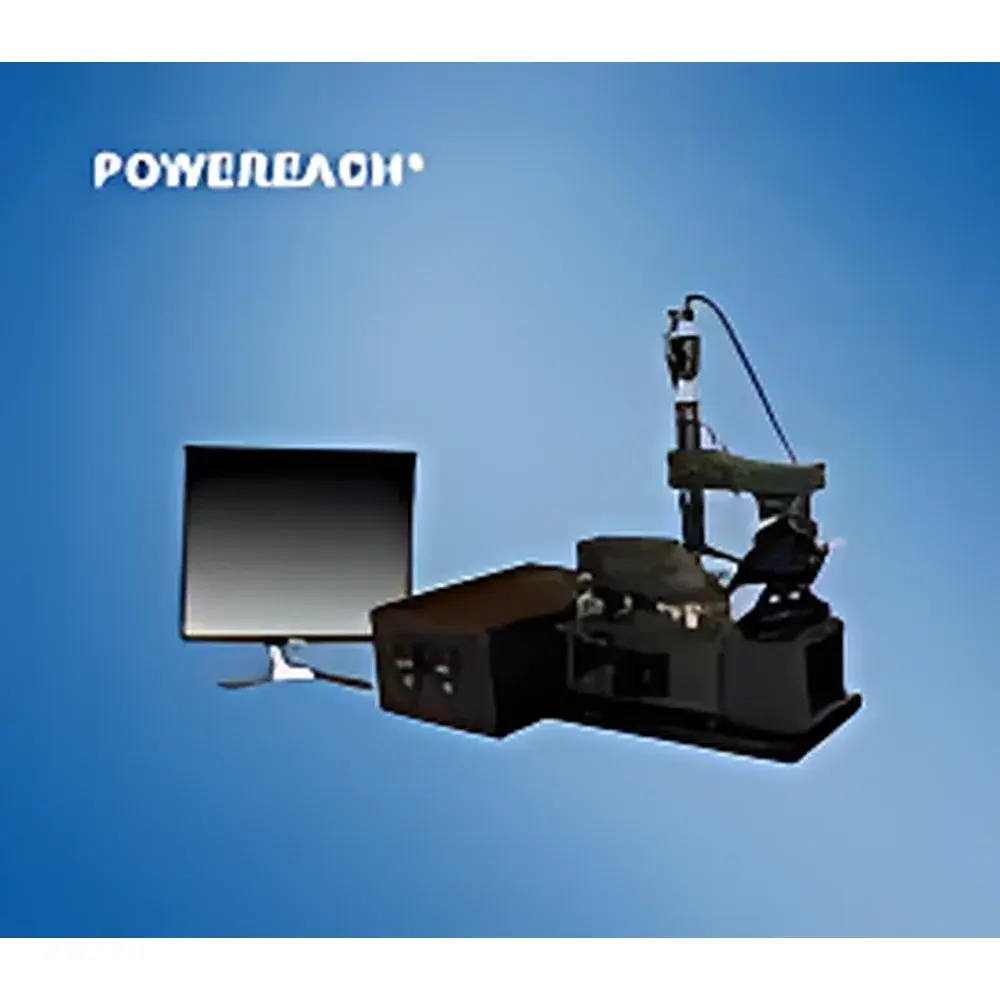
POWEREACH JOS06 Optical Shear Rheometer
| Brand | POWEREACH |
|---|---|
| Origin | Shanghai, China |
| Model | JOS06 |
| Temperature Range | Ambient to 300 °C |
| Sample Area | 25 mm diameter |
| Quartz Disk Gap Adjustment | 0.05–2 mm |
| Temperature Accuracy | ±1 °C (±0.1 °C within 100 °C) |
| Shear Modes | Oscillatory (0.01–10 Hz) and Steady-State (0.001–500 rpm, controllable down to 0.01 rpm) |
| Optical System | Transmitted light + polarized light paths |
| Imaging Resolution | 25 pixels/µm |
| CCD Stage | 3-axis motorized translation |
| Objective Working Distance | 7 mm |
| Observation Window | Large-aperture viewport |
| Temperature Control | Dual-zone heated quartz disks with Pt100 sensors |
Overview
The POWEREACH JOS06 Optical Shear Rheometer is a specialized laboratory instrument engineered for in situ microstructural characterization of complex fluids under controlled shear and thermal conditions. It integrates precision rotational rheometry with high-resolution optical microscopy to enable real-time observation of structural evolution—such as domain formation, particle alignment, network breakdown, or crystallization kinetics—during mechanical deformation. The system operates on the principle of parallel-plate Couette flow between two highly polished quartz disks, where one or both plates rotate or oscillate under computer-controlled actuation while maintaining precise thermal uniformity across the sample gap. This architecture supports quantitative correlation between macroscopic rheological response (e.g., storage/loss moduli, viscosity, yield stress) and concurrent microscopic structural dynamics—critical for R&D in soft matter physics, colloidal science, polymer processing, and functional material formulation.
Key Features
- Thermally isolated dual-zone quartz disk geometry with integrated Pt100 temperature sensors and resistive heating elements, enabling stable operation from ambient to 300 °C with ±0.1 °C stability within the 0–100 °C range
- Independent motorized control of upper and lower quartz disks, supporting both steady-state rotation (0.001–500 rpm) and oscillatory shear (0.01–10 Hz), with torque resolution sufficient for low-viscosity and weakly structured systems
- Adjustable disk separation (0.05–2 mm) via micrometer-driven vertical translation, accommodating samples ranging from dilute dispersions to highly filled pastes and gels
- Dedicated optical path design featuring interchangeable transmitted-light and polarized-light illumination, optimized for birefringence imaging, phase contrast, and anisotropy analysis
- Motorized XYZ stage supporting a high-sensitivity color CCD camera with 25 pixels/µm spatial resolution and 7 mm working distance objective—enabling focus stacking, time-lapse acquisition, and region-of-interest tracking
- Removable top cover and field-replaceable quartz disk sets (optional multi-set configuration recommended for cross-contamination-sensitive applications)
- Full data synchronization: simultaneous timestamped acquisition of rheological parameters (torque, angular displacement, temperature) and image sequences, exported in open formats (TIFF, CSV, HDF5)
Sample Compatibility & Compliance
The JOS06 accommodates a broad spectrum of viscoelastic and heterogeneous materials—including polymer melts and solutions, colloidal suspensions, emulsions, surfactant mesophases, hydrogels, ceramic slurries, battery electrode slurries, and biological macromolecular assemblies. Its quartz-based measurement geometry ensures chemical inertness toward organic solvents, acids, and bases commonly used in formulation labs. The instrument’s thermal and mechanical design conforms to IEC 61000-6-2 (EMC immunity) and IEC 61010-1 (safety requirements for electrical equipment). While not pre-certified for GMP environments, its software architecture supports audit-trail-enabled operation when deployed with compliant host systems meeting FDA 21 CFR Part 11 requirements (electronic signatures, change control, secure data archiving). All temperature and motion control subsystems are traceable to NIST-calibrated references through documented calibration protocols.
Software & Data Management
The proprietary JOS06 Control Suite provides intuitive experiment sequencing, real-time parameter monitoring, and synchronized multimodal data capture. Users define shear profiles (ramp, sweep, step, frequency sweep), thermal ramps (linear, isothermal, multi-step), and imaging triggers (frame rate, exposure, ROI selection) via a graphical workflow interface. Raw data—including torque vs. time, strain amplitude sweeps, phase angle spectra, and time-resolved image stacks—are stored in hierarchical, metadata-rich files compatible with MATLAB, Python (via h5py/pandas), and commercial rheology analysis packages (e.g., TA Instruments TRIOS, Anton Paar RheoCompass). Export functions include batch conversion to standardized formats (CSV for rheology, TIFF/AVI for video), automated report generation (PDF), and direct integration with LIMS via configurable REST API endpoints.
Applications
- Structure–property mapping of thermoresponsive polymers during sol–gel transitions
- In situ observation of shear-induced crystallization in polyolefin melts
- Quantification of yield behavior and microstructural hysteresis in colloidal gels
- Time-resolved analysis of droplet deformation and coalescence in Pickering emulsions
- Correlation of birefringence development with elastic modulus growth in liquid crystal formulations
- Stability assessment of battery cathode slurries under coating-relevant shear histories
- Microstructural aging studies of cementitious suspensions and geopolymers
FAQ
Is the JOS06 compatible with vacuum or inert gas environments?
The standard configuration operates under ambient atmosphere. Optional vacuum-compatible or glovebox-integrated enclosures are available upon request, requiring modifications to the sealing interface and feedthroughs for power/data lines.
What is the minimum measurable sample volume?
With a 25 mm diameter measurement area and 0.05 mm minimum gap, the theoretical lower limit is ~25 µL. Practical minimum depends on sample adhesion and meniscus control; for low-surface-tension liquids, edge effects may necessitate ≥50 µL for reliable data.
Can third-party microscopes or cameras be integrated?
Yes—the optical module features standardized C-mount and SM1-thread interfaces. Users may substitute the included CCD with OEM-compatible alternatives (e.g., FLIR Blackfly S, Basler ace) provided driver support is implemented via the SDK.
Does the system support automated cleaning protocols?
No built-in fluidic cleaning system is included. However, the removable quartz disk design and large access port facilitate manual solvent rinsing and plasma cleaning. Recommended cleaning SOPs are provided in the technical manual.
Is remote operation supported?
Full remote control and monitoring are enabled via TCP/IP connection using the native software client. Secure remote desktop access (e.g., via SSH tunneling or corporate VPN) is required for firewall-compliant deployment in regulated networks.
Related Products