
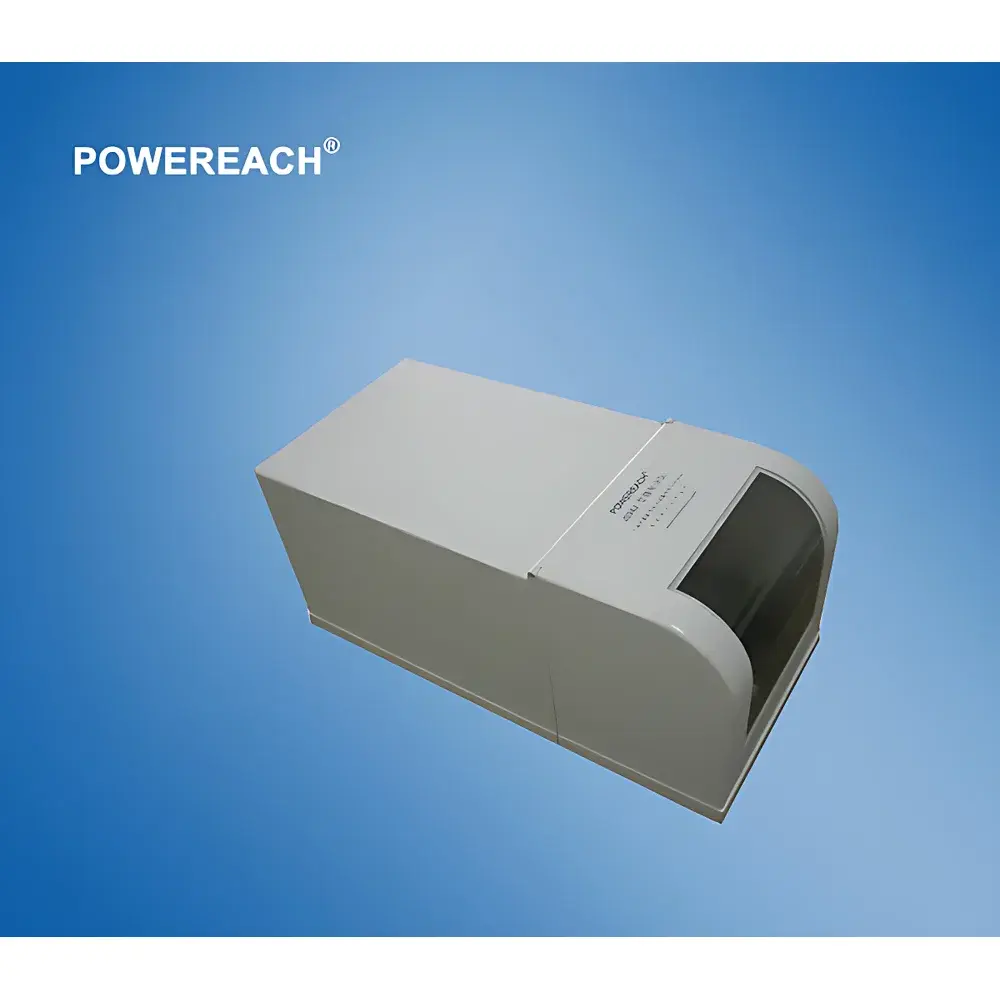
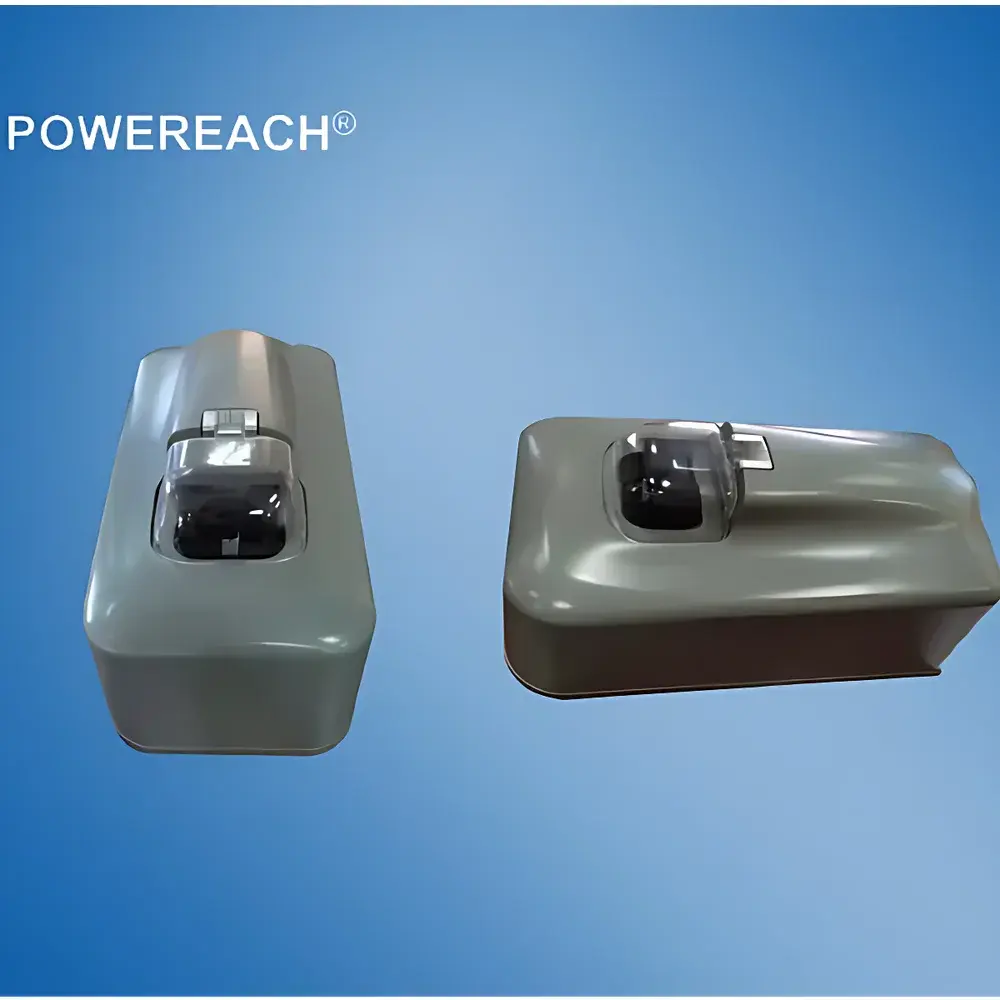
POWEREACH JS94 Series Microelectrophoresis Zeta Potential Analyzer
| Brand | POWEREACH |
|---|---|
| Origin | Shanghai, China |
| Model | JS94 |
| Measurement Principle | Microelectrophoresis (Video-Based Particle Tracking) |
| Compliance | GB/T 32668–2016 (National Standard for Colloidal Particle Zeta Potential Analysis – Electrophoretic Method) |
| Power Consumption | <150 W |
| Input Voltage | 220 V, 50 Hz |
| Operating Temperature Range | Ambient to 35 °C |
| Zeta Potential Accuracy | Systematic error ≤5% |
| pH Range | 1.6–13.0 (typical operational range: 2.0–12.0) |
| Sample Volume per Test | 0.5 mL |
| Optical Magnification | Up to 1200× |
| Imaging System | USB Digital CCD with Customized Micrometer Grid Calibration |
| Electrode Configuration | Integrated Ag, Pt, and Ti/POM electrodes in open-cell electrophoresis chamber |
| Voltage Control | Adjustable DC bias with polarity reversal (0.30–1.20 s interval) |
| Temperature Compensation | Real-time thermistor-based ambient temperature sampling |
| Software Platform | Unified cross-model analysis suite with GLP-compliant data logging and audit trail capability |
Overview
The POWEREACH JS94 Series Microelectrophoresis Zeta Potential Analyzer is a precision instrument engineered for direct, video-based measurement of electrophoretic mobility and subsequent calculation of zeta potential (ζ) in colloidal dispersions and emulsions. Unlike light-scattering-based systems that rely on theoretical optical models (e.g., Mie theory) requiring accurate input of refractive index and absorption coefficient, the JS94 employs a validated microelectrophoretic method—explicitly referenced in China’s national standard GB/T 32668–2016. This approach captures real-time motion trajectories of individual charged particles under controlled electric fields using high-magnification (up to 1200×), low-power semiconductor illumination (blue/green wavelength), and synchronized digital imaging. The system delivers experimentally observed, particle-level ζ values—free from assumptions about particle morphology or optical properties—making it particularly suitable for heterogeneous, polydisperse, or optically opaque samples where scattering methods face fundamental limitations.
Key Features
- Open-cell electrophoresis chamber with integrated Ag, Pt, and POM electrodes—designed via microfluidic field simulation for uniform electric field distribution and minimal edge effects.
- 0.5 mL sample requirement per measurement; reusable, easily cleaned glass cells (5 mm wall thickness) reduce consumable costs and contamination risk.
- Calibrated micrometer grid (crosshair “rice-character” pattern) mounted directly into the cell enables precise focal plane alignment and eliminates stagnant layer artifacts common in capillary-based systems.
- Low-power (<100 µW) near-field optical system avoids thermal convection currents, preserving particle suspension stability during acquisition.
- Programmable voltage polarity reversal (0.30–1.20 s intervals) suppresses electrode polarization while enabling rapid mobility determination (3–10 s acquisition time).
- Real-time ambient temperature monitoring via embedded thermistor feeds dynamic correction parameters into the Smoluchowski/Henry equation solver.
- Unified software architecture supports all JS94 variants (H, J, K series) without retraining—model-specific optics and resolution settings auto-detected via hardware handshake.
Sample Compatibility & Compliance
The JS94 analyzer accommodates aqueous and organic-phase dispersions—including suspensions of nanoparticles, polymer latexes, liposomes, protein aggregates, and mineral colloids—without mandatory dilution or refractive index calibration. Its operational pH range spans 1.6 to 13.0, supporting studies of acid- or base-sensitive interfaces (e.g., silica dissolution, alumina protonation). The instrument conforms strictly to GB/T 32668–2016, which specifies test procedures, cell geometry, voltage application protocols, and data validation criteria for microelectrophoretic ζ determination. While not certified to ISO 13086 or ASTM D7825, its methodology aligns with principles outlined in ISO/IEC 17025 for measurement traceability when operated within documented environmental controls (vibration-isolated bench, ambient temperature stability ±1 °C). Data output includes raw trajectory coordinates, velocity histograms, and calculated ζ distributions—exportable in CSV and PDF formats compliant with internal GLP documentation requirements.
Software & Data Management
The proprietary POWEREACH ZetaSoft platform provides full control over image capture timing, voltage sequencing, and temperature compensation algorithms. Each measurement session generates timestamped metadata (operator ID, sample ID, environmental conditions, instrument configuration), enabling full audit trail reconstruction per FDA 21 CFR Part 11 guidelines (when deployed with Windows domain authentication and electronic signature modules). Image processing applies adaptive contrast enhancement and sub-pixel centroid tracking to achieve consistent particle displacement quantification—even at low signal-to-noise ratios. Batch analysis mode allows comparative evaluation across multiple samples or pH titration series, automatically generating isoelectric point (IEP) curves. Software updates are delivered free of charge for the instrument’s lifetime, with version-controlled release notes archived for regulatory review.
Applications
The JS94 series serves as a foundational tool in colloid science education and industrial R&D. In academic laboratories, it supports undergraduate and graduate coursework in surface chemistry, soft matter physics, and pharmaceutical formulation. Industrially, it informs stabilization strategies in cosmetics (emulsion charge screening), mineral processing (flotation reagent optimization), battery slurry rheology (anode/cathode particle surface charge vs. binder adsorption), and biopharmaceutical development (protein aggregation propensity under varying pH/salt conditions). Its ability to characterize low-concentration or highly viscous systems—without centrifugation, filtration, or dilution—makes it indispensable for quality control in inkjet inks, ceramic slurries, and nanomedicine suspensions where scattering-based instruments yield ambiguous or non-reproducible results.
FAQ
What distinguishes microelectrophoresis from laser Doppler electrophoresis (LDE)?
Microelectrophoresis directly observes particle motion under microscopy; LDE infers mobility from frequency shifts in scattered laser light. The former yields absolute, model-independent ζ values for individual particles; the latter requires optical property inputs and reports ensemble-averaged values sensitive to polydispersity.
Can the JS94 measure zeta potential in non-aqueous media?
Yes—models JS94H2AU, JS94J2AU, and JS94K2AU include POM electrodes compatible with low-dielectric solvents (e.g., toluene, THF, DMF), provided conductivity is sufficient for measurable electrophoretic response.
Is temperature control built-in?
The system monitors ambient temperature continuously but does not include active Peltier cooling/heating. For isothermal studies, users must maintain laboratory temperature within ±1 °C using external climate control.
How is data integrity ensured during long-term deployment?
All measurements store raw image sequences, processed trajectories, and intermediate calculation parameters. Software enforces user-defined pass/fail criteria (e.g., minimum tracked frames, velocity standard deviation thresholds) before final ζ reporting.
Does the instrument support Good Manufacturing Practice (GMP) workflows?
When configured with network-authenticated login, electronic signatures, and automated backup to secure NAS storage, the system meets core GMP data integrity requirements for QC labs—though formal validation must be performed by end-users per their internal SOPs.



