
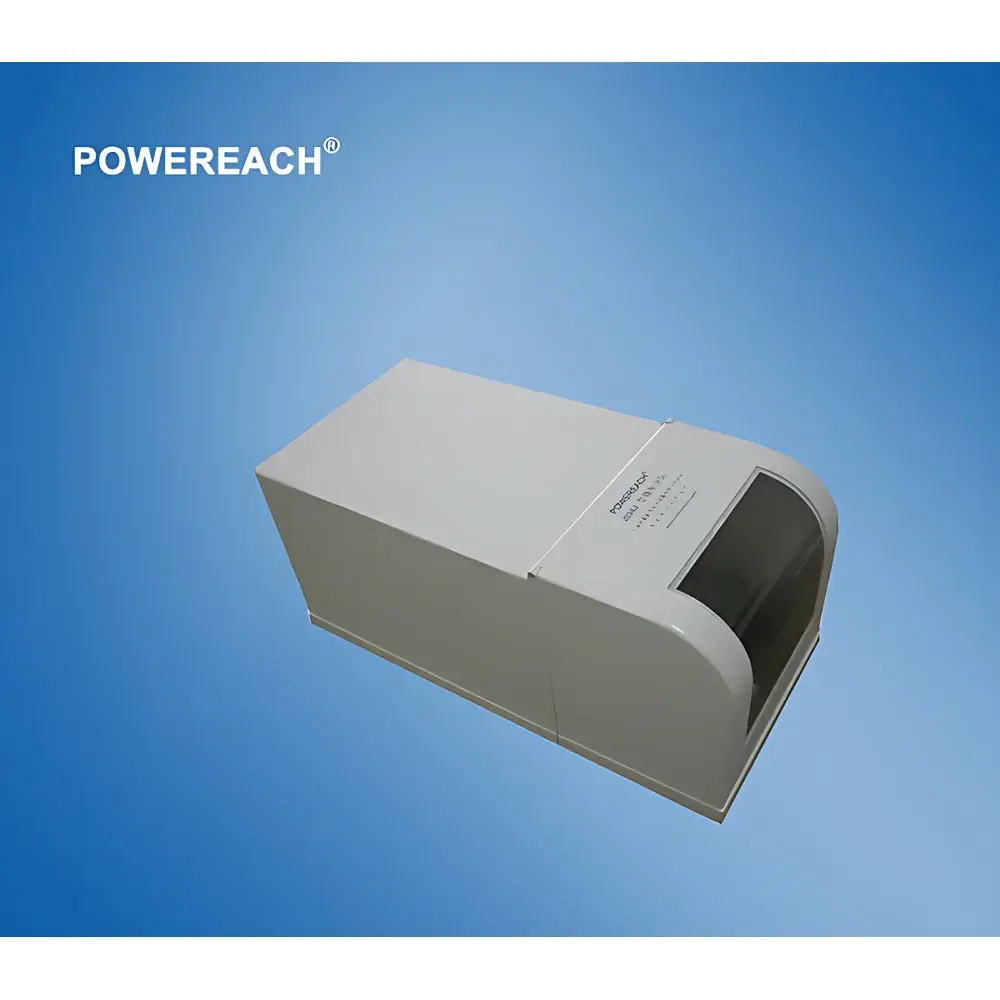
POWEREACH JS94J-1K20X Microelectrophoresis Zeta Potential Analyzer
| Brand | POWEREACH |
|---|---|
| Origin | Shanghai, China |
| Model | JS94J-1K20X |
| Zeta Potential Range | ±200 mV (typical, dependent on sample conductivity) |
| pH Range | 1.6–13.0 (optimal 2.0–12.0) |
| Operating Temperature | 20–35 °C |
| Temperature Resolution | 0.1 °C |
| Optical Resolution | 12 pixel/μm |
| System Accuracy | ≤5% systematic error |
| Particle Size Applicability | 0.1–10 μm (aqueous dispersions) |
| Power Consumption | <150 W |
| Input Voltage | 220 V, 50 Hz |
Overview
The POWEREACH JS94J-1K20X Microelectrophoresis Zeta Potential Analyzer is a precision optical-electrophoretic instrument engineered for direct visualization and quantitative measurement of electrophoretic mobility—and thus zeta potential (ζ)—of colloidal particles and emulsion droplets in aqueous dispersions. It implements the microelectrophoresis method defined in GB/T 32668–2016, China’s national standard for colloidal particle zeta potential analysis, which was developed based on the JS94 series instrumentation. Unlike laser Doppler electrophoresis systems, this instrument relies on real-time microscopic observation of particle motion under controlled DC electric fields, enabling “what-you-see-is-what-you-measure” validation of electrophoretic behavior. The system integrates a high-magnification near-field optical path (1200× effective magnification), semiconductor-based blue/green illumination (low thermal load, <100 µW), and synchronized digital image capture to resolve sub-micron particle trajectories with high spatial fidelity. Its core application lies in characterizing interfacial charge at solid–liquid and liquid–liquid interfaces—critical for predicting colloidal stability, optimizing surface modification protocols, and elucidating adsorption/desorption kinetics in complex formulations.
Key Features
- Optimized open-cell electrophoresis chamber: 0.5 mm-thick borosilicate glass cell with integrated Ag/AgCl and Pt electrodes; eliminates dead-volume artifacts and ensures uniform field distribution via microfluidic simulation-validated geometry.
- Stable electrode architecture: Precision-machined titanium-supported silver and platinum wire electrodes with electrochemically conditioned surfaces; minimizes polarization and maintains consistent current density over extended measurement cycles.
- Calibrated optical targeting system: Custom-engineered “crosshair grid” (micrometer-scale fiducial marker) mounted on a motorized XYZ translation stage; enables rapid, repeatable positioning of the field-of-view to the electrophoretic measurement zone—eliminating stationary layer interference inherent in capillary-based systems.
- Low-frequency bipolar voltage supply: Adjustable polarity reversal interval (0.30–1.20 s), programmable DC voltage output (0–300 V), and automatic duty-cycle compensation to suppress electrode polarization while preserving measurement speed (3–10 s per acquisition).
- Real-time thermal compensation: Integrated Pt100 temperature probe continuously feeds ambient thermal data to the acquisition software, dynamically correcting Smoluchowski or Hückel model parameters used in ζ calculation.
- Unified software platform: Single GUI supports all JS94-series configurations; no retraining required when upgrading hardware modules or switching between cell types or electrode sets.
Sample Compatibility & Compliance
The JS94J-1K20X is validated for use with aqueous colloidal suspensions and oil-in-water emulsions in the size range of 0.1–10 μm. It accommodates low-conductivity samples (e.g., purified protein solutions, nanoparticle dispersions in deionized water) as well as moderately conductive media (up to ~5 mS/cm), provided pH remains within 1.6–13.0. Sample volume requirement is only 0.5 mL per measurement, reducing material consumption and cross-contamination risk. The instrument complies with GB/T 32668–2016 and aligns with fundamental principles referenced in ISO 13099-2 (2012) for electrophoretic light scattering and microelectrophoresis methods. While not certified to FDA 21 CFR Part 11 out-of-the-box, its software architecture supports audit trail logging, user access control, and electronic signature integration—enabling customization for GLP/GMP-regulated environments upon customer request.
Software & Data Management
The proprietary acquisition and analysis suite runs on Windows OS and provides full control over imaging parameters (exposure time, gain, frame rate), voltage sequencing, temperature monitoring, and trajectory tracking algorithms. It captures four sequential grayscale images per measurement cycle (two forward, two reverse polarity frames), computes particle displacement vectors using centroid-based sub-pixel registration, and applies Smoluchowski–Henry corrections based on measured viscosity and dielectric constant inputs. Raw image stacks, metadata logs (timestamp, voltage, temperature, pH if externally logged), and calculated ζ distributions are stored in HDF5 format for traceability. Export options include CSV, Excel, and PDF reports compliant with internal QA documentation standards. Software updates are delivered free-of-charge for the lifetime of the instrument, including algorithm refinements derived from peer-reviewed method validation studies.
Applications
- Colloidal formulation development: Quantifying pH-dependent zeta potential shifts to identify isoelectric points (IEP) of silica, titania, polymer nanoparticles, and biopolymer complexes.
- Surface functionalization assessment: Validating covalent grafting efficiency of PEG, carboxyl, or amine ligands onto nanocarriers by measuring charge reversal or attenuation.
- Emulsion stability prediction: Correlating interfacial ζ of lipid droplets with creaming/sedimentation rates in pharmaceutical and cosmetic emulsions.
- Mineral processing optimization: Characterizing charge reversal thresholds of ore slurry particles during froth flotation reagent dosing.
- Academic teaching: Demonstrating electrokinetic theory, Debye length effects, and Stern layer modeling in undergraduate physical chemistry and materials science laboratories.
- Regulatory support: Generating reproducible zeta data for ICH Q5C stability protocols and USP emulsion characterization requirements.
FAQ
What electrophoretic principle does the JS94J-1K20X employ?
It uses classical microelectrophoresis: particles are observed directly under high-magnification optics while subjected to a precisely controlled DC electric field; their velocity is measured visually and converted to electrophoretic mobility, then to zeta potential using established electrokinetic models.
Is the instrument compatible with non-aqueous solvents?
No—it is optimized for aqueous and polar protic media only. Non-aqueous systems (e.g., toluene, hexane) require alternative instrumentation due to insufficient conductivity and optical refractive index mismatch.
Does the system require external pH measurement?
Yes. While the instrument operates across pH 1.6–13.0, it does not include an integrated pH probe; users must log pH separately using a calibrated meter prior to each measurement.
Can the software generate GMP-compliant audit trails?
The base software includes timestamped operation logs and user ID tagging; full 21 CFR Part 11 compliance (electronic signatures, immutable archives) requires optional configuration and validation support services.
What maintenance is required for long-term accuracy?
Annual recalibration of optical magnification and voltage output is recommended; electrode cleaning with dilute nitric acid and storage in deionized water prevents passivation. No consumables beyond standard epi-fluorescence filters are required.



