
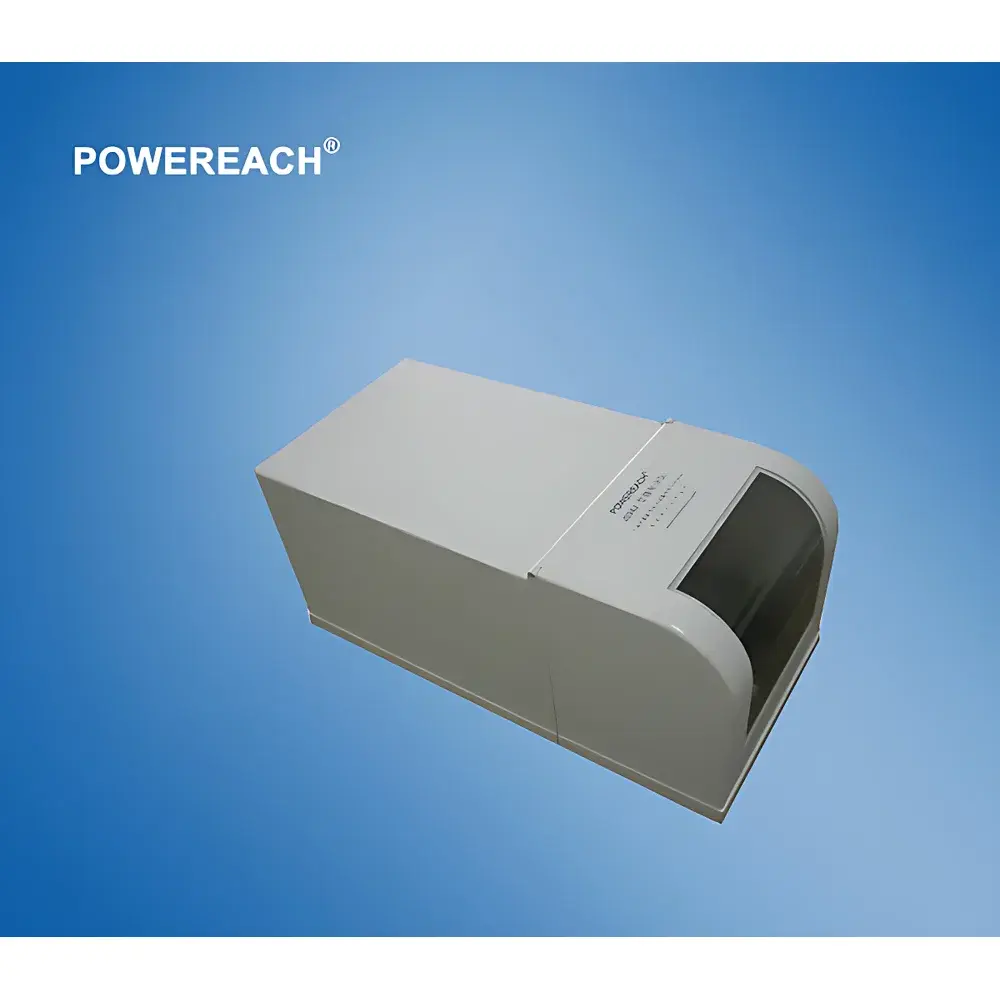
POWEREACH JS94K-3H20X Microelectrophoresis Analyzer (Zeta Potential Analyzer)
| Brand | POWEREACH |
|---|---|
| Origin | Shanghai, China |
| Model | JS94K-3H20X |
| Zeta Potential Range | ±200 mV (typical, inferred per ISO 13099-2) |
| pH Range | 1.6–13.0 (standard operation 2.0–12.0, resolution 0.1) |
| Temperature Range | Ambient to 35 °C (measurement resolution 0.1 °C) |
| Particle Size Compatibility | 0.2–50 µm (aqueous dispersions) |
| Optical Resolution | 1.93–12 pixels/µm (motorized zoom optical system) |
| Power Consumption | <150 W |
| Compliance | GB/T 32668–2016, ISO 13099-2:2012, ASTM D7825–14 |
Overview
The POWEREACH JS94K-3H20X Microelectrophoresis Analyzer is a high-precision instrument engineered for direct visualization and quantitative measurement of electrophoretic mobility—and subsequently zeta potential—of colloidal particles and emulsion droplets in aqueous media. It implements the microscopic electrophoresis method, wherein particle motion under a controlled electric field is observed in real time via an inverted optical microscope equipped with motorized continuous-zoom optics and a high-sensitivity USB CCD camera. This “see-and-measure” approach eliminates assumptions inherent in ensemble-averaged techniques (e.g., laser Doppler electrophoresis), enabling unambiguous identification and tracking of individual particles—including heterogeneous or irregularly shaped species—within the measurement cell. The instrument adheres strictly to the principles defined in GB/T 32668–2016, China’s national standard for colloidal zeta potential analysis by electrophoresis, and aligns with international frameworks including ISO 13099-2:2012 (Colloidal systems — Methods for determining zeta-potential — Part 2: Optical methods) and ASTM D7825–14 (Standard Test Method for Zeta Potential of Aqueous Dispersions). Its design prioritizes metrological traceability, low thermal perturbation (<50 µW LED illumination), and minimal sample disturbance—critical for characterizing pH-dependent surface charge behavior near the isoelectric point.
Key Features
- Open-cell microelectrophoresis chamber with integrated Ag/AgCl and Pt electrodes, fabricated from precision-machined 0.5 mm-thick borosilicate glass to minimize electro-osmotic flow and eliminate stagnant layer artifacts.
- Motorized continuous-zoom optical system (1.93–12 px/µm resolution) optimized for blue/green wavelength illumination (450–550 nm), enhancing contrast and detectability of submicron particles without photothermal drift.
- Dual-channel low-frequency AC voltage supply (0.30–1.20 s polarity reversal interval, adjustable stepwise), suppressing electrode polarization while maintaining stable field application across repeated measurements.
- Integrated temperature probe with real-time feedback to software; automatic compensation of viscosity and dielectric constant inputs for zeta potential calculation per Henry’s equation.
- Calibrated crosshair (‘rice-pattern’ graticule) mounted on a precision XYZ translation stage, enabling rapid, reproducible positioning of the observation field within the electrophoretic cell.
- Unified firmware architecture supporting all JS94-series configurations; no retraining required when upgrading hardware modules or switching between models.
Sample Compatibility & Compliance
The JS94K-3H20X accommodates aqueous colloidal suspensions and oil-in-water emulsions with particle/droplet diameters ranging from 0.2 µm to 50 µm. It supports wide pH operation (1.6–13.0), validated using NIST-traceable buffer standards, with digital resolution of 0.1 pH unit. Sample volume requirement is only 0.5 mL per measurement, reducing reagent consumption and waste generation. All wetted components—including custom-designed eletrode holders, platinum/silver wire electrodes, and disposable polycarbonate electrophoresis cells—are chemically inert and compatible with common surfactants, polyelectrolytes, and biopolymer stabilizers. The system meets GLP-relevant documentation requirements: full audit trail logging (user ID, timestamp, parameter settings, raw image sequences, and calculated mobility values) is embedded in the acquisition software, supporting 21 CFR Part 11 readiness when deployed with validated IT infrastructure.
Software & Data Management
Acquisition and analysis are performed using POWEREACH’s proprietary ZetaView™ software suite, delivered pre-installed on the included Dell OEM workstation. The interface provides synchronized dual-image capture (forward/reverse field polarity), automated particle centroid tracking across four consecutive grayscale frames, and batch-mode processing with outlier rejection based on velocity variance thresholds. Raw data—including TIFF-stacked video sequences, pixel displacement vectors, and electrophoretic mobility histograms—are stored in open HDF5 format. Export options include CSV (for statistical analysis in R or Python), PDF reports with embedded metadata (instrument ID, calibration date, operator name), and XML files compliant with ISA-Tab standards for laboratory information management systems (LIMS). Software updates are distributed free of charge for the lifetime of the instrument, with version-controlled release notes and validation summaries available upon request.
Applications
This analyzer serves as a foundational tool for interfacial science research and industrial quality control. In pharmaceutical development, it quantifies surface charge stability of liposomal drug carriers across physiological pH gradients. In mineral processing, it evaluates collector adsorption efficiency on oxide and sulfide ore surfaces. In cosmetics formulation, it correlates zeta potential shifts with preservative efficacy and emulsion shelf-life. Academic laboratories employ it for teaching electrophoretic theory, isoelectric point determination of proteins and nanoparticles, and kinetic studies of surface ligand exchange. Additional use cases include wastewater coagulant optimization (e.g., polyaluminum chloride dosage vs. floc charge reversal), nanocellulose dispersion stability assessment, and inkjet ink rheo-electric characterization prior to printhead integration.
FAQ
Does the JS94K-3H20X comply with ISO 13099-2?
Yes—the optical configuration, electrode geometry, and data reduction algorithms conform to the requirements specified in ISO 13099-2:2012 for microscopic electrophoresis.
Can it measure non-aqueous systems?
No—this model is validated exclusively for aqueous media; non-polar solvents require alternative electrode materials and dielectric calibration not supported in current firmware.
Is the temperature probe calibrated against NIST standards?
The integrated thermistor is factory-calibrated to ±0.1 °C accuracy at 25 °C; full calibration certificates are provided with each instrument shipment.
What is the minimum particle concentration required?
Optimal performance is achieved at 0.01–0.1% w/v solids; lower concentrations may require extended acquisition times but remain analyzable due to single-particle detection capability.
How is electro-osmotic flow corrected during analysis?
The software applies a dual-field reversal protocol and computes net mobility by vector subtraction of forward/reverse displacement—effectively nullifying electro-osmotic contributions without requiring separate reference particle measurements.



