
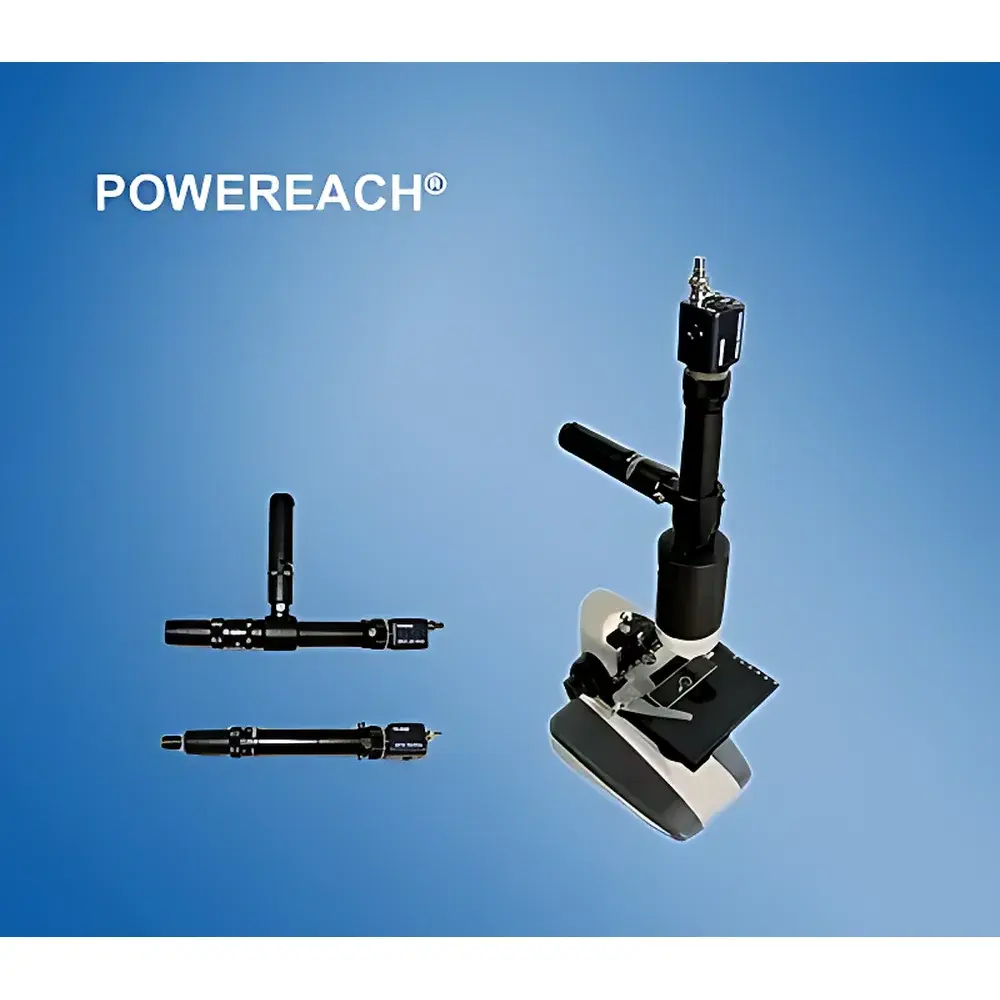
POWEREACH JZ95MS Series Digital Image Analysis System for Microscopic Metrology
| Brand | POWEREACH |
|---|---|
| Origin | Shanghai, China |
| Model | JZ95MS Series (MS-01, MS-02, MS-40, MS-60, MS-80, MS-160) |
| Zoom Mechanism | Continuous zoom system |
| Illumination | Reflected (MS-01, MS-40–MS-160) or coaxial incident (MS-02) |
| Objective Magnification Range | 0.75×–4.5× (MS-01/MS-02), 6.5×–40× (MS-40), 10×–60× (MS-60), 13×–80× (MS-80), 26×–160× (MS-160) |
| Image Resolution | 600 px/mm (MS-01/MS-02), 6–24 px/µm (MS-40 to MS-160) |
| Working Distance | 90 mm (MS-01/MS-02), 8.5–7.5 mm (MS-40–MS-160) |
| Aperture Control | Manual iris ring |
| Software Compliance | ISO 9276-1, GB/T 15445 |
| Operating System Support | Windows 95/98 (legacy environment |
Overview
The POWEREACH JZ95MS Series Digital Image Analysis System is a precision optical metrology platform engineered for quantitative microscopic measurement and dynamic morphological observation. Built upon a modular metallurgical microscope architecture, it employs high-stability continuous zoom optics and calibrated digital imaging to deliver traceable dimensional analysis at sub-micron spatial resolution. Unlike conventional inspection microscopes, the JZ95MS integrates metrological-grade magnification linearity, fixed working distance consistency, and pixel-to-length calibration protocols—enabling direct conversion of image coordinates into physical dimensions (µm, nm) without reliance on stage micrometers for every measurement. Its design supports real-time monitoring of time-dependent microstructural evolution—including crystal nucleation and growth, polymer chain alignment under electric fields, cellular morphology shifts, and thin-film phase transitions—making it suitable for both laboratory R&D and inline process surveillance in semiconductor fabrication, liquid crystal cell assembly, pharmaceutical crystallization, and advanced coating development.
Key Features
- Modular continuous zoom optical path with factory-calibrated magnification linearity across full range (0.75× to 160×), ensuring repeatable scale fidelity between acquisitions.
- Dedicated metallurgical illumination configurations: reflected brightfield for opaque samples (metals, ceramics, coatings), coaxial incident for semi-transparent specimens (thin films, biological sections), and optional oblique/annular lighting for edge contrast enhancement.
- Extended working distance (up to 90 mm on entry-level models) enables non-contact observation of dynamic processes in liquid cells, electrochemical cells, or environmental chambers without optical interference.
- Compact, low-profile zoom tube design facilitates OEM integration into automated production lines, robotic workcells, or confined instrumentation enclosures—compatible with vibration-damping mounts and rigid coupling interfaces.
- Optical train optimized for CCD/CMOS sensor coupling: M42 or C-mount adapters support industrial cameras with global shutter, high quantum efficiency, and 12-bit+ dynamic range for low-noise quantitative imaging.
Sample Compatibility & Compliance
The JZ95MS accommodates a broad spectrum of solid and semi-solid specimens relevant to materials science and quality control laboratories. It is routinely deployed for grain size analysis per ASTM E112, inclusion rating per ASTM E45, coating thickness verification, solder joint inspection, and particle morphology characterization in catalysts and pigments. All optical components comply with ISO 10110 surface quality standards, while mechanical stability meets ISO 10360-2 requirements for coordinate measuring instrument repeatability under thermal drift conditions (±1°C). The system supports GLP-compliant documentation workflows when paired with validated software configurations—audit trails, user access logs, and calibration certificate linkage are programmatically enforced within the image analysis environment.
Software & Data Management
The bundled Windows-native image analysis suite provides ISO 9276-1–aligned particle sizing, shape factor computation (circularity, aspect ratio, convexity), and multi-threshold segmentation algorithms. It implements full metrological traceability through embedded calibration management: users define and store multiple lens/camera/sensor configurations, each with certified pixel-to-length coefficients derived from NIST-traceable stage rulers or graticules. Data export conforms to ASTM E2933 for digital image metadata preservation, including EXIF-tagged magnification, illumination mode, exposure time, and software version. Analytical results are exportable to SQL databases or CSV for statistical process control (SPC) integration, and reports adhere to ISO/IEC 17025 formatting guidelines for accredited testing laboratories.
Applications
- Semiconductor: Wafer defect mapping, bond pad geometry verification, photomask registration accuracy assessment.
- Liquid Crystal Displays: Alignment layer microstructure evaluation, spacer distribution uniformity, pixel electrode edge roughness quantification.
- Pharmaceuticals: Polymorph identification via crystal habit analysis, granule size distribution in dry powder inhalers, tablet coating thickness homogeneity.
- Advanced Coatings: Pigment dispersion analysis, corrosion pit depth profiling, cross-section porosity measurement in thermal barrier layers.
- Geosciences & Mining: Ore mineral liberation analysis, gangue phase boundary detection, flotation bubble size distribution in froth imaging.
FAQ
Is the JZ95MS system compliant with FDA 21 CFR Part 11 for regulated environments?
The base hardware and firmware do not include electronic signature or audit trail features by default; however, the software architecture supports third-party validation packages that enable 21 CFR Part 11 compliance when deployed on locked-down Windows systems with role-based access control and timestamped action logging. Validation documentation templates are available upon request.
Can the system be integrated with machine vision libraries such as OpenCV or HALCON?
Yes—DLL-based SDKs provide raw frame buffer access, real-time trigger synchronization, and parameter control APIs. Custom algorithm pipelines can ingest calibrated pixel data and output metrologically traceable measurements directly into external analytics platforms.
What is the uncertainty budget for length measurements at 100× magnification?
At nominal 100× (achieved via 25× objective + 4× digital zoom), combined standard uncertainty is ±0.8 µm (k=2) under controlled lab conditions (23±1°C, anti-vibration table), derived from optical distortion (<0.15%), camera sensor nonlinearity (<0.05%), and calibration standard uncertainty (NIST SRM 2053, ±0.2 µm).
Does the system support automated focus stacking for extended depth-of-field imaging?
Focus stacking is achievable via motorized Z-stage integration (optional accessory); the software includes Z-stack alignment and fusion algorithms optimized for high-contrast metallurgical surfaces, though native autofocus is not embedded in the core optical module.





