POWEREACH JZW08A UV-Ozone Cleaning and Surface Characterization System
| Key | Brand: POWEREACH (Shanghai Zhongchen) |
|---|---|
| Origin | Shanghai, China |
| Manufacturer Type | Authorized Distributor |
| Product Category | Domestic |
| Model | JZW08A |
| Power Supply | 220 V AC |
| Effective Irradiation Area | 17,662 mm² |
| Wavelengths | 254 nm and 184 nm |
| UV Intensity | 21 mW/cm² |
| Vacuum Level | 6.7 × 10⁻² Pa |
| Lamp Power | 100 W |
| Software Interface | USB + RS-232 (COM port required) |
| OS Requirement | 32-bit Windows |
| Compliance | CE-marked components, GLP-supporting software architecture |
Overview
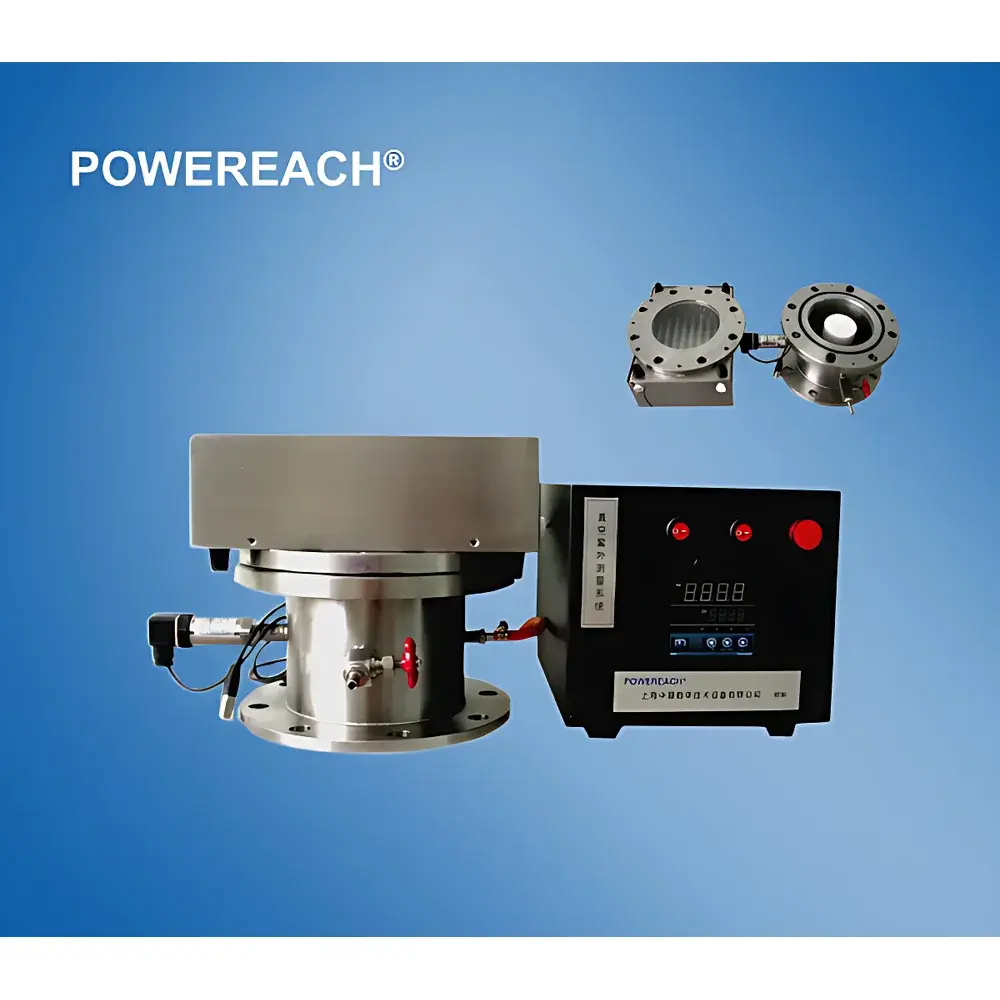
The POWEREACH JZW08A UV-Ozone Cleaning and Surface Characterization System is an integrated benchtop instrument engineered for controlled ultraviolet/ozone (UV/O₃) surface modification and real-time monitoring of cleaning efficacy in vacuum or ambient conditions. It operates on the principle of photochemical oxidation: short-wavelength UV radiation (184 nm and 254 nm) dissociates molecular oxygen (O₂) to generate atomic oxygen (O), which reacts with organic contaminants to form volatile CO₂, H₂O, and other gaseous byproducts—effectively removing hydrocarbons, photoresist residues, and adventitious carbon layers from substrates without solvents or mechanical abrasion. The system’s dual-wavelength lamp design enables simultaneous direct photolysis (254 nm) and ozone generation (184 nm), ensuring high reproducibility in surface energy restoration and oxide layer passivation. Designed for cleanroom-compatible operation, it supports pre- and post-treatment surface analysis workflows in semiconductor fabrication, microelectronics packaging, optical coating preparation, and advanced material R&D laboratories.
Key Features
- Dual-band low-pressure mercury vapor lamp emitting at precisely 184 nm (ozone-generating) and 254 nm (direct photolysis), calibrated per IEC 62471 photobiological safety standards
- Stainless-steel vacuum chamber with integrated pressure sensor and analog vacuum gauge, capable of stable operation down to 6.7 × 10⁻² Pa
- Uniform irradiation field over 17,662 mm² (133 mm × 133 mm), verified via NIST-traceable UV radiometry
- Fixed-intensity output of 21 mW/cm² at sample plane (measured at 254 nm, 1 cm distance), with thermal stabilization to minimize drift during extended exposure cycles
- Modular control unit with programmable exposure timing (1–9999 s), manual vacuum release, and interlocked safety shutter
- Embedded firmware supporting repeatable protocol storage and execution—compatible with external PC-based logging via USB/RS-232 interface
Sample Compatibility & Compliance
The JZW08A accommodates rigid planar substrates up to 130 mm × 130 mm × 25 mm (L × W × H), including silicon wafers, quartz crystals, sapphire windows, ITO-coated glass, metal foils, and ceramic substrates. Flexible or curved samples may be processed using custom fixtures (available upon request). All internal surfaces are electropolished stainless steel (316L) to prevent outgassing and metal ion contamination. The system meets ISO 14644-1 Class 5 cleanroom compatibility requirements when operated under laminar flow hoods. Its operational parameters align with ASTM F2297-22 (Standard Guide for UV/Ozone Cleaning of Surfaces) and support GLP-compliant documentation when used with validated software configurations. Electrical safety complies with IEC 61010-1; UV shielding conforms to EN 62471 for risk group 3 (moderate hazard) classification—requiring operator training and use of UV-blocking safety goggles.
Software & Data Management
The JZW08A includes POWEREACH’s proprietary UV-CleanControl™ v3.2 software suite, delivered as a Windows 32-bit application. It provides real-time vacuum level readout, exposure timer synchronization, and event-log timestamping with operator ID fields. Data export is supported in CSV and XML formats, enabling integration into LIMS or ELN platforms. Audit trail functionality records all parameter changes, session starts/stops, and error events—meeting FDA 21 CFR Part 11 requirements when deployed with Windows domain authentication and electronic signature modules. Software updates are distributed via secure HTTPS portal; no cloud connectivity is embedded in the base configuration. For GMP environments, optional IQ/OQ documentation packages and calibration certificate traceability to national metrology institutes (e.g., NIM China) are available upon order.
Applications
- Pre-bonding surface activation of silicon, glass, or polymer substrates in MEMS and wafer-level packaging
- Removal of organic residue from AFM/STM tips and calibration standards prior to nanoscale imaging
- Restoration of hydrophilicity on PDMS microfluidic chips after plasma aging
- Cleaning of optical components (lenses, prisms, beam splitters) prior to anti-reflective coating deposition
- Surface conditioning of electrodes for electrochemical biosensors and battery electrode research
- Validation of cleanliness in ISO Class 5–7 cleanrooms per SEMI F21-0201 guidelines
FAQ
Is the JZW08A suitable for cleaning temperature-sensitive polymer substrates?
Yes—UV/O₃ cleaning is a non-thermal process. Substrate temperature rise remains below 5 °C during standard 5-minute exposures, making it compatible with PET, PI, and PMMA films.
Can the system operate without vacuum?
Yes. The chamber supports both vacuum-mode (optimal for rapid ozone diffusion and contaminant volatilization) and ambient-air mode (for larger or non-vacuum-compatible samples), with adjustable exposure duration to compensate for reduced reaction kinetics.
What maintenance is required for the UV lamp?
The 100 W low-pressure mercury lamp has a rated lifetime of ≥1,500 hours. Output intensity degrades gradually; periodic recalibration using a calibrated UV radiometer is recommended every 300 operating hours.
Does the system include validation documentation for regulated labs?
Standard delivery includes factory calibration certificates for vacuum gauge and UV intensity. Full GxP validation kits—including DQ/IQ/OQ protocols, test scripts, and raw data templates—are available as optional add-ons.
Is remote operation supported?
Remote start/stop and status monitoring are possible via RS-232 serial command set (SCPI-like syntax); however, full GUI control requires local PC connection due to licensing and security architecture.
Related Products