
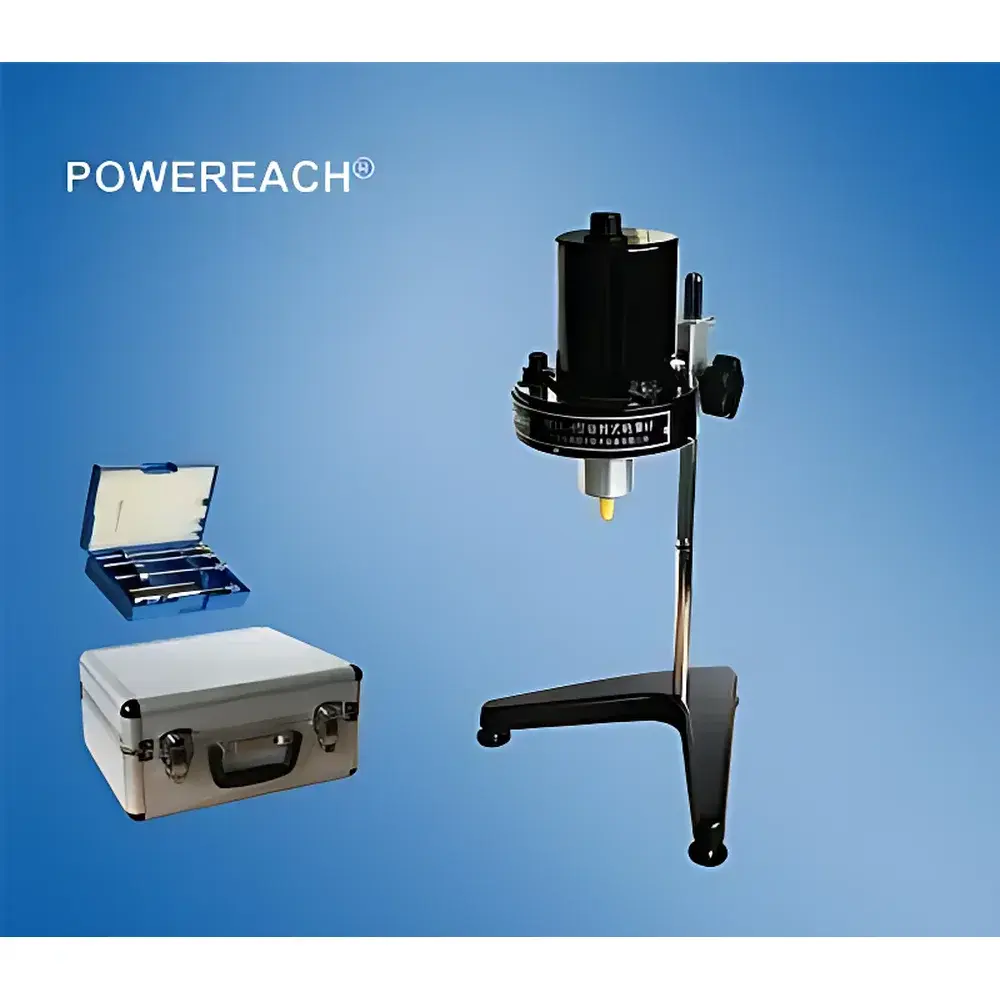
POWEREACH NDJ-4 Portable Rotational Viscometer
| Brand | POWEREACH |
|---|---|
| Origin | Shanghai, China |
| Model | NDJ-4 |
| Instrument Type | Portable Rotational Viscometer |
| Viscosity Range | 1–2,000,000 mPa·s |
| Speed Settings | 0.3, 0.6, 1.5, 3, 6, 12, 30, 60 rpm |
| Accuracy | ±5% (for Newtonian fluids) |
| Power Supply | 220 V ±10%, 50 Hz |
| Net Weight | 1.5 kg |
| Dimensions | 320 × 260 × 170 mm |
| Included Rotors | #1, #2, #3, #4 |
| Compliance | Designed for GLP-compliant routine viscosity monitoring in QC/QA and R&D environments |
Overview
The POWEREACH NDJ-4 Portable Rotational Viscometer is a mechanically coupled, spring-balanced analog viscometer engineered for reliable measurement of dynamic viscosity in Newtonian and near-Newtonian liquids under ambient laboratory conditions. It operates on the principle of torsional deflection: a precision-calibrated hairspring transmits torque from a micro-stepper motor-driven rotor immersed in the sample. As the rotor encounters viscous drag, the spring twists proportionally—this angular displacement is indicated by a mechanical pointer on a calibrated dial. The displayed value, multiplied by the rotor–speed–scale factor, yields absolute viscosity in millipascal-seconds (mPa·s). Unlike digital rheometers with complex sensor arrays or temperature-controlled cells, the NDJ-4 prioritizes robustness, portability, and operational simplicity—making it suitable for rapid on-site checks, teaching laboratories, and production-floor quality verification where full rheological profiling is not required.
Key Features
- Mechanically stable torsion-spring sensing system with direct analog readout—no software dependency or calibration drift from electronic components.
- Eight discrete rotational speeds (0.3–60 rpm) controlled via microprocessor-driven stepper motor, enabling consistent shear rate selection across viscosity ranges.
- Four standardized spindles (#1–#4) optimized for complementary coverage: low-viscosity oils (e.g., solvents, thin coatings) to highly viscous pastes (e.g., adhesives, polymer melts).
- Dedicated pointer locking mechanism for stable reading at high speeds (30/60 rpm), eliminating parallax error during manual observation.
- Integrated protective guard ring ensures consistent immersion depth and minimizes edge effects—critical for reproducibility per ASTM D2196 and ISO 2555.
- Sturdy gear-and-damper vertical lift assembly enables smooth, vibration-free spindle immersion and withdrawal; compatible with optional bench-mounted base and column for fixed-position operation.
- Compact footprint (320 × 260 × 170 mm) and lightweight design (1.5 kg) support field deployment, classroom mobility, and integration into constrained workspaces.
Sample Compatibility & Compliance
The NDJ-4 accommodates a broad spectrum of industrial and research-grade fluids—including lubricating oils, paint resins, food emulsions, pharmaceutical suspensions, cosmetic gels, and adhesive formulations—provided they are non-corrosive to stainless-steel spindles and remain stable over short-duration measurements (≤60 s). While not equipped with Peltier temperature control or automated data logging, its mechanical architecture conforms to foundational metrological practices outlined in ISO 3219 (rotational viscometry) and supports documentation traceability for internal QA protocols. When operated within specified speed–spindle combinations and with proper cleaning between samples, it delivers repeatability ≤±3% RSD (n=6) for homogeneous Newtonian references. For regulated environments, users may incorporate manual audit trails, handwritten logs, and periodic verification against NIST-traceable standard oils to align with GLP and basic GMP documentation requirements.
Software & Data Management
The NDJ-4 functions as a standalone analog instrument without embedded firmware or USB connectivity. All measurements are manually recorded using the front-panel dial scale and associated multiplication factors provided in the included calibration chart. This architecture eliminates cybersecurity vulnerabilities, software licensing constraints, or OS compatibility issues common in PC-dependent systems. Users maintain full ownership of raw data integrity through handwritten lab notebooks or locally hosted spreadsheets. Optional third-party digital capture solutions (e.g., smartphone-based dial imaging with angle recognition tools) may be employed for semi-automated digitization—though such workflows fall outside factory validation scope. No FDA 21 CFR Part 11 compliance is claimed; however, the device’s deterministic mechanical response supports retrospective review and reanalysis when paired with contemporaneous procedural documentation.
Applications
- Routine QC screening of batch-to-batch consistency in paints, inks, and varnishes prior to packaging.
- Educational demonstration of Newtonian flow behavior and shear-independent viscosity in undergraduate physics and chemical engineering labs.
- Field assessment of transformer oil degradation or hydraulic fluid contamination in maintenance depots.
- Pre-formulation viscosity checks for topical pharmaceuticals and personal care products during early-stage development.
- Monitoring curing progression in two-part epoxy systems via time-resolved viscosity sweeps (manual interval timing required).
- Verification of dilution accuracy in solvent-based adhesives before coating application.
FAQ
Is the NDJ-4 suitable for non-Newtonian fluid characterization?
It provides single-point viscosity values at discrete shear rates but lacks programmable ramping or oscillatory capability—thus unsuitable for yield stress, thixotropy, or viscoelastic modulus determination.
Can I use this viscometer with elevated or sub-ambient temperatures?
No integrated temperature control is present. Measurements should be conducted at stable room temperature (20–25°C); external water baths or environmental chambers must be used independently if thermal variation studies are required.
What maintenance is required to ensure long-term accuracy?
Regular cleaning of spindles and guard with appropriate solvents, periodic inspection of hairspring tension, and annual verification against certified viscosity standards are recommended.
Does the instrument include calibration certification?
A factory-issued certificate of conformance is supplied; NIST-traceable calibration reports are available as a paid service upon request.
How does the NDJ-4 compare to digital viscometers like the Brookfield DV2T?
The NDJ-4 offers lower acquisition cost, zero software dependency, and superior shock resistance—but sacrifices data export, temperature integration, and advanced rheological modeling capabilities inherent in microprocessor-based platforms.



