
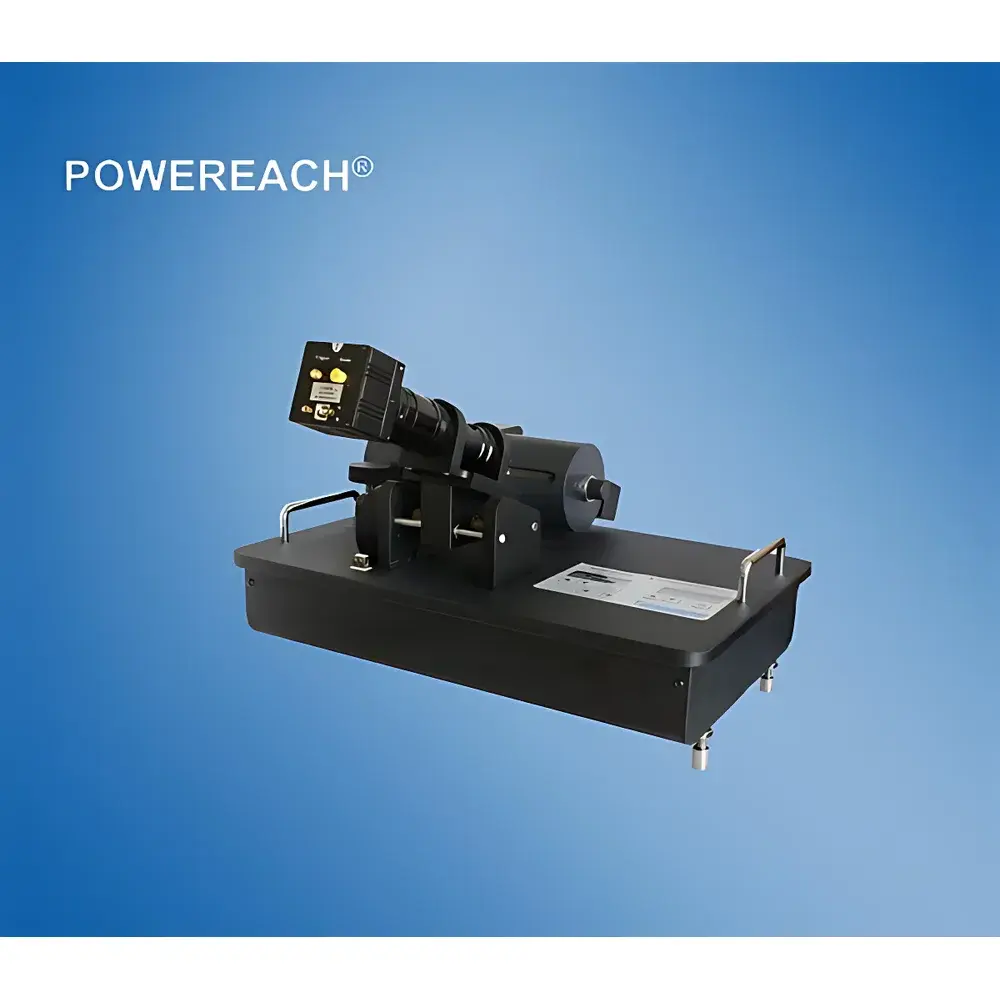
POWEREACH TX-500C Rotating Drop Interfacial Tensiometer
| Brand | POWEREACH (Shanghai Zhongchen) |
|---|---|
| Origin | Shanghai, China |
| Model | TX-500C |
| Measurement Range | 10⁻⁶–100 mN/m |
| Temperature Control Range | RT+5 °C to 95 °C |
| Temperature Display Range | 0–99.9 °C |
| Temperature Accuracy | ±0.1 °C |
| Image Capture | USB Digital CCD (60 fps, 752×480 px) |
| Rotation Speed | 1,000–10,000 rpm (±5 rpm control accuracy) |
| Spatial Resolution | 0.001 mm |
| Optical Readout Field | 0–6 mm |
| Interface | USB & RS-232 |
| Heating System | PID-Controlled Stainless Steel Electric Heater |
| Sample Tube Options | High-Purity Quartz Tubes (ID: 2 mm, 4 mm, 6 mm) |
Overview
The POWEREACH TX-500C Rotating Drop Interfacial Tensiometer is a precision instrument engineered for ultra-low interfacial tension (IFT) measurement across eight decades — from 10⁻⁶ mN/m to 100 mN/m — using the rotating drop method. This technique relies on the balance between centrifugal force and interfacial energy to deform a dispersed-phase droplet within a continuous phase under controlled rotation. By analyzing the equilibrium shape of the rotating droplet via high-resolution digital imaging, the instrument calculates interfacial tension based on Laplace’s equation and calibrated geometric parameters. Designed for rigorous laboratory environments in petroleum recovery research, formulation science, and colloidal interface engineering, the TX-500C delivers trace-level sensitivity essential for evaluating ultralow-tension systems such as microemulsions, surfactant-polymer floods, and nanoscale dispersion interfaces.
Key Features
- Modular quartz capillary design with spring-loaded quick-release mechanism ensures reproducible sample loading, minimizes tube breakage, and simplifies cleaning between measurements.
- Stainless steel thermal sleeve and rotor assembly provide matched thermal expansion coefficients, enhancing temperature uniformity and mechanical stability during high-speed rotation (up to 10,000 rpm).
- Digital USB CCD camera operating in speed-synchronized trigger mode eliminates image flicker at all rotational speeds; 60 fps capture rate and 752×480 pixel resolution support robust edge detection even in turbid or optically heterogeneous systems.
- PITTMAN high-speed servo motor with 500-line optical encoder enables precise speed control (±5 rpm) and dynamic response suitable for transient IFT kinetics studies.
- Integrated PID-controlled electric heating system maintains temperature stability within ±0.1 °C across 0–99.9 °C display range; optional external circulation platform allows integration with external thermostats per ASTM D97 or ISO 291 standards.
- Windows-based software automates image acquisition, droplet contour fitting, tension calculation, data logging, and real-time curve plotting — all compliant with ALCOA+ principles for raw data integrity.
Sample Compatibility & Compliance
The TX-500C accommodates a broad spectrum of immiscible liquid pairs, including hydrocarbon–aqueous, silicone–water, fluorocarbon–surfactant, and polymer melt–solvent systems. Its configurable quartz capillaries (2 mm, 4 mm, and 6 mm internal diameters) enable optimization for both ultra-low-tension microemulsions (10 mN/m). The instrument meets functional requirements for GLP-compliant laboratories: audit-trail-enabled software logs user actions, timestamped image files (BMP format), parameter settings, and calculated results. Data export to Excel (.xlsx) supports traceability per FDA 21 CFR Part 11 when paired with appropriate IT validation protocols. It is routinely deployed in R&D labs adhering to ISO/IEC 17025, USP , and API RP 42 guidelines for enhanced oil recovery (EOR) screening.
Software & Data Management
The proprietary Windows application provides dual-mode operation — standalone panel control or full PC-integrated workflow. Each measurement session auto-generates a timestamped folder containing raw images, processed contours, numerical outputs, and metadata (speed, temperature, time). The database engine supports multi-parameter sorting (e.g., by surfactant concentration, aging time, or thermal ramp), statistical batch analysis, and comparative overlay of IFT vs. rotation speed or temperature curves. All images are saved in lossless BMP format without compression artifacts, ensuring metrological fidelity. Software updates are provided free-of-charge for the lifetime of the instrument, with version history and change logs maintained for regulatory documentation.
Applications
- Chemical EOR formulation development and screening for tertiary oil recovery, including alkali-surfactant-polymer (ASP) and low-salinity flood systems.
- Surfactant structure–property relationship studies, critical micelle concentration (CMC) validation, and mixed surfactant synergy evaluation.
- Emulsion and foam stability assessment in personal care, agrochemical, and food-grade formulations.
- Interfacial rheology precursor characterization for viscoelastic interfaces in pharmaceutical nanoemulsions and lipid-based drug delivery systems.
- Surface modification efficacy testing of nanoparticles, fibers, and porous media in filtration and catalysis research.
- Quality control of industrial lubricants, coatings, inks, and functional fluids where interfacial compatibility dictates performance.
FAQ
What is the minimum measurable interfacial tension value?
The instrument achieves reliable quantification down to 10⁻⁶ mN/m under optimized conditions using 2 mm ID quartz capillaries and high-magnification imaging.
Can the TX-500C operate without a connected computer?
Yes — front-panel controls allow manual setup of rotation speed, temperature setpoint, and basic imaging functions; however, full data analysis and archival require the PC software.
Is external temperature control supported?
Yes — the unit includes a circulation port compatible with external thermostats, enabling compliance with ISO 6271 or ASTM D1331 test methods requiring bath-based thermal regulation.
How is calibration verified?
Calibration is performed using certified reference wires (1 mm and 2 mm diameter) included in the standard kit; system linearity and spatial resolution are validated prior to each measurement series.
What file formats are generated during data acquisition?
Images are saved as uncompressed BMP files; numerical results are stored in structured text and Excel-compatible CSV formats, with full metadata embedded in XML sidecar files.



