
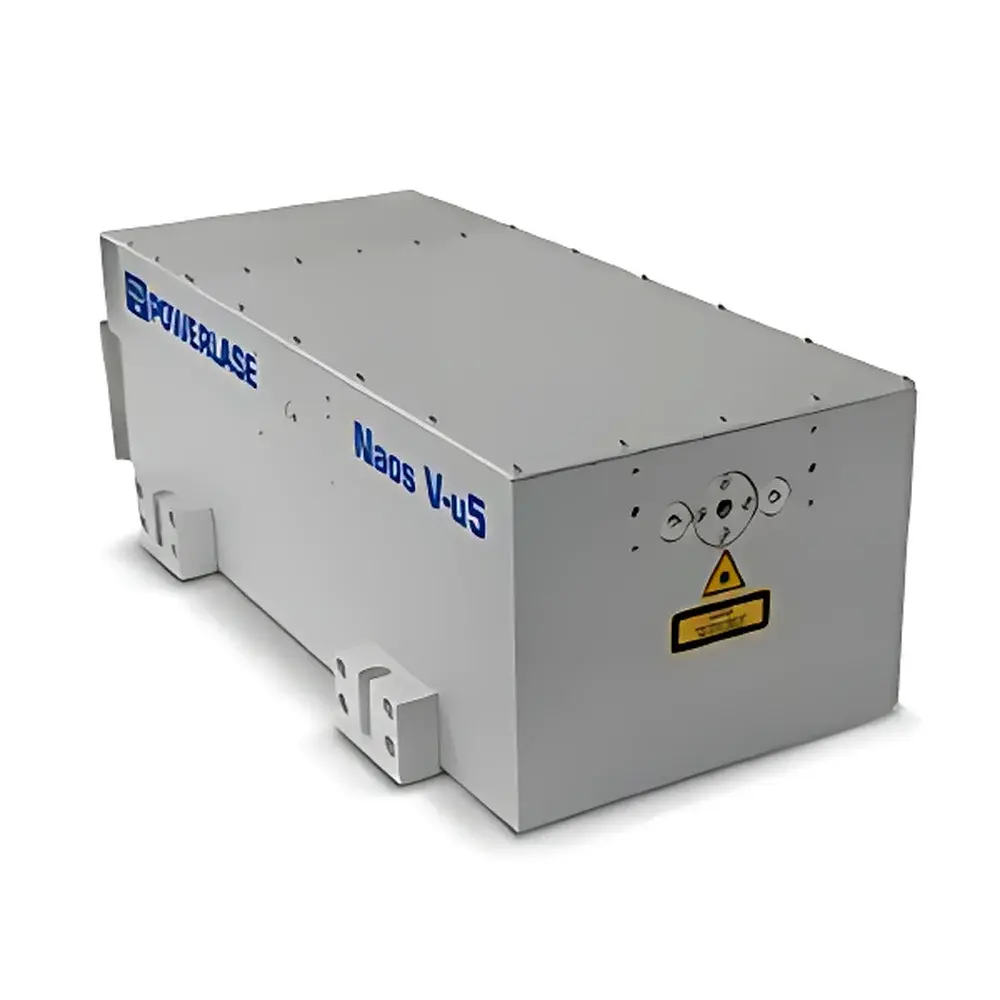
Powerlase Rigel Series High-Power Diode-Pumped Solid-State (DPSS) Laser
| Brand | Powerlase |
|---|---|
| Origin | United Kingdom |
| Product Type | Diode-Pumped Solid-State Laser System |
| Model Family | Rigel Series |
| Output Configuration | Q-switched, Nanosecond Pulsed |
| Pulse Repetition Rate | 3–50 kHz |
| Beam Quality (M²) | <1.3 |
| Average Output Power | Up to 100 W (model-dependent) |
| Pulse Energy | Up to 20 mJ (at low rep rate) |
| Wavelength | 1064 nm (fundamental), with optional harmonic generation (532 nm, 355 nm, 266 nm) |
| Cooling | Forced-air or water-cooled (depending on power level) |
| Control Interface | RS-232, USB, Ethernet |
| Compliance | CE, RoHS, IEC 60825-1:2014 Class 4 Laser Product |
Overview
The Powerlase Rigel Series is a high-performance, diode-pumped solid-state (DPSS) nanosecond pulsed laser system engineered for demanding applications requiring both high average power and high pulse energy. Based on a monolithic Nd:YAG or Nd:YVO₄ gain medium, the Rigel architecture employs end-pumping with high-brightness laser diodes and a robust, thermally stable resonator design to deliver exceptional beam quality (M² < 1.3) and long-term amplitude stability (<±1.5% RMS over 8 hours). Its fundamental output at 1064 nm supports efficient harmonic generation—enabling reliable operation at 532 nm (green), 355 nm (UV), and 266 nm (deep UV)—making it suitable for precision ablation, nonlinear frequency conversion, and photochemical processing. Designed for integration into OEM platforms and industrial workstations, the Rigel series bridges the performance gap between laboratory-grade research lasers and production-floor robustness.
Key Features
- High average power output (up to 100 W at 1064 nm), scalable across model variants
- Nanosecond pulse duration (typically 10–25 ns FWHM) with pulse energies up to 20 mJ at reduced repetition rates
- Adjustable pulse repetition frequency from 3 kHz to 50 kHz, enabling process optimization for material interaction dynamics
- Integrated real-time status monitoring—including diode current, cavity temperature, pulse energy feedback, and interlock diagnostics—accessible via front-panel display or remote interface
- Optional fiber-coupled output (with SMA905 or QBH connectors) for flexible beam delivery in confined or multi-axis systems
- Motorized internal attenuator (0–99% transmission control) for precise, software-driven pulse energy regulation without external optics
- Compact, rack-mountable mechanical design (standard 19″ chassis) with low acoustic noise and minimal footprint (≤450 × 400 × 150 mm)
- Comprehensive safety architecture compliant with IEC 60825-1:2014, including key-switch interlocks, emission indicators, and shutter control
Sample Compatibility & Compliance
The Rigel series is compatible with a broad range of optically transparent, reflective, and absorptive materials—including fused silica, sapphire, silicon wafers, copper, stainless steel, polyimide, and thin-film photovoltaic stacks (e.g., CIGS, perovskite). Its high peak intensity and controllable pulse parameters enable non-thermal ablation regimes critical for clean edge definition in micromachining and minimal HAZ in thin-film removal. All units are CE-marked and conform to RoHS 2011/65/EU directives. Laser safety documentation—including full hazard classification reports, nominal ocular hazard distance (NOHD) calculations, and alignment procedure guidelines—is supplied with each system. For regulated environments, the Rigel supports audit-ready operation under GLP and GMP frameworks when paired with validated control software and calibrated energy meters traceable to NPL or NIST standards.
Software & Data Management
Rigel systems ship with Powerlase LaserControl Suite—a Windows-based application supporting full parameter configuration (rep rate, Q-switch delay, attenuation setpoint), real-time energy logging, and automated sequence execution. The suite provides native support for LabVIEW™, MATLAB®, and Python (via DLL and TCP/IP APIs), enabling seamless integration into custom automation workflows. All operational logs—including timestamped pulse energy measurements, thermal sensor readings, and fault events—are stored in CSV and SQLite formats with configurable retention policies. Optional firmware upgrades include FDA 21 CFR Part 11-compliant electronic signature capability and audit trail functionality for pharmaceutical and medical device manufacturing validation.
Applications
- Precision micromachining of ceramics, semiconductors, and flex PCBs
- Laser-induced forward transfer (LIFT) and selective laser sintering (SLS) in additive manufacturing
- Photovoltaic cell scribing and edge isolation for silicon, thin-film, and tandem solar modules
- Ultrafast laser polishing (ULP) and laser shock peening (LSP) of metallic surfaces
- Deep-ultraviolet (EUV) light source seeding via high-harmonic generation in gas jets or solid targets
- Time-resolved fluorescence lifetime imaging (FLIM) and pump-probe spectroscopy in academic and industrial labs
- OEM integration into semiconductor inspection tools, LIBS analyzers, and laser marking engines
FAQ
What cooling method is required for continuous operation at maximum average power?
Water cooling is mandatory for models rated above 40 W average power; forced-air cooling suffices for lower-power variants (≤30 W), with ambient temperature maintained below 28°C.
Is harmonic generation included as standard or optional?
Fundamental 1064 nm output is standard; frequency-doubled (532 nm), tripled (355 nm), and quadrupled (266 nm) modules are available as factory-installed options with integrated dichroic beam combining and collimation.
Can the Rigel be synchronized with external equipment such as motion stages or cameras?
Yes—TTL-compatible sync outputs (pulse trigger, ready signal, shutter control) and programmable delay generators are built-in, supporting sub-microsecond timing accuracy and jitter < 5 ns.
What maintenance intervals are recommended for optimal long-term stability?
No routine optical alignment is required. Diode pump lifetime exceeds 10,000 hours; annual calibration of internal energy sensor and thermal sensors is recommended for metrology-critical applications.
Does Powerlase provide application-specific beam delivery optics or integration support?
Yes—custom scan lens assemblies, galvo interfaces, and vacuum-compatible mounting solutions are available through Powerlase’s Application Engineering Group, with turnkey integration services offered under NDA.




