
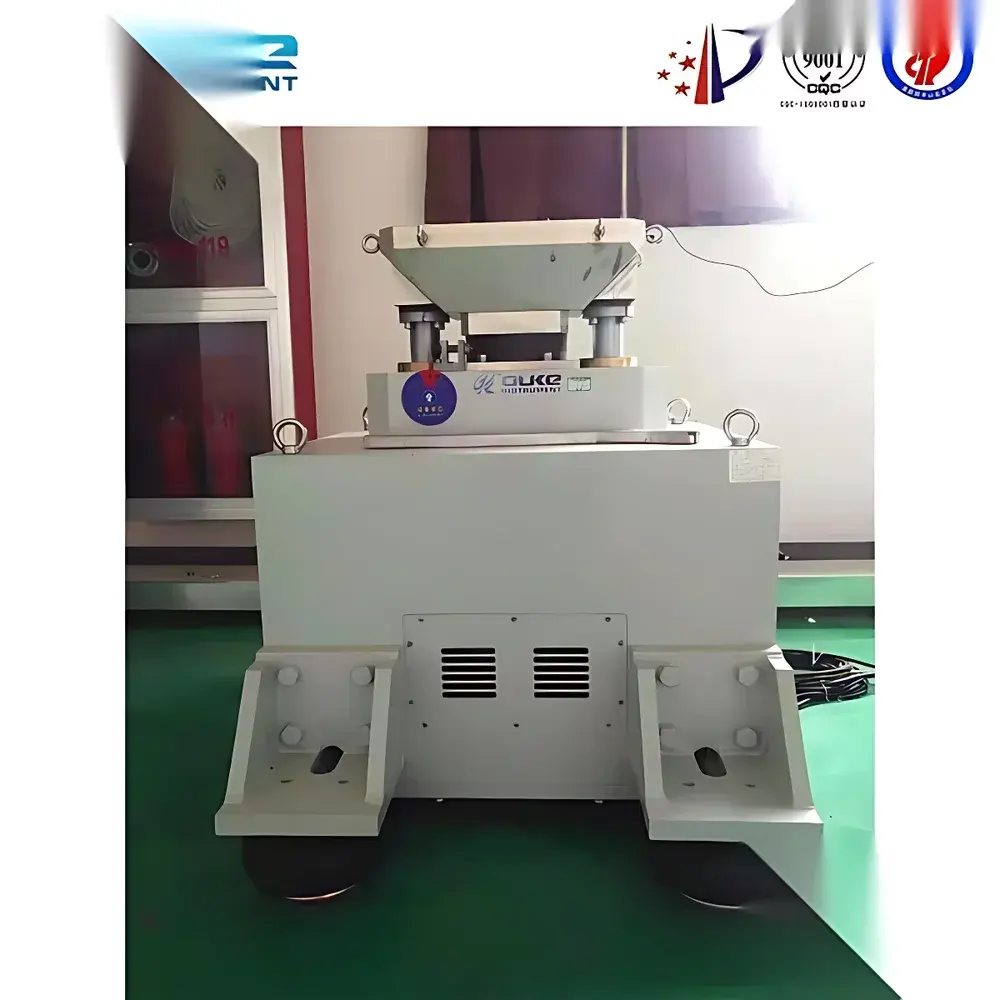
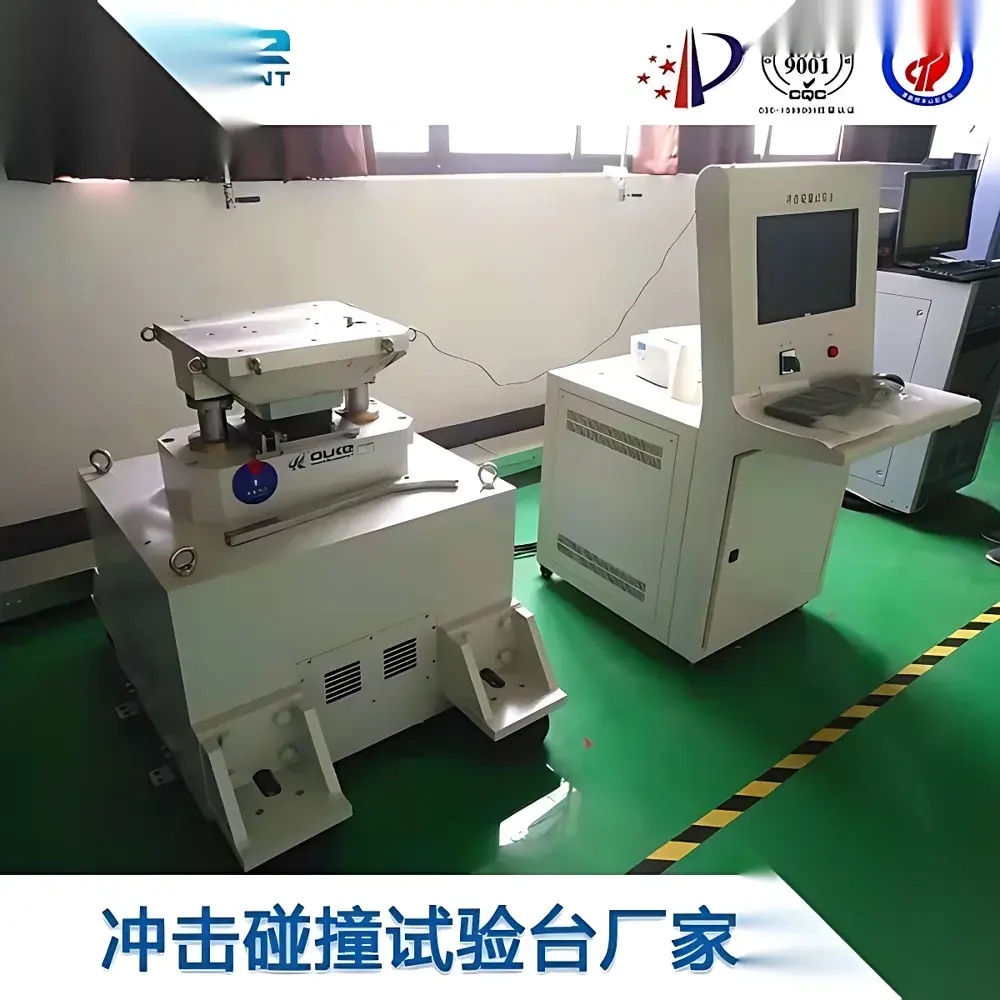
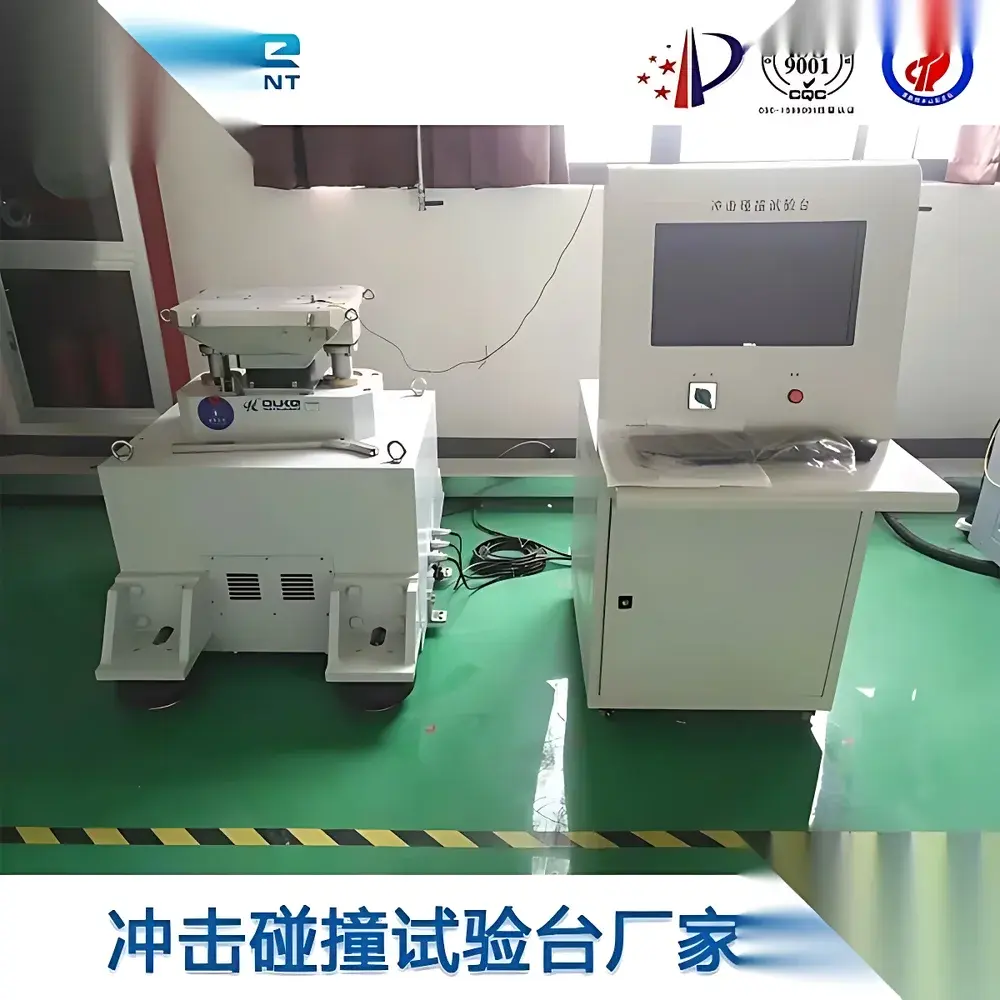
Pre-Loaded Shock Test Table for Transportation & Structural Impact Compliance Testing
| Brand | Other Brands |
|---|---|
| Origin | Imported |
| Supplier Type | Authorized Distributor |
| Load Capacity | 50–800 kg |
| Peak Acceleration | 30–1000 m/s² |
| Pulse Duration | 20–130 ms |
| Repetition Rate | 10–60 impacts/min |
| Table Surface Dimensions | 500×700 mm to 1000×1000 mm |
| Maximum Drop Height | 0–80 mm |
| Continuous Operation Time | 8 h |
| Power Supply | 220 VAC ±10% / 380 VAC ±10%, 50 Hz |
| Environmental Operating Range | –40 to +50 °C, Humidity <85% RH (at 25 °C) |
| Compliance Standards | GB/T 2423.5–1995, GB/T 2423.6–1995, IEC 60068-2-27, IEC 60068-2-29, JJG 497–2000 |
Overview
The Pre-Loaded Shock Test Table is a mechanically driven, electro-hydraulic or servo-pneumatic impact simulation system engineered for controlled, repeatable mechanical shock testing in accordance with international environmental stress screening (ESS) and transportation durability protocols. Unlike free-fall drop testers, this table employs pre-compressed energy storage (e.g., pneumatic springs or hydraulic accumulators) to generate highly reproducible half-sine, trapezoidal, or modified sawtooth shock pulses—enabling precise acceleration-time profile replication across multiple test cycles. Its primary function is to evaluate product structural integrity under transient mechanical loads representative of logistics handling, vehicular vibration, aerospace launch transients, and operational misuse scenarios. The system operates on the principle of controlled impulse transfer: kinetic energy is stored during a pre-loading phase and released instantaneously to accelerate the test platform, subjecting mounted specimens to calibrated G-level shocks without requiring elevated drop heights or complex positioning hardware.
Key Features
- High-rigidity aluminum or steel alloy test table surface ensuring uniform acceleration distribution (<±5% spatial variation across full active area)
- Closed-loop acceleration control using integrated piezoelectric accelerometers and real-time PID feedback for pulse fidelity within ±3% of setpoint
- Optical position sensing and zero-signal interlock system for automatic shutdown upon abnormal displacement or signal loss
- Dual-layer safety architecture: mechanical door interlock + electronic fly-carriage arrest to prevent uncontrolled platform motion
- Modular waveform generation capability supporting half-sine, trapezoidal, and post-peak sawtooth pulses per IEC 60068-2-27 Annex A
- Scalable load capacity range (50–800 kg) accommodates small electronics assemblies to large automotive subassemblies
- Configurable pulse duration (20–130 ms) and repetition rate (10–60 impacts/min) for fatigue-level shock sequencing
Sample Compatibility & Compliance
The test table accepts samples mounted via standard ISO 22810-compliant fixture plates or custom clamping interfaces. Compatible specimen dimensions span from handheld devices (≤200 mm) to chassis-mounted modules (up to 1000×1000 mm footprint). All configurations meet traceable calibration requirements per JJG 497–2000 (Chinese National Verification Regulation for Shock Test Equipment) and support audit-ready documentation for GLP and ISO/IEC 17025-accredited laboratories. System validation includes as-found/as-left verification against reference accelerometers (NIST-traceable), pulse shape deviation reporting, and repeatability assessment per IEC 60068-2-27 Clause 6. The equipment satisfies mandatory shock test clauses in automotive OEM standards (e.g., GMW 3172, Ford CETP 00.00-L-467), aerospace DO-160 Section 7, and packaging ISTA 3A/3E protocols.
Software & Data Management
Control and analysis are performed via Windows-based application compliant with FDA 21 CFR Part 11 requirements, featuring electronic signatures, audit trail logging, and user role-based access control. Real-time oscilloscope-style visualization displays acceleration vs. time waveforms with adjustable sampling rates (up to 1 MHz). Post-test reports include peak G-value, velocity change (Δv), pulse duration at 10%/50%/90% amplitude, and spectral content up to 10 kHz. Raw binary data export (IEEE 754 float32) supports third-party analysis in MATLAB, Python (SciPy), or LabVIEW environments. Calibration certificates and uncertainty budgets (k=2) are embedded in each test record for regulatory submission.
Applications
- Transportation simulation: validating package integrity per ISTA 3-series and ASTM D4169
- Automotive component qualification: airbag control units, ADAS sensors, battery enclosures under crash-relevant shock spectra
- Aerospace ground support equipment (GSE) certification per MIL-STD-810H Method 516.7
- Consumer electronics drop resilience assessment (smartphones, wearables, IoT gateways)
- Medical device mechanical safety verification per IEC 60601-1 Clause 9.4.2 (mechanical stress)
- Structural optimization feedback loop: correlating shock response data with FEA models to refine mounting stiffness and damping
FAQ
What shock pulse shapes can this system generate?
Standard half-sine and trapezoidal pulses per IEC 60068-2-27 are supported; optional firmware enables post-peak sawtooth and user-defined arbitrary waveforms via CSV import.
Is the system suitable for continuous endurance testing?
Yes—rated for 8 hours of uninterrupted operation at nominal load; thermal management includes forced-air cooling of actuation cylinders and controller heat sinks.
How is calibration maintained between scheduled intervals?
Built-in self-check routines verify sensor linearity, amplifier gain stability, and timing accuracy prior to each test sequence; NIST-traceable field calibrations recommended annually.
Can the table be integrated into an automated test cell?
Yes—Ethernet/IP and Modbus TCP interfaces enable synchronization with robotic handlers, environmental chambers, and MES systems.
Does it comply with EU Machinery Directive 2006/42/EC?
CE marking is provided with full technical file including risk assessment per EN ISO 12100 and functional safety evaluation per EN ISO 13849-1 (PL e, Cat 4).



