
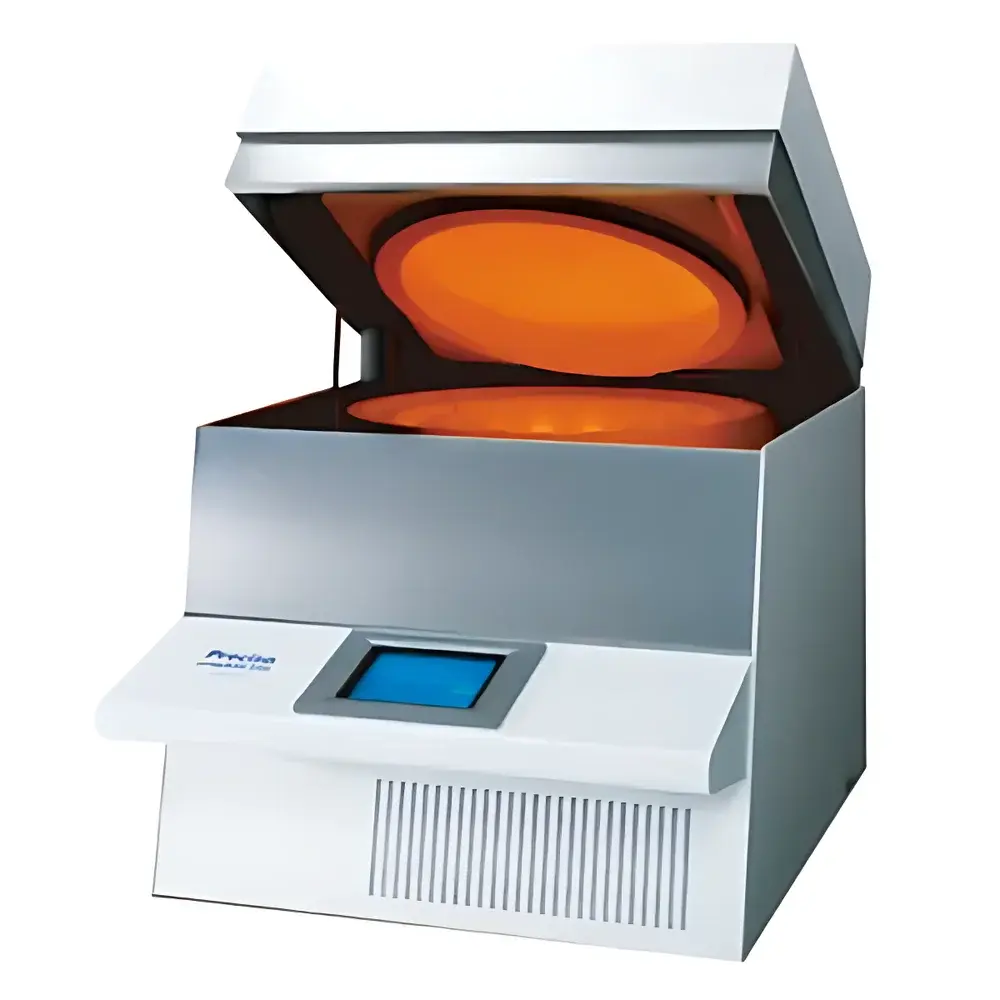
Precisa prepASH Automated Moisture and Ash Analyzer
| Brand | Precisa |
|---|---|
| Origin | Switzerland |
| Model | prepASH |
| Heating Range | Up to 1000 °C |
| Sample Capacity | 29 positions |
| Balance Resolution | 0.1 mg |
| Atmosphere Options | Air, N₂, O₂ |
| Compliance | ASTM D3172, D3174, D3175 |
Overview
The Precisa prepASH Automated Moisture and Ash Analyzer is an integrated thermogravimetric system engineered for precise, fully automated determination of moisture content, volatile matter, and ash residue in solid heterogeneous samples. Based on standardized loss-on-ignition (LOI) principles, the instrument combines high-stability ceramic furnace architecture with an in-situ 0.1 mg resolution analytical balance—operating continuously at elevated temperatures up to 1000 °C. Unlike conventional workflows requiring manual transfer between muffle furnace, desiccator, and analytical balance, the prepASH executes all thermal treatment, intermediate weighing, and endpoint detection within a single sealed chamber under programmable atmosphere control (air, nitrogen, or oxygen). Its operation adheres strictly to gravimetric fundamentals: mass loss upon heating reflects volatilization (moisture + volatiles), while residual mass after complete oxidation represents inorganic ash content. The system implements real-time mass monitoring at user-defined intervals, applying statistically robust constant-mass criteria (e.g., ≤2 mg change over 30 min) to objectively terminate heating cycles—eliminating operator subjectivity and ensuring method reproducibility across laboratories.
Key Features
- Monolithic platform integrating furnace, high-temperature balance, rotary sample carousel (29-position), and controlled-atmosphere manifold—replacing three discrete instruments and associated handling errors.
- Ceramic crucible and sample pan assembly rated for continuous operation at 1000 °C, with low thermal mass and uniform heat distribution verified per ASTM E1530 thermal mapping protocols.
- Rotary carousel with precision indexing ensures identical thermal exposure history for every sample position—critical for inter-sample comparability in regulatory testing.
- Embedded analytical balance performs uninterrupted tare subtraction, gross-to-net mass conversion, and dynamic drift compensation during heating—no manual re-taring required.
- Atmosphere selection (Air/N₂/O₂) enables method-specific oxidative or inert pyrolysis pathways; optional sulfuric acid fume exhaust module supports sulfate ashing per AOAC 942.05.
- Automated cooling phase initiates immediately upon endpoint confirmation, reducing cycle time and enabling rapid throughput without operator intervention.
Sample Compatibility & Compliance
The prepASH accommodates diverse solid matrices—including powders, granules, pellets, and compressed tablets—within standard ceramic crucibles (25–35 mL capacity). It is validated for use with foodstuffs (e.g., cereals, dairy powders), pharmaceutical excipients, coal and coke, catalyst supports, activated carbons, biomass feedstocks, and mineral-based composites. All thermal protocols are preconfigured to comply with mandatory clauses in ASTM D3172 (moisture), D3174 (ash), D3175 (volatile matter), ISO 5984 (ash), ISO 5982 (crude protein via N determination), AOAC 942.05 (sulfated ash), and ICC Standard 105/2 (cereal ash). Software validation documentation includes IQ/OQ/PQ protocols aligned with FDA 21 CFR Part 11 requirements, featuring electronic signatures, full audit trail, and role-based access control—ensuring readiness for GLP and GMP audits.
Software & Data Management
The proprietary prepASH Control Suite provides ISO/IEC 17025-compliant data governance: all raw mass/time/temperature points are timestamped, digitally signed, and stored in encrypted SQLite databases with immutable history. Users define multi-step thermal ramps (e.g., 105 °C/30 min → cool → 550 °C/60 min → cool → 750 °C/30 min) with independent atmosphere switching per segment. Real-time graphical overlays display mass loss curves, derivative (dm/dt) profiles, and furnace temperature gradients. Export formats include CSV (for LIMS integration), PDF analytical reports with embedded metadata (operator ID, instrument serial, calibration status), and XML files compliant with ASTM E1382 data exchange standards. Backup and restore functions support 3-2-1 redundancy (3 copies, 2 media types, 1 offsite).
Applications
This analyzer serves quality control laboratories in food safety (AOAC-certified moisture in infant formula), pharmaceutical manufacturing (residual solvents and inorganic impurities per USP <281>), energy sector (ASTM-compliant proximate analysis of coal and biofuels), environmental testing (ash content in sewage sludge per EPA Method 2540F), and advanced materials R&D (thermal stability screening of graphene oxide dispersions or nuclear graphite). Its ability to execute sequential moisture-volatile-ash determination on a single sample aliquot minimizes material consumption and eliminates cross-contamination risks inherent in manual transfers—particularly critical for low-yield specialty chemicals and radiological samples.
FAQ
Does the prepASH require external balance calibration during operation?
No—the integrated balance undergoes automatic internal calibration prior to each batch using traceable reference weights; external verification is recommended only at scheduled maintenance intervals per ISO/IEC 17025.
Can the system validate compliance with pharmacopeial methods such as USP <281>?
Yes—preloaded USP <281> templates include defined ramp rates, dwell times, and acceptance criteria for loss on drying (LOD); full audit trail satisfies ALCOA+ data integrity principles.
Is it possible to run customized thermal protocols outside published standards?
Yes—users may define arbitrary multi-zone temperature profiles with independent atmosphere control, mass tolerance thresholds, and cooling logic—subject to hardware limits (max 1000 °C, min 1 °C/min ramp rate).
How is crucible tare mass handled across repeated cycles?
The system records individual crucible IDs via RFID tags or manual entry; tare values are retained per crucible and automatically applied to subsequent runs, eliminating manual re-weighing.
What maintenance is required to sustain accuracy over long-term operation?
Annual thermocouple verification, furnace insulation inspection, and balance linearity check using NIST-traceable masses—documented in the included Preventive Maintenance Log template.



