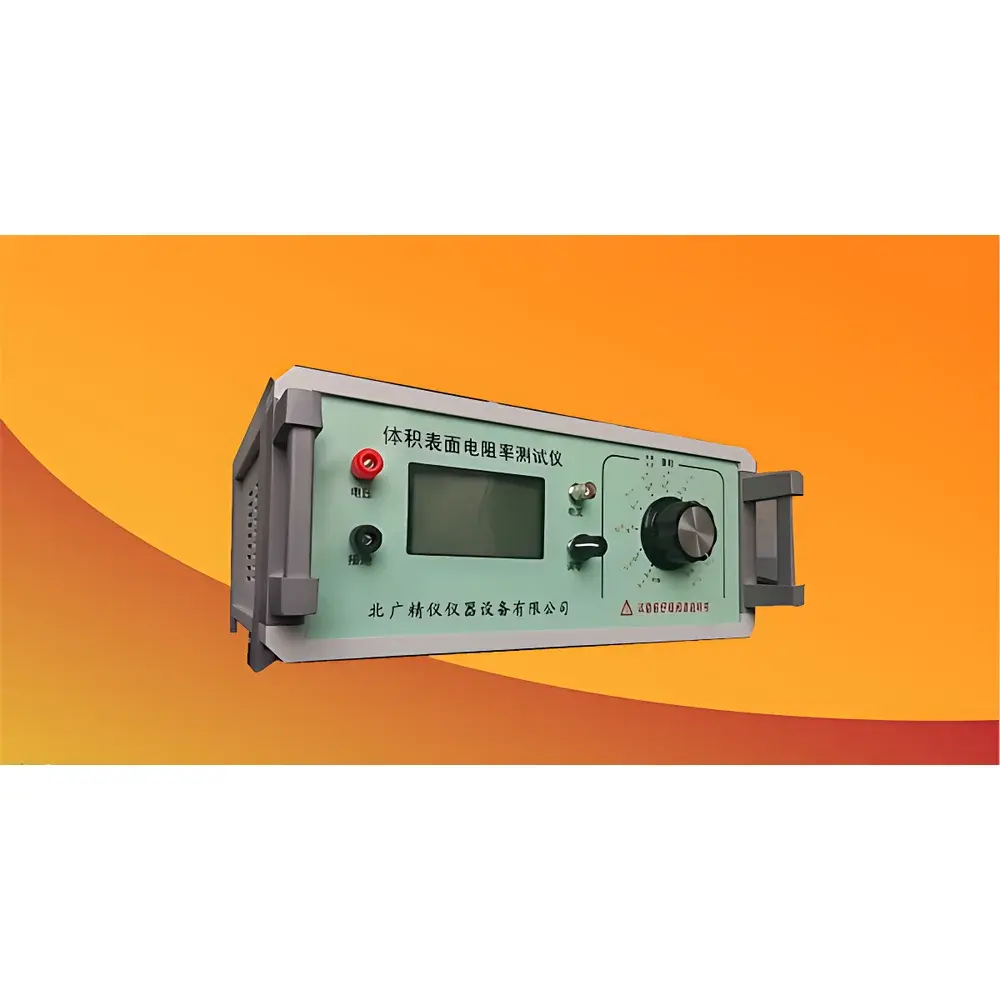
All Precision Instrument BEST-121 High-Resistance Meter for Volume & Surface Resistivity Testing of Rubber and Plastic Insulating Materials
| Brand | All Precision Instrument |
|---|---|
| Origin | Beijing, China |
| Manufacturer Type | Direct Manufacturer |
| Model | BEST-121 |
| Test Voltage Range | DC 10 V, 50 V, 100 V, 250 V, 500 V, 1000 V |
| Resistance Measurement Range | 1×10⁴ Ω to 1×10¹⁸ Ω |
| Current Measurement Range | 2×10⁻⁴ A to 1×10⁻¹⁶ A |
| Volume Resistivity Range | 1.0×10³ Ω·m to 2.0×10¹² Ω·m |
| Surface Resistivity Range | 1.0×10⁴ Ω/□ to 2.0×10¹² Ω/□ |
| Resolution | 0.1×10³ Ω to 0.1×10¹² Ω (adjustable across 1–2 decades) |
| Power Supply | AC 220 V ±10%, 50 Hz ±4%, ≤20 W |
| Dimensions (W×H×L) | 280 mm × 90 mm × 275 mm |
| Net Weight | ≤3.0 kg |
| Compliance | GB/T 1410–2006 / IEC 60093:1980 |
Overview
The All Precision Instrument BEST-121 High-Resistance Meter is an engineered solution for precise determination of volume resistivity (ρv) and surface resistivity (ρs) in solid insulating materials—including elastomers, thermoplastics, thermosets, and composite polymers—using the guarded three-terminal (ring-type) electrode configuration defined in GB/T 1410–2006 and IEC 60093:1980. The instrument operates on the principle of constant-voltage DC excitation (selectable from 10 V to 1000 V), enabling stable measurement of extremely low conduction currents (down to 10−16 A) through high-impedance dielectric specimens. Its core architecture integrates a regulated high-voltage source, a low-noise electrometer-grade current amplifier, and an embedded microcontroller system with digital parameter input, auto-ranging capability, and dual numeric display of both resistance value and corresponding current. Designed for metrological integrity, the system supports traceable calibration via zero- and full-scale adjustments and features shielded signal paths to minimize electromagnetic interference and leakage current errors—critical for measurements exceeding 1015 Ω.
Key Features
- Triple-range selectable test voltages (10 V, 50 V, 100 V, 250 V, 500 V, 1000 V DC) to accommodate diverse material classes and international standard requirements.
- Simultaneous digital readout of resistance (Ω) and current (A), eliminating manual calculation or scaling factors during data acquisition.
- Auto/manual range switching with resolution optimized per decade—from 0.1×10³ Ω at low impedances to 0.1×10¹² Ω at ultra-high impedances.
- Integrated guard circuitry and triaxial cabling support to suppress surface leakage and ensure accurate volume resistivity extraction per ASTM D257 and ISO 3915 methodologies.
- Compact benchtop form factor (280 × 90 × 275 mm; ≤3.0 kg) with low power consumption (<20 W), suitable for QC labs, R&D environments, and production floor deployment.
- Digital keypad interface with non-volatile memory for user-defined test protocols, including dwell time, voltage ramp rate, and pass/fail thresholds.
Sample Compatibility & Compliance
The BEST-121 is validated for use with rigid and semi-rigid polymer sheets, molded rubber components, anti-static flooring tiles, ESD-safe packaging films, and elastomeric gaskets. It accepts standard ring electrodes per GB/T 1410 (central electrode Ø50 mm, guard ring ID 60 mm / OD 80 mm, base plate Ø100 mm) and supports custom electrode configurations compliant with ASTM D257 Annex A2 (concentric ring), ISO 3915 (two-electrode for surface resistivity), or customer-specified geometries. All measurements adhere to environmental conditioning requirements: 23 ±2 °C and 60–70 % RH for ≥2 hours prior to testing. The instrument meets national and international standards for electrical safety (GB 4793.1), electromagnetic compatibility (GB/T 18268), and metrological traceability. Its design facilitates audit readiness under GLP and GMP frameworks, with documented calibration procedures aligned to ISO/IEC 17025 requirements.
Software & Data Management
While the BEST-121 operates as a standalone instrument with front-panel control, it supports optional RS-232 or USB serial output for integration into laboratory information management systems (LIMS). Data export includes timestamped resistance/current pairs, applied voltage, test duration, and operator ID fields—enabling structured logging for FDA 21 CFR Part 11-compliant environments when paired with validated third-party software. Internal storage retains up to 100 test records with metadata (date, voltage setting, range, pass/fail flag). Firmware updates are delivered via secure binary file transfer, maintaining version control and revision history per quality system documentation requirements.
Applications
- Quality assurance of insulating materials in wire & cable manufacturing (e.g., PVC, XLPE, silicone rubber jackets).
- Validation of electrostatic discharge (ESD) control properties in cleanroom flooring, workbench mats, and packaging foams.
- Development and specification verification of conductive fillers (carbon black, metal-coated polymers) in antistatic composites.
- Research into aging effects on polymer dielectric performance under thermal, UV, or humidity stress.
- Baseline characterization of liquid plasticizers and processing aids per GB/T 1410 Annex B methodology.
- Low-current diagnostics in optoelectronic devices, including dark current measurement of photodiodes and phototransistors.
FAQ
What standards does the BEST-121 comply with?
It conforms to GB/T 1410–2006 and its international counterpart IEC 60093:1980 for volume and surface resistivity testing of solid insulators. Additional alignment exists with ASTM D257, ISO 3915, and EN 61340-2-3 for ESD material evaluation.
Can the instrument measure both volume and surface resistivity on the same sample?
Yes—using the supplied three-terminal ring electrode set, volume resistivity is measured between the central electrode and outer guard ring (with base plate grounded), while surface resistivity is derived between the central and guard electrodes with the base plate floating.
Is calibration traceable to national standards?
Calibration is performed using NIST-traceable high-value resistors (10⁶ Ω to 10¹⁵ Ω) and certified electrometers; certificate includes uncertainty budgets per ISO/IEC 17025 guidelines.
What environmental conditions are required for valid testing?
Testing must occur in a controlled environment at 23 ±2 °C and 60–70 % relative humidity, with specimens conditioned for ≥2 hours prior to measurement per GB/T 1410 Clause 3.3.
Does the system support automated reporting for regulatory submissions?
When integrated with validated LIMS or ELN platforms, raw data export enables generation of audit-ready reports meeting FDA 21 CFR Part 11, EU Annex 11, and ISO 13485 documentation requirements.