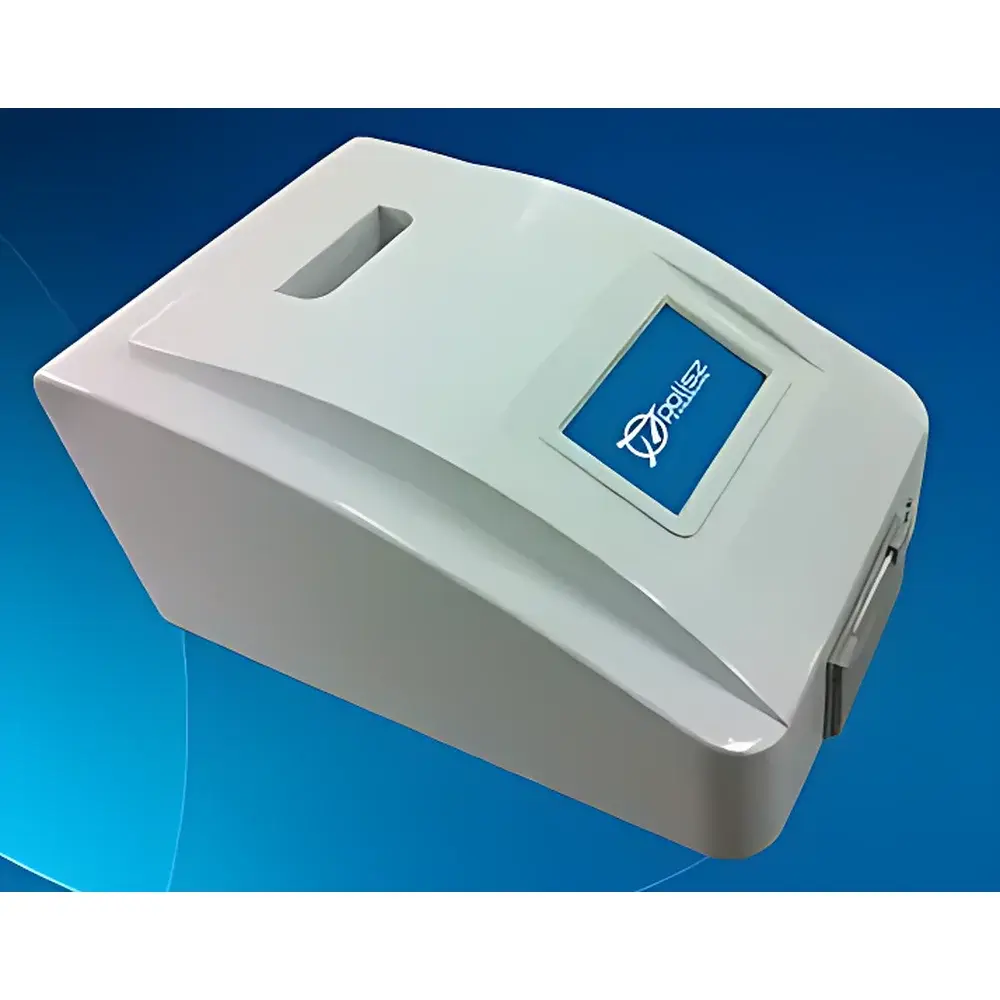
All Precision Instrument S-19 Portable Automated Filter Integrity Tester
| Brand | All Precision Instrument |
|---|---|
| Origin | Jiangsu, China |
| Manufacturer Type | Direct Manufacturer |
| Country of Origin | China |
| Model | S-19 |
| Power Supply | 170–240 V AC, 50/60 Hz, 100 W |
| Max Operating Pressure | 7999 mbar |
| Minimum Inlet Pressure | 3000 mbar |
| Test Pressure Range | 500–6900 mbar |
| Pressure Sensitivity | ±1.0 mbar |
| Bubble Point Accuracy | ±60 mbar |
| Dimensions (W×D×H) | 240 × 320 × 260 mm |
| Display | 5.7–7-inch color TFT touchscreen, 256-color, GUI in English/Chinese |
| Data Storage | 32 GB internal flash memory (≥1 million test records) |
| Communication Interface | RS232/USB/Ethernet for PC connectivity and remote supervision |
| Compliance | Designed to support GMP, FDA 21 CFR Part 11 (audit trail ready), ISO 13408-2, ASTM F838, USP <1207> |
Overview
The All Precision Instrument S-19 Portable Automated Filter Integrity Tester is an engineered solution for quantitative, non-destructive verification of pore integrity in sterilizing-grade filters used across biopharmaceutical manufacturing, aseptic processing, and parenteral drug production. It operates on three internationally recognized physical principles: bubble point testing (determining the minimum pressure required to force air through saturated pores), diffusion flow measurement (quantifying gas flow through wetted membranes under sub-bubble-point pressure), and water intrusion testing (assessing hydrophobic membrane integrity via pressure-driven water penetration). The instrument employs high-resolution digital pressure control with closed-loop feedback, eliminating mechanical throttling valves and ensuring consistent performance across variable supply pressure conditions — a critical requirement in dynamic cleanroom utility environments. Its ARM9-based embedded architecture runs Windows CE 6.0, enabling deterministic real-time control, deterministic test sequencing, and deterministic data logging — all essential for regulated environments governed by GMP and FDA 21 CFR Part 11.
Key Features
- Full automation of test execution: bubble point, diffusion flow, and water intrusion tests execute without manual intervention after parameter entry.
- Digital automatic gas inlet regulation: replaces legacy analog flow control; maintains stable test pressure regardless of upstream supply fluctuations (±10% typical variation).
- Auto-exit-on-pass function: terminates pressurization immediately upon confirmation of pass criteria, minimizing unnecessary exposure of filter media to elevated pressure and extending service life.
- User-level access control: supports multi-tiered operator roles (e.g., Operator, Supervisor, Administrator) with configurable password policies and audit-trail-capable parameter change logging.
- Integrated thermal printer: outputs full test reports including test type, applied pressure, measured flow, pass/fail status, timestamp, operator ID, and real-time pressure vs. time curve — available in English or Chinese.
- High-fidelity data retention: 32 GB onboard storage retains ≥1 million complete test records (parameters + results + curves); exportable via USB or Ethernet to LIMS or QA databases.
- Remote supervisory capability: native serial/USB/Ethernet interface enables centralized monitoring, batch scheduling, and historical data retrieval using included PC software — compliant with distributed facility architectures.
- Intelligent UI design: context-sensitive on-screen prompts, “last-condition recall” for repeat testing, and one-touch execution mode reduce operator training burden and minimize procedural errors.
Sample Compatibility & Compliance
The S-19 accommodates a broad spectrum of filter configurations per ISO 13408-2 and USP : disc membranes (Φ25 mm to Φ300 mm), standard pleated cartridges (2.5″ to 40″ length, 1–9 cores), capsule filters, mini-cartridges, and vent filters. Its high-sensitivity transducer array and adaptive signal filtering ensure reliable detection even for large-area filters (e.g., 5-core, 20-inch PES cartridges), where low-delta-pressure signals are prone to noise interference. All test methods align with regulatory expectations for validation and routine release testing: bubble point tests verify pore size distribution; diffusion flow quantifies membrane wetting stability; water intrusion validates hydrophobic barrier integrity without organic solvents. The system supports full traceability — every test record includes unique identifier, environmental conditions (ambient temperature/humidity), operator credentials, and digital signature fields — fulfilling ALCOA+ (Attributable, Legible, Contemporaneous, Original, Accurate, Complete, Consistent, Enduring, Available) data integrity requirements.
Software & Data Management
Embedded firmware implements deterministic state-machine logic for test sequencing, with built-in self-diagnostic routines that verify sensor calibration, valve actuation, and pressure decay integrity prior to each run. Upon power-up, the system performs automated safety checks: if residual chamber pressure exceeds 50 mbar, it initiates controlled venting before allowing user interaction. The PC application provides secure database import/export, customizable report templates (PDF/CSV), trend analysis tools for longitudinal filter performance assessment, and electronic signature integration for electronic batch record (EBR) workflows. Audit trails capture all user actions — login/logout, parameter edits, test initiation, result overrides — with immutable timestamps and IP/user metadata, satisfying FDA 21 CFR Part 11 Subpart B requirements for electronic records and signatures.
Applications
This instrument serves critical quality control functions across the pharmaceutical lifecycle: pre-use post-sterilization integrity verification of final-fill filters; post-use integrity testing of process filters in bioreactor harvest and purification trains; qualification of single-use system (SUS) fluid path filters; validation of HVAC terminal HEPA/ULPA filters; and routine surveillance of compressed air and nitrogen distribution systems. It is routinely deployed in QC labs supporting sterile drug manufacturing (injectables, ophthalmics, vaccines), cell and gene therapy facilities, and contract development and manufacturing organizations (CDMOs) requiring rapid, auditable filter release.
FAQ
Does the S-19 comply with FDA 21 CFR Part 11 for electronic records?
Yes — its embedded audit trail, role-based access control, electronic signature support, and immutable data storage meet core technical and procedural requirements for Part 11 compliance.
Can the instrument perform water intrusion testing on hydrophobic PTFE membranes?
Yes — the S-19 implements water intrusion per USP Annex 2, with calibrated pressure ramping and flow compensation algorithms validated for PTFE, PVDF, and polypropylene membranes.
What is the maximum filter area supported for diffusion flow testing?
The system has been verified for reproducible diffusion flow measurement on filters up to 12 m² effective filtration area (e.g., 9-core, 40-inch cartridges), leveraging adaptive signal averaging and noise suppression.
Is external calibration required, and how often?
Annual calibration using NIST-traceable pressure standards is recommended; the instrument stores calibration coefficients and supports user-initiated verification routines.
How does the auto-exit-on-pass feature improve filter longevity?
By terminating pressurization within 0.5 seconds of pass confirmation, it reduces cumulative mechanical stress on membrane support structures and minimizes potential for micro-fracture propagation during repeated testing cycles.