
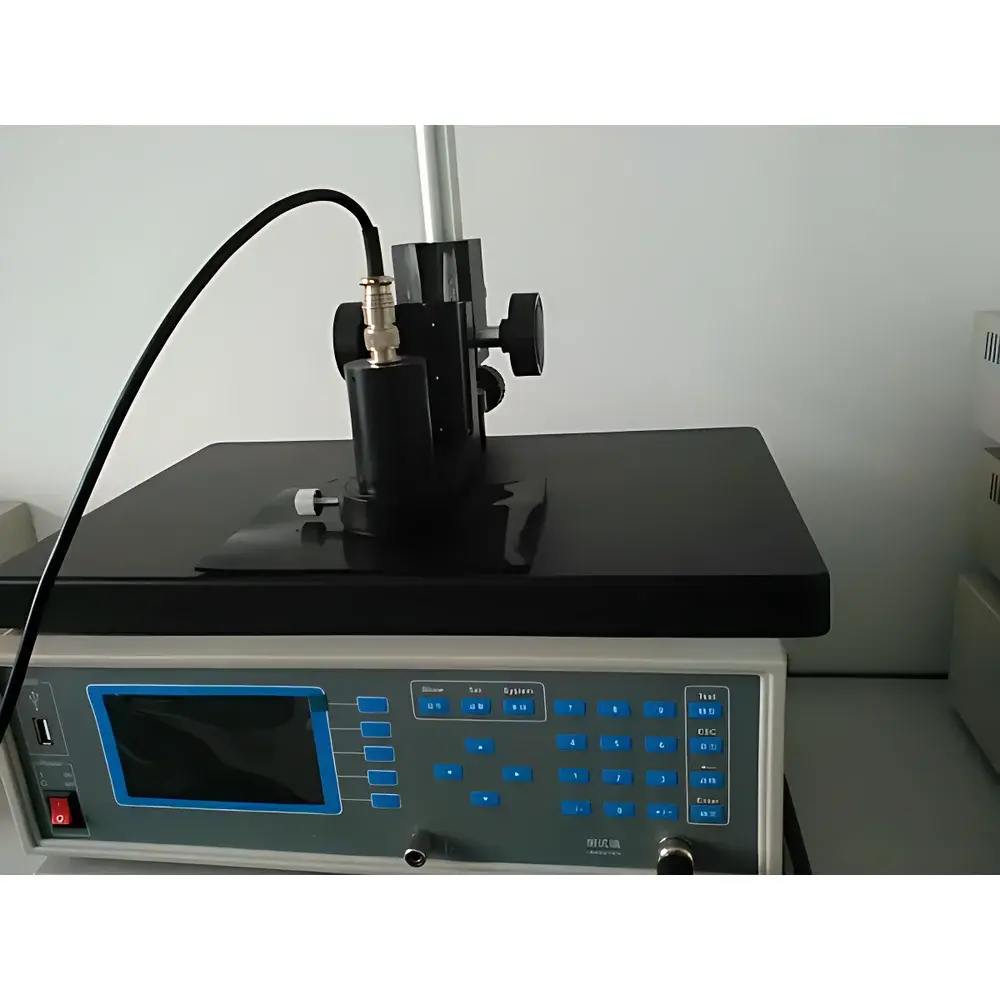
All Precision Instrument BEST-300C Four-Terminal Conductivity and Resistivity Tester
| Key | Brand: All Precision Instrument |
|---|---|
| Origin | Beijing, China |
| Manufacturer Type | Direct Manufacturer |
| Model | BEST-300C |
| Form Factor | Benchtop |
| Conductivity Range | 5 × 10⁻⁶ – 1 × 10⁸ mS/cm |
| TDS Range | 0–100 g/L |
| Resistivity Range | 1 × 10⁻⁸ – 2 × 10⁶ Ω·cm |
| Salinity Range | 0–100 ppt |
| Temperature Range | 0–40 °C |
| Accuracy | ±0.05% of reading |
| Minimum Resolution | 0.1 μΩ |
| Voltage Ranges | 2 mV / 20 mV / 200 mV / 2 V (±0.1% rdg, resolution down to 0.1 μV) |
| Current Output | 0–1000 mA DC, adjustable |
| ranges | 1 μA to 1000 mA (±0.2% rdg ±2 digits) |
| Display | 4.3-inch LCD with auto-unit conversion |
| Interface | Dual-language (English/Chinese), PC-compatible via optional software |
| Dimensions | 330 × 340 × 120 mm |
| Power | 220 V ±10%, 50/60 Hz |
Overview
The All Precision Instrument BEST-300C Four-Terminal Conductivity and Resistivity Tester is an engineered benchtop instrument designed for high-accuracy electrical characterization of conductive and semiconductive solid materials. It operates on the four-terminal (Kelvin) measurement principle—eliminating lead and contact resistance errors—to deliver traceable, reproducible resistivity (Ω·cm), conductivity (mS/cm), sheet resistance (Ω/sq), and derived parameters including TDS (total dissolved solids), salinity (ppt), and temperature-compensated values. The system is calibrated against NIST-traceable standards and conforms to fundamental metrological requirements for laboratory-grade material qualification in QC, R&D, and academic settings. Its architecture supports stable DC current sourcing and high-resolution voltage sensing across six decades of resistance (10⁻⁵ Ω to 2 × 10⁵ Ω), enabling reliable analysis of elastomeric conductors, carbon-loaded polymers, metalized films, graphite composites, and thin-film electrodes.
Key Features
- Four-terminal (Kelvin) configuration ensures measurement integrity by decoupling current injection and voltage sensing paths—critical for low-resistance (10⁶ Ω·cm) materials.
- Auto-ranging measurement engine dynamically selects optimal voltage/current ranges and units (e.g., μS/cm, mS/cm, S/m) without manual intervention, minimizing operator error and setup time.
- Integrated temperature compensation (0–40 °C) applies linear or polynomial correction per ASTM D257 and IEC 60093, referenced to 25 °C standard conditions.
- 4.3-inch backlit LCD displays simultaneous real-time readouts of resistance, resistivity, sheet resistance, conductivity, temperature, and pressure (when used with optional pneumatic test fixtures).
- DC current source delivers stable, ripple-free output from 1 μA to 1000 mA with programmable ramping—essential for non-destructive testing of sensitive conductive elastomers and printed electronics.
- Dual-language UI (English/Chinese) and USB/RS-232 interface support international deployment and integration into automated QA workflows.
Sample Compatibility & Compliance
The BEST-300C accommodates diverse sample geometries—including bulk rods, wafers, coatings, pastes, and molded elastomers—via interchangeable test fixtures (e.g., collinear four-probe, van der Pauw, and spring-loaded electrode platens). Fixtures are constructed from corrosion-resistant stainless steel and gold-plated contacts to ensure long-term repeatability. The instrument meets functional requirements of ASTM D257 (Standard Test Methods for DC Resistance or Conductance of Insulating Materials), ISO 3915 (Electrical Resistance of Conductive Plastics), and GB/T 1410 (Chinese national standard for solid insulating materials). While not certified for regulatory submission, its measurement uncertainty budget (±0.05% base accuracy, ±0.2% current sourcing) aligns with GLP-compliant lab practices. Data audit trails, user access control, and electronic signature readiness can be enabled via optional PC software compliant with FDA 21 CFR Part 11 when deployed in regulated environments.
Software & Data Management
An optional Windows-based application enables remote instrument control, real-time data streaming, batch logging, and statistical process monitoring. The software exports timestamped CSV files compatible with LIMS integration and generates customizable reports—including trend charts, histogram distributions, and pass/fail compliance summaries against user-defined specification limits. All measurement sessions include metadata (operator ID, sample ID, fixture type, ambient temperature/humidity if logged externally), supporting ISO/IEC 17025 documentation requirements. Audit logs record parameter changes, calibration events, and user login/logout activity—retained for ≥12 months per internal QA policy. Firmware updates are distributed via secure download and installed without hardware modification.
Applications
- Quality control of conductive rubber formulations (e.g., EMI shielding gaskets, antistatic flooring compounds)
- Resistivity mapping of CVD-grown graphene and transparent conductive oxides (ITO, AZO)
- Process validation of printed silver nanoparticle inks on flexible substrates
- Batch consistency verification for carbon-black-filled thermoplastics and conductive adhesives
- Research-grade characterization of thermoelectric materials and doped semiconductor ceramics
- Educational labs requiring hands-on instruction in solid-state transport phenomena and contact resistance physics
FAQ
What measurement principle does the BEST-300C use, and why is it preferred for conductive materials?
It employs the four-terminal (Kelvin) method to separate current forcing and voltage sensing, eliminating parasitic lead and contact resistance—ensuring accuracy below 1 mΩ and above 10⁶ Ω·cm.
Does the instrument support temperature compensation per industry standards?
Yes—it applies automatic linear compensation per ASTM D257 and IEC 60093 using built-in Pt1000 sensor input, referenced to 25 °C.
Can test data be exported for regulatory compliance (e.g., FDA, ISO 13485)?
With optional software, raw data, audit logs, and electronic signatures meet 21 CFR Part 11 and ISO/IEC 17025 traceability requirements.
What sample fixtures are available, and how are they selected?
Fixtures include collinear four-probe heads for bulk solids, van der Pauw clips for isotropic wafers, and pneumatic compression platens for soft elastomers—selected based on sample geometry and ASTM/ISO test method alignment.
Is factory calibration traceable to national standards?
Calibration certificates reference NIST-traceable resistance standards and include full uncertainty budgets per ISO/IEC 17025 guidelines.



