
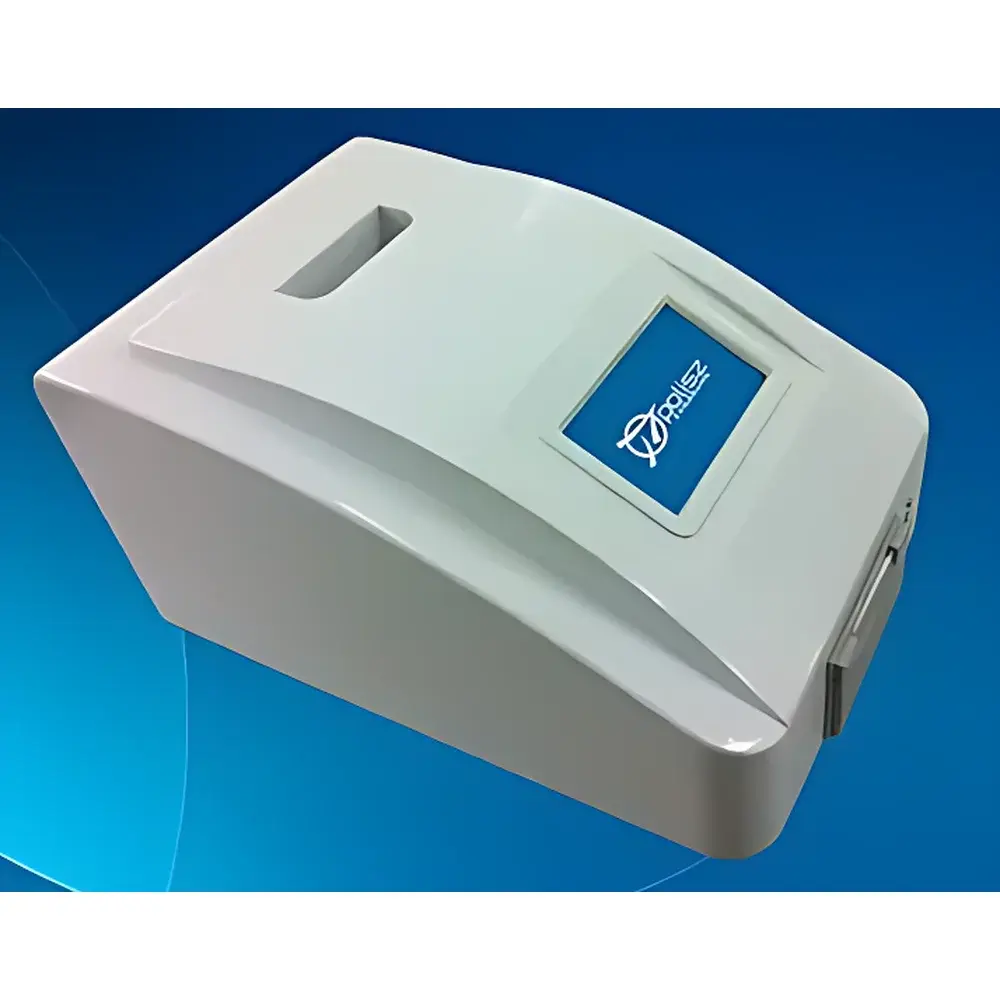
All Precision Instrument B-31 Portable Total Organic Carbon (TOC) Analyzer
| Brand | All Precision Instrument |
|---|---|
| Origin | Beijing, China |
| Manufacturer Type | Direct Manufacturer |
| Instrument Type | Portable TOC Analyzer |
| Detection Principle | Direct Conductivity Method |
| Oxidation Method | UV/Persulfate Oxidation |
| Measurement Range | 0–50,000 µg/L (ppb) as C |
| Accuracy | ±4% of reading |
| Resolution | 0.001 mg/L |
| Detection Limit | 0.05 mg/L |
| Repeatability | ≤3% RSD |
| Conductivity Range Limit | <10.0 µS/cm |
| Sample Temperature Range | 1–90 °C |
| Power Supply | 220 V AC, 50/60 Hz |
| Operating Ambient Temperature | 5–40 °C |
| Display | Color Touchscreen |
| Analysis Time | ≤6 minutes per sample |
Overview
The All Precision Instrument B-31 Portable Total Organic Carbon (TOC) Analyzer is an engineered solution for on-site and laboratory-based quantification of non-purgeable organic carbon in aqueous matrices. It operates on the direct conductivity detection principle: organic carbon in the sample is first oxidized to carbon dioxide (CO₂) via synergistic UV irradiation and persulfate chemistry under acidic conditions; the resulting CO₂ dissolves to form carbonic acid, which dissociates into conductive ions (H⁺ and HCO₃⁻). The change in solution conductivity—proportional to the CO₂ concentration—is measured in real time using a high-stability dual-electrode conductivity cell. This method eliminates interference from inorganic carbon (IC) through acidification and sparging prior to oxidation, ensuring selective TOC determination without subtraction artifacts. Designed for compliance with pharmacopeial requirements—including USP , EP 2.2.44, and ChP 2020 Volume II—the B-31 delivers trace-level sensitivity and robust performance across purified water, WFI, clean-in-place (CIP) rinse waters, and environmental surface water samples.
Key Features
- Portable architecture with integrated power management and ruggedized housing for field deployment or mobile QC labs
- Dual-stage oxidation: 185/254 nm UV lamp combined with catalyzed sodium persulfate ensures >95% oxidation efficiency for refractory organics (e.g., sucrose, benzoquinone)
- Automated IC removal module: acidification (H₃PO₄) followed by inert gas sparging suppresses residual carbonate/bicarbonate contribution
- High-precision conductivity sensor with temperature compensation (±0.1 °C) and auto-calibration against NIST-traceable KCl standards
- Color touchscreen interface with embedded method templates aligned with USP, EP, and ISO 8467:2017 protocols
- Onboard data logging (≥10,000 records) with time-stamped audit trail, supporting GLP/GMP documentation requirements
Sample Compatibility & Compliance
The B-31 accepts liquid samples with conductivity <10.0 µS/cm and suspended solids <10 mg/L. It is validated for use with pharmaceutical water systems (PW, WFI, Purified Steam Condensate), municipal wastewater effluents, groundwater, and industrial process streams. System suitability testing—per USP —is supported via built-in sucrose and 1,4-benzoquinone challenge tests. The analyzer meets ISO/IEC 17025:2017 calibration traceability requirements and provides full documentation for FDA 21 CFR Part 11 compliance when paired with optional secure user authentication and electronic signature modules. All wetted components (quartz oxidation chamber, PFA fluidic path, platinum conductivity electrodes) are chemically inert and compliant with USP Class VI biocompatibility standards.
Software & Data Management
Firmware v3.2 includes embedded TOC analysis software with configurable reporting (PDF/CSV export), trend visualization, and pass/fail flagging against user-defined limits. Data integrity safeguards include write-protected storage, automatic backup to USB drives, and tamper-evident audit logs recording operator ID, method parameters, calibration events, and raw conductivity waveforms. Optional PC-based TOC Manager Suite enables remote monitoring, multi-instrument fleet management, and integration with LIMS via ASTM E1384-compliant HL7 or OPC UA interfaces. All software modules undergo annual verification per ICH Q9 principles and support retrospective validation per GAMP 5 guidelines.
Applications
- Pharmaceutical manufacturing: Routine TOC monitoring of purified water loops, WFI generation systems, and equipment rinse validation
- Biotechnology: Feedstock water qualification, buffer preparation QC, and single-use system extractables screening
- Environmental laboratories: EPA Method 415.3-compliant analysis of drinking water, wastewater, and sediment pore water
- Power generation: Boiler feedwater purity assurance and condensate return line contamination detection
- Academic research: Kinetic studies of photocatalytic degradation, humic acid characterization, and carbon cycle modeling
FAQ
What sample pretreatment is required before analysis?
Samples with turbidity >5 NTU or particulate load >10 mg/L must be filtered through a 0.45 µm hydrophilic PVDF membrane. High-ionic-strength samples (>10 µS/cm) require dilution with TOC-free water (≤0.01 mg/L certified blank) to avoid conductivity saturation.
How often must the UV lamp be replaced?
The low-pressure mercury UV lamp has a rated lifetime of 10,000 hours. The instrument tracks cumulative irradiation time and triggers a maintenance alert at 9,500 hours; replacement is mandatory before 10,000 hours to maintain oxidation efficiency ≥95%.
Can the B-31 perform NPOC (Non-Purgeable Organic Carbon) analysis?
Yes. The integrated acidification/sparging module enables full NPOC mode per ISO 8467:2017. Users may select “NPOC” or “TC–IC” calculation modes directly from the method editor.
Is method validation support available?
All Precision Instrument provides IQ/OQ documentation packages, including installation checklists, operational verification protocols, and system suitability test reports aligned with USP and EU GMP Annex 15.
What is the minimum sample volume required?
The standard analysis consumes 20 mL per run. A low-volume kit (optional) reduces requirement to 5 mL using micro-conductivity cell configuration—ideal for precious or limited-volume samples such as bioreactor harvests.
Related Products







