
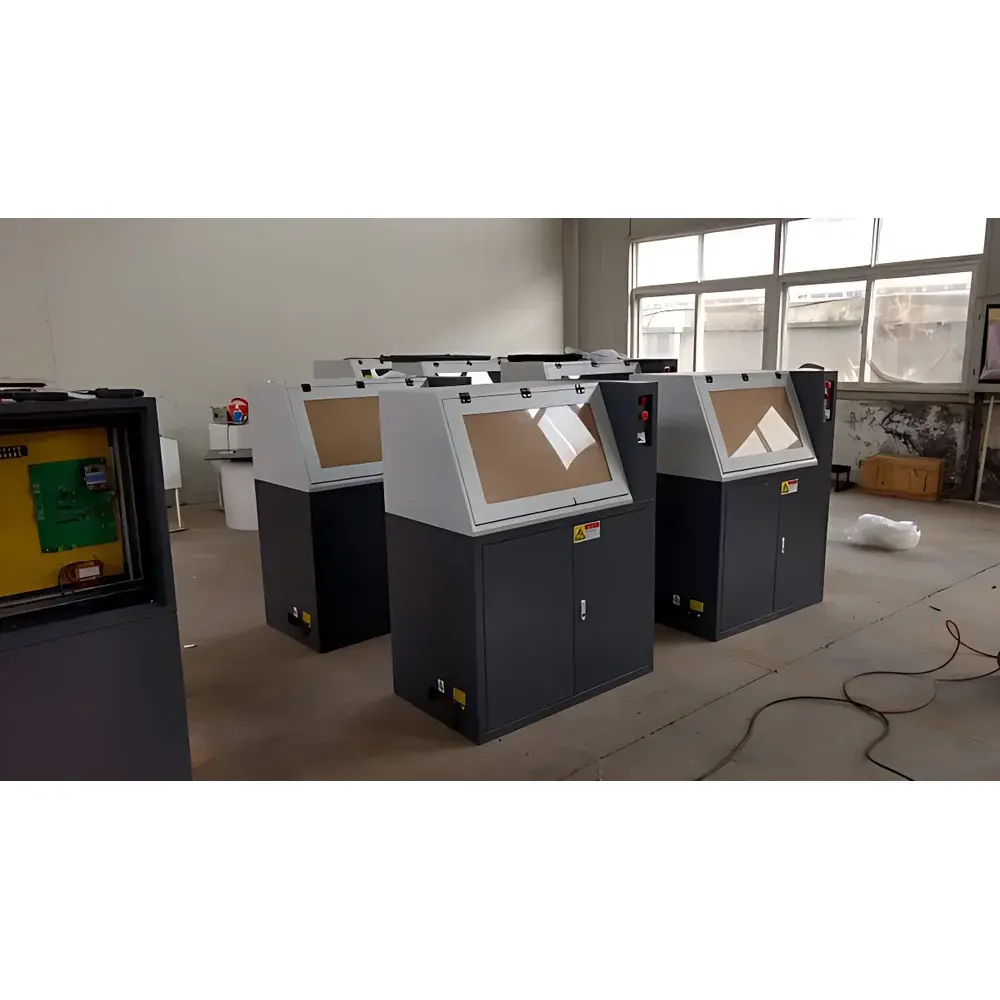
All Precision Instrument C-50KV High-Voltage Dielectric Strength Tester for Rubber and Insulating Materials
| Key | Brand: All Precision Instrument |
|---|---|
| Origin | Beijing, China |
| Manufacturer Type | Direct Manufacturer |
| Model | C-50KV |
| Max Output Voltage | 50 kV AC/DC (RMS) |
| Input Voltage | AC 220 V |
| Power Rating | 3 kVA |
| Voltage Ramp Rate | 0.1–5.0 kV/s (adjustable) |
| Compliance | GB/T 1981.2–2003, GB/T 7113.2–2005, GB/T 10580–2003, ISO 293, ISO 294-1, ISO 294-3, ISO 295, ISO 10724, IEC 60296, IEC 60455-2, IEC 60674-2 |
Overview
The All Precision Instrument C-50KV High-Voltage Dielectric Strength Tester is an engineered solution for determining the dielectric breakdown strength of solid insulating materials—including vulcanized rubber, elastomers, thermoplastics, thermosets, laminates, and electrical insulation films—under controlled laboratory conditions. It operates on the principle of controlled voltage ramping across a standardized test specimen placed between two parallel brass electrodes, in accordance with the fundamental physics of electrical breakdown in dielectrics. When subjected to increasing electric stress, insulating materials undergo ionization, partial discharge, and eventual conductive channel formation—culminating in catastrophic failure (i.e., puncture or flashover). This instrument quantifies the critical electric field threshold at which such failure occurs, expressed as peak kilovolts per millimeter (kV/mm), enabling comparative evaluation of material integrity, formulation consistency, aging effects, and process-induced defects.
Key Features
- True dual-mode operation: fully configurable AC (0–50 kV RMS) and DC (0–50 kV, pulsating unidirectional) output via mechanical short-circuit rod insertion/removal in the high-voltage transformer tower—no electronic switching required.
- Programmable voltage ramp rates from 0.1 to 5.0 kV/s, compliant with ASTM D149, IEC 60243-1, and GB/T 1408.1 requirements for both step-stress and continuous ramp protocols.
- Integrated high-fidelity data acquisition: simultaneous sampling of primary voltage (via calibrated 100 V instrument winding, 1:1000 ratio), leakage current (via precision shunt sensor), time stamp, and ramp rate at ≥1 kHz resolution.
- Automatic breakdown detection algorithm: real-time analysis of current surge (>10 mA sustained for >20 ms) combined with voltage plateau collapse to trigger immediate voltage cutoff and event logging.
- Robust safety architecture: interlocked enclosure with grounded copper mesh, HV equalizing sphere with dedicated discharge probe (≥5 s contact recommended), and dual-channel audible/visual DC warning indicator activated by front-panel selector.
- Self-contained control system: embedded microcontroller manages servo-driven autotransformer positioning, relay sequencing, arc suppression timing, and hardware-level overcurrent/overvoltage protection independent of PC software.
Sample Compatibility & Compliance
The C-50KV accommodates standard test geometries per ISO 293 (compression-molded plaques), ISO 294-1 (injection-molded bars), and ISO 295 (thermoset compression specimens), with electrode configurations supporting both volume and surface breakdown assessment. Its design meets essential requirements for GLP-compliant laboratories: full audit trail capability (user ID, timestamp, parameter set, raw waveform export), password-protected method libraries, and electronic signature support aligned with FDA 21 CFR Part 11 principles. Test reports include traceable calibration metadata, environmental condition logging (temperature/humidity per GB/T 10580–2003), and statistical summary per batch (mean, SD, min/max). The system is validated for use in quality control environments governed by IEC 60674-2 (polymeric films), IEC 60455-2 (resin compounds), and IEC 60296 (mineral insulating oils).
Software & Data Management
The proprietary Windows-based application provides ISO/IEC 17025-aligned test sequence definition, real-time oscillographic display (voltage vs. time, current vs. time), and post-test analysis tools including Weibull distribution fitting for breakdown probability modeling. All raw datasets are stored in vendor-neutral CSV and binary formats with embedded metadata headers (test ID, operator, ambient T/RH, electrode gap, ramp rate, polarity). Software supports automated report generation compliant with internal QA templates or external client specifications—including PDF export with digital signature fields, barcode embedding, and optional integration with LIMS via OPC UA or REST API adapters. Audit logs record every parameter modification, test initiation, abort event, and calibration action with immutable timestamps and user attribution.
Applications
This tester serves core R&D and QC functions across rubber compounding labs, cable insulation manufacturers, aerospace polymer suppliers, and power transmission component producers. Typical use cases include: comparative screening of sulfur-cure systems versus peroxide-cure elastomers; validation of silica/nanocellulose filler dispersion efficacy on dielectric homogeneity; accelerated aging studies (thermal, UV, ozone) correlated with breakdown voltage decay kinetics; qualification of extruded silicone tubing for medical device applications per USP and ; and incoming inspection of epoxy-glass laminates used in high-voltage switchgear busbars. Its ability to distinguish between bulk puncture and surface flashover—by varying electrode geometry and environmental conditioning (dry, wet, contaminated)—enables root-cause analysis of insulation failure modes beyond simple pass/fail thresholds.
FAQ
What is the difference between AC and DC breakdown testing on this instrument?
AC testing applies sinusoidal voltage with zero-crossings, allowing partial discharges to extinguish between cycles; DC testing subjects the sample to continuous stress, often yielding higher apparent breakdown values due to absence of recovery periods—but more representative of HVDC cable or capacitor film service conditions.
Can the system perform step-stress (multi-step) tests?
Yes—software-defined step protocols allow holding at intermediate voltages for user-specified durations (e.g., 1 min at 20 kV, then 30 kV, etc.) to assess time-lag breakdown behavior per IEC 60243-2.
Is the 50 kV rating applicable to both AC RMS and DC peak values?
The 50 kV specification denotes maximum RMS AC output and maximum DC output (pulsating, not smoothed); DC peak voltage approximates 50 kV × √2 ≈ 70.7 kV, but breakdown is reported as the DC RMS-equivalent value per standard practice.
How is electrode spacing verified and maintained?
Standard brass disk electrodes (25 mm diameter, 2 mm edge radius) are mounted on micrometer-adjustable holders; spacing is measured with certified gauge blocks prior to each test series and logged in the audit trail.
Does the system support third-party calibration certificates?
Yes—high-voltage divider and current sensor modules are traceable to NIM (National Institute of Metrology, China) standards; factory calibration reports include uncertainty budgets per ISO/IEC 17025 Annex A.
Related Products



