
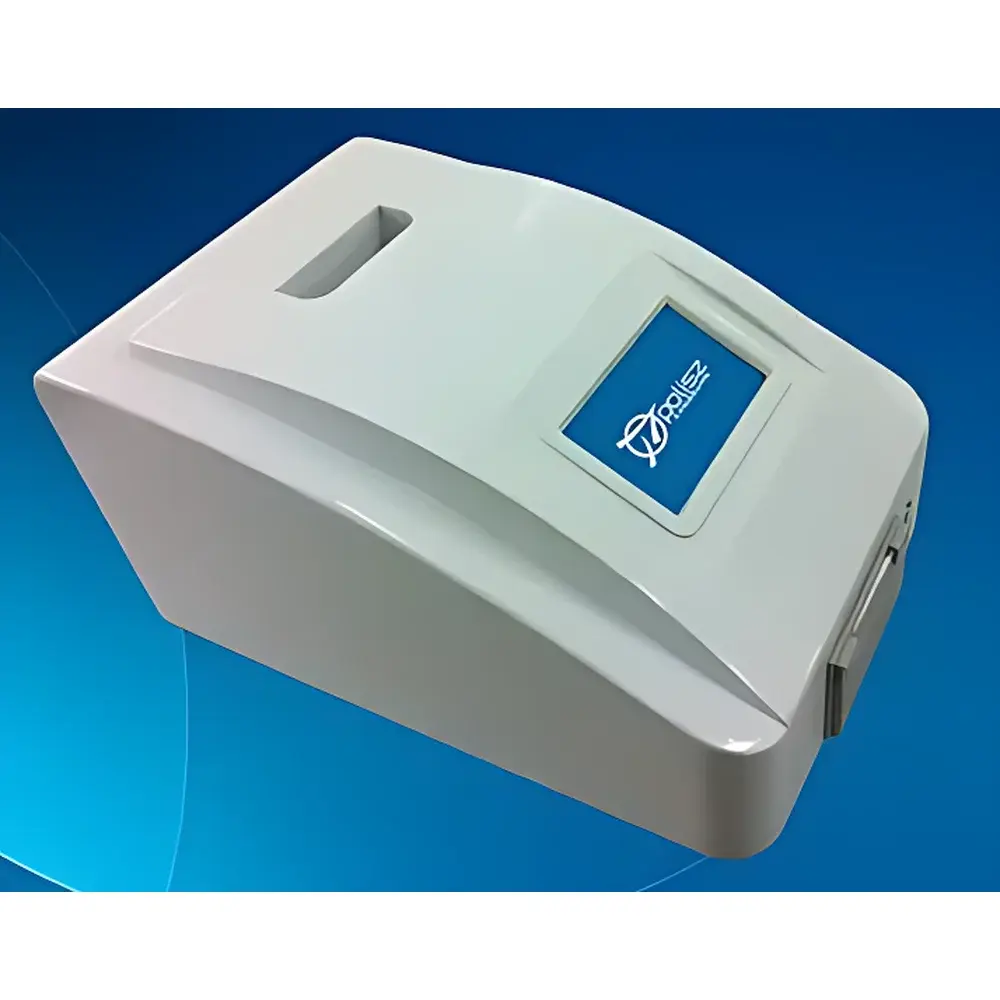
All Precision Instrument bBC-31 Portable Total Organic Carbon (TOC) Analyzer
| Brand | All Precision Instrument |
|---|---|
| Origin | Beijing, China |
| Manufacturer Type | OEM Manufacturer |
| Instrument Type | Portable TOC Analyzer |
| Detection Principle | Direct Conductivity Method |
| Oxidation Method | UV/Persulfate Oxidation |
| Measurement Range | 0–50,000 ppm (as C) |
| Accuracy | ±4% |
| Resolution | 0.001 mg/L |
| Detection Limit | 0.001 mg/L |
| Repeatability | ≤3% |
| Sample Temperature Range | 1–90 °C |
| Analysis Time | <6 minutes |
| Power Supply | 220 V AC |
| Display | Color Touchscreen |
| Compliance | Chinese Pharmacopoeia 2010 Edition |
Overview
The All Precision Instrument bBC-31 Portable Total Organic Carbon (TOC) Analyzer is engineered for precise, on-site quantification of organic carbon in aqueous matrices using the direct conductivity detection principle. It operates by oxidizing dissolved organic carbon (DOC) and particulate organic carbon (POC) to carbon dioxide (CO₂) via combined ultraviolet (UV) irradiation and persulfate chemical oxidation under acidic conditions. The resulting CO₂ dissolves in deionized water to form carbonic acid, inducing a measurable change in solution conductivity proportional to the original TOC concentration. This method eliminates the need for carrier gases, infrared optics, or catalytic combustion furnaces—enabling robust, low-maintenance operation ideal for regulated environments such as pharmaceutical water systems, clean-in-place (CIP) validation, and environmental compliance monitoring.
Key Features
- True portable architecture with integrated battery option (optional), enabling field deployment at sampling points without external gas cylinders or exhaust ducting.
- Embedded Linux-based control system with 7-inch color capacitive touchscreen interface; supports intuitive navigation, multi-language firmware (English/Chinese), and context-sensitive help.
- Optimized for pharmacopeial compliance: validated for USP , EP 2.2.44, and Chinese Pharmacopoeia 2010 Edition Chapter IV L1, including IQ/OQ/PQ documentation support packages.
- No moving parts in the core detection module—no pumps, valves, or IR cells—minimizing mechanical failure risk and reducing scheduled maintenance intervals.
- Zero-consumable operation: requires no catalysts, carrier gases, or proprietary reagents; only high-purity phosphoric acid (for IC removal) and sodium persulfate (oxidant) are used—both commercially available and stable at ambient storage.
- Automated alarm logic with configurable threshold limits (ppb or ppm); triggers visual/audible alerts and optional 4–20 mA analog output for integration into SCADA or DCS systems.
- Internal non-volatile memory stores ≥10,000 test records with full metadata: timestamp, operator ID, sample ID, temperature, conductivity baseline, raw signal, and calculated TOC value.
Sample Compatibility & Compliance
The bBC-31 accepts liquid samples within a viscosity range of 0.8–1.5 cP and total suspended solids (TSS) <5 mg/L. It is validated for purified water (PW), water for injection (WFI), clean steam condensate, and environmental surface rinse waters per ISO 14644-1 and ASTM D511–22. For regulatory traceability, audit trails comply with ALCOA+ principles and support 21 CFR Part 11-compliant electronic signatures when paired with optional secure login modules. All calibration and verification procedures adhere to ISO/IEC 17025:2017 requirements for testing laboratories. System suitability tests—including oxidant blank, system contamination check, and linearity verification across 0.1–1000 ppb—are programmable and auto-documented.
Software & Data Management
Data export is supported via USB 2.0 and RS-232 serial interface in CSV and PDF formats. Optional PC software (TOC-Link Pro v3.2) provides GMP-compliant data review workflows, trend analysis, and automated report generation compliant with Annex 11 and EU GMP guidelines. Raw conductivity waveforms, oxidation kinetics curves, and real-time baseline drift compensation logs are retained for forensic investigation. Electronic records include immutable timestamps, user authentication hashes, and revision-controlled firmware versioning. Audit trail configuration meets FDA expectations for “secure, computer-generated, time-stamped audit trails” as defined in Guidance for Industry: Computerized Systems Used in Clinical Trials (2023).
Applications
Primary use cases include continuous monitoring of pharmaceutical water loops (PW/WFI), routine QC release testing of final rinse solutions in bioprocessing equipment, and environmental compliance reporting for wastewater discharge permits (e.g., EPA Method 415.3). Secondary applications span semiconductor ultrapure water (UPW) qualification per SEMI F63, food & beverage process water validation, and academic research in aquatic biogeochemistry where rapid, field-deployable TOC screening is required. The instrument’s low detection limit (1 ppb) and sub-minute response make it suitable for detecting organic leachables from single-use systems and evaluating membrane integrity in tangential flow filtration (TFF) setups.
FAQ
Does the bBC-31 require daily calibration?
No—calibration is performed semi-annually using certified NIST-traceable potassium hydrogen phthalate (KHP) standards; system suitability checks are recommended before each analytical batch.
Can it measure TOC in seawater or high-salinity samples?
Yes, with optional saline matrix correction enabled; the UV/persulfate oxidation remains effective up to 3.5% NaCl, though dilution may be required for samples >10,000 ppm TDS to maintain conductivity linearity.
Is method transfer support available for regulatory submissions?
Yes—All Precision Instrument provides complete validation protocols, URS documentation, and protocol execution support aligned with ICH Q2(R2) and WHO TRS 1033 Annex 5.
What is the expected service life of the UV lamp?
The low-pressure mercury UV lamp has a rated lifetime of 12,000 hours; intensity decay is continuously monitored and reported in system diagnostics.
How is carryover mitigated between high- and low-concentration samples?
A three-stage rinse cycle (deionized water → acid flush → final rinse) is executed automatically; residual carbon recovery is verified to be <0.5% per ICH Q5C acceptance criteria.
Related Products







