
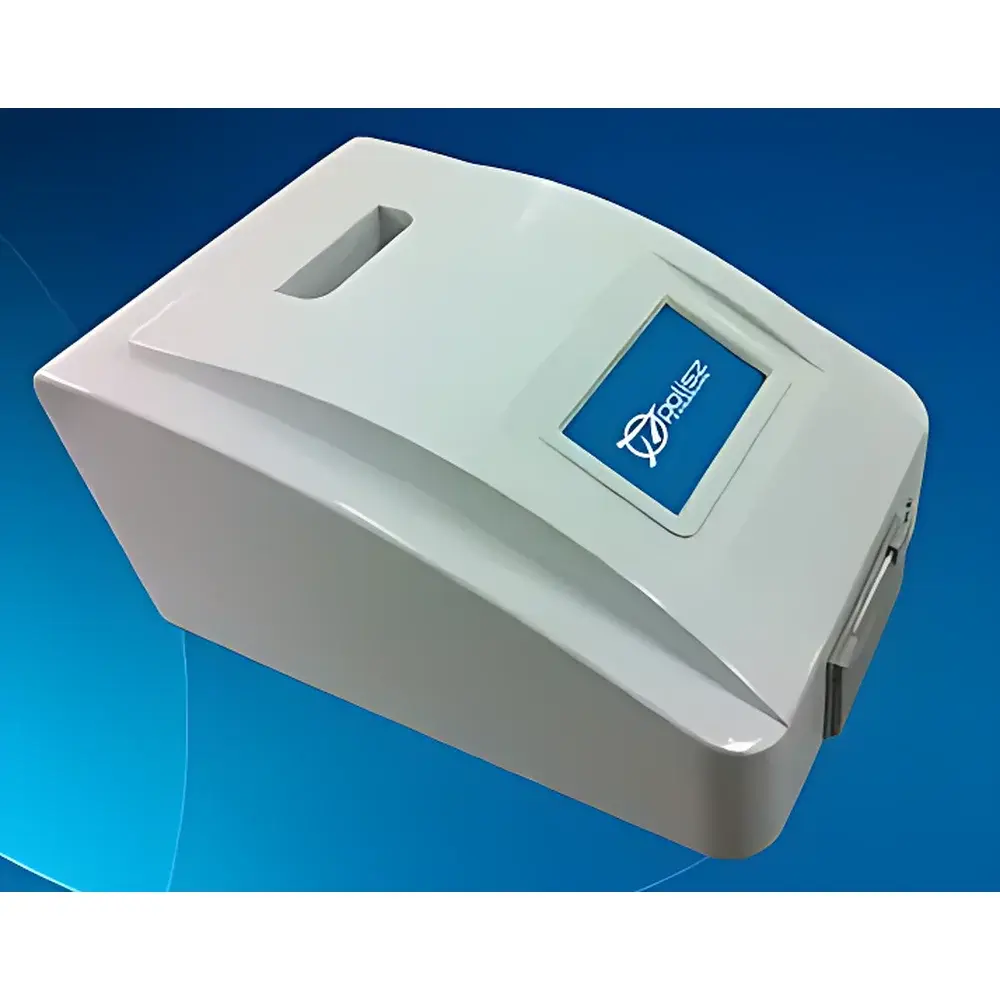
All Precision Instrument BC-40A Portable Total Organic Carbon (TOC) Analyzer
| Brand | All Precision Instrument |
|---|---|
| Origin | Beijing, China |
| Manufacturer Type | Manufacturer |
| Product Category | Domestic |
| Model | BC-40A Standard |
| Instrument Type | Portable TOC Analyzer |
| Detection Principle | Direct Conductivity Method |
| Oxidation Method | UV/Persulfate Oxidation |
| Measurement Range | 0.001–1.000 mg/L |
| Accuracy | ±4% |
| Resolution | 0.001 mg/L |
| Detection Limit | 0.001 mg/L |
| Repeatability | ≤3% |
| Analysis Time | ≤6 minutes |
| Sample Temperature Range | 1–90 °C |
| Power Supply | 220 V AC |
| Display | Color Touchscreen |
Overview
The All Precision Instrument BC-40A Portable Total Organic Carbon (TOC) Analyzer is an engineered solution for high-integrity, regulatory-compliant TOC quantification in ultrapure water systems. It operates on the fundamental principle of differential conductivity measurement following controlled oxidation: organic carbon in aqueous samples is quantitatively converted to CO2 via combined UV irradiation and persulfate chemistry; the resulting CO2 dissolves to form carbonic acid, altering solution conductivity. TOC concentration is calculated as the difference between total carbon (TC) and total inorganic carbon (TIC) — TC measured after full oxidation, TIC measured without oxidation. This method eliminates interference from volatile organic compounds that may escape during combustion-based approaches and avoids the complexity and maintenance burden of catalytic high-temperature furnaces. Designed specifically for pharmaceutical water applications — including purified water (PW), water for injection (WFI), and ultra-pure water (UPW) — the BC-40A meets the stringent performance criteria outlined in USP <645>, EP 2.2.44, and ChP 2015 Edition Chapter 0831. Its compact, battery-ready chassis enables both on-line integration and off-line grab-sample analysis at critical sampling points across clean utility networks.
Key Features
- True portable architecture with integrated rechargeable power management — no external gas cylinders, reagents, or consumable catalysts required.
- UV/persulfate dual-oxidation module delivering >95% oxidation efficiency across the full 1–1000 ppb (0.001–1.000 mg/L) range, validated per ASTM D5905 and ISO 8245 protocols.
- High-stability conductivity cell with NIST-traceable cell constant verification capability using certified standard resistors and conductivity reference solutions.
- Embedded Linux-based control system with 7-inch color capacitive touchscreen interface — intuitive navigation, password-protected configuration access, and audit trail-enabling firmware.
- On-board data storage supporting ≥10,000 test records with timestamp, operator ID, sample ID, calibration history, and raw conductivity traces.
- Automatic over-limit alarm with configurable digital output (4–20 mA or relay contact closure) for integration into SCADA or BMS systems.
- Zero-maintenance design: no moving parts, no pumps requiring replacement, no ozone generators or mercury lamps — optimized for GMP environments where uptime and qualification stability are paramount.
Sample Compatibility & Compliance
The BC-40A is validated for use with low-conductivity matrices typical of pharmaceutical water systems (conductivity < 2.0 µS/cm at 25 °C). It accommodates grab samples (vial-based) and can be interfaced with continuous flow cells for unattended on-line monitoring. All operational parameters — including oxidation dwell time, conductivity acquisition window, and baseline drift compensation — are configurable to align with site-specific validation protocols. The analyzer supports full IQ/OQ/PQ documentation packages compliant with FDA 21 CFR Part 11, EU Annex 11, and ICH Q2(R2) guidelines. Built-in electronic signatures, user role-based access control, and immutable audit logs ensure data integrity for GLP/GMP-regulated laboratories. Calibration verification follows USP <645> requirements using NIST-traceable KCl standards and certified TOC reference materials (e.g., potassium hydrogen phthalate).
Software & Data Management
Data export is supported via USB 2.0 and optional Ethernet/Wi-Fi modules, generating CSV or PDF reports compliant with ALCOA+ principles (Attributable, Legible, Contemporaneous, Original, Accurate, Complete, Consistent, Enduring, Available). The embedded software includes automated system suitability testing (SST), blank subtraction routines, and real-time drift monitoring. For enterprise deployment, optional PC-based software provides centralized instrument fleet management, trend analysis (including Shewhart control charts), and electronic batch record (EBR) integration. All firmware updates are digitally signed and version-locked to prevent unauthorized modification — a requirement under cybersecurity provisions of IEC 62443-3-3.
Applications
- Pharmaceutical water systems: routine TOC surveillance of PW, WFI, and UPW in manufacturing suites and QC labs.
- Clean-in-place (CIP) and sterilize-in-place (SIP) validation: TOC profiling before/after cycle execution to demonstrate organic residue removal.
- Environmental monitoring of low-TOC effluents from semiconductor fab ultrapure water loops or biotech process skids.
- Electronics-grade water quality assurance in wafer fabrication facilities where sub-ppb TOC excursions risk microcontamination.
- Method transfer support for compendial compliance (ChP, USP, EP) and regulatory inspection readiness.
FAQ
Does the BC-40A require carrier gas or chemical reagents during operation?
No. It operates exclusively on UV/persulfate oxidation with no compressed air, oxygen, or acid reagent delivery systems — eliminating associated infrastructure, safety hazards, and consumable costs.
Can the instrument be qualified per FDA 21 CFR Part 11 requirements?
Yes. It includes electronic signature capability, audit trail logging, user authentication, and secure data archiving — all configurable to meet Part 11 technical and procedural controls.
What is the recommended calibration frequency for GMP use?
Initial calibration verification upon installation (IQ), followed by daily system suitability testing (SST) and weekly full calibration using certified TOC standards — consistent with USP <645> and internal SOPs.
Is temperature compensation applied during conductivity measurement?
Yes. Real-time temperature sensing (±0.2 °C accuracy) drives automatic conductivity compensation to 25 °C, ensuring traceable results across the 1–90 °C operating range.
How is method robustness ensured against matrix effects in high-purity water?
The analyzer employs dual-channel differential conductivity measurement with dynamic baseline correction and adaptive gain control — minimizing impact from ionic background fluctuations common in low-conductivity samples.







