
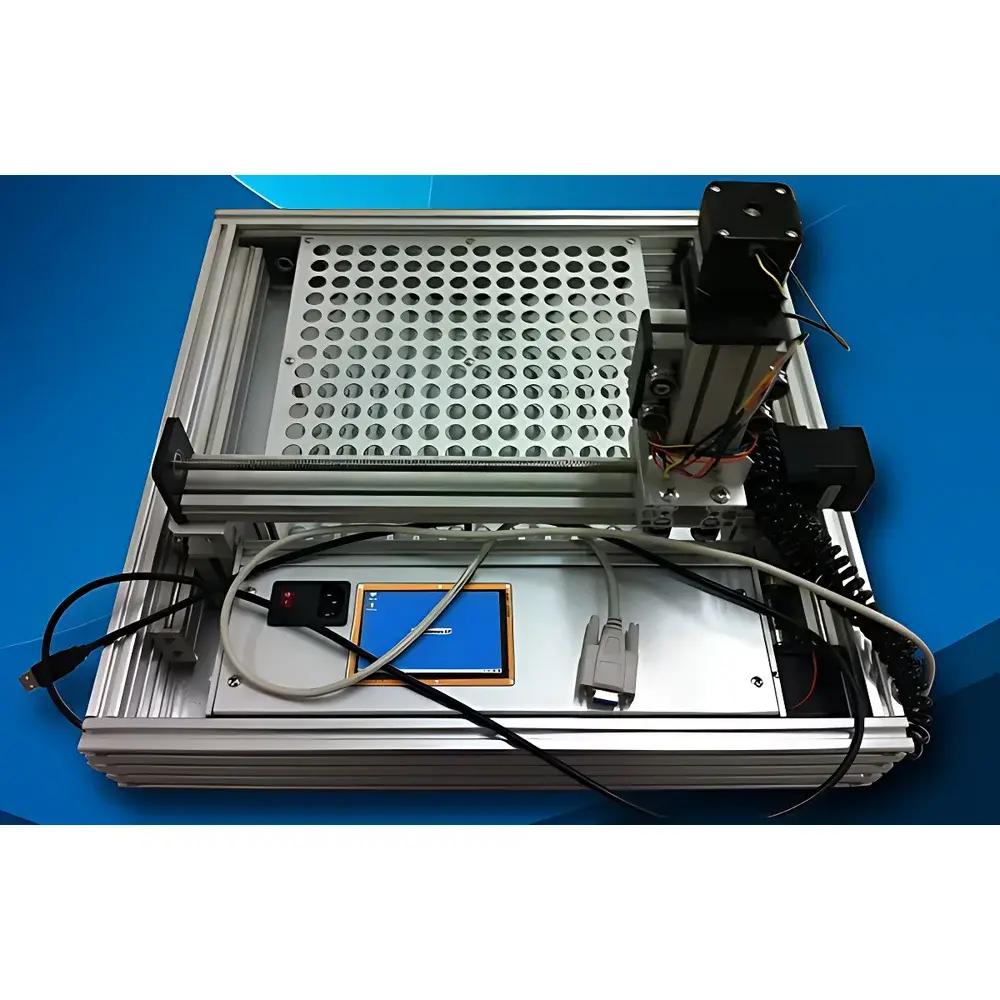
All Precision Instrument BKQ-20 Multifunctional Gas Chromatography Autosampler
| Brand | All Precision Instrument |
|---|---|
| Origin | Beijing, China |
| Manufacturer Type | OEM Manufacturer |
| Instrument Type | GC Autosampler |
| Model | BKQ-20 |
| Sample Vial Capacity | 12 mL |
| Maximum Vial Count | 196 (14 × 14 array) |
| Positioning Accuracy | ±0.01 mm |
| Power Input | AC 220 V |
| Display | Blue TFT LCD |
| Dimensions (W × D × H) | 490 mm × 482 mm × 330 mm |
| GC Synchronization | Triggered via TTL/relay signal |
| Vacuum Reconditioning | Integrated for vial reuse |
| Communication Interfaces | RS-232, USB, optional Ethernet |
| Sample Injection Modes | Headspace, direct gas loop, split/splitless compatible |
Overview
The All Precision Instrument BKQ-20 Multifunctional Gas Chromatography Autosampler is an engineered solution designed to eliminate manual gas sampling bottlenecks in high-throughput environmental and atmospheric research laboratories. Unlike conventional syringe-based or bag-sampling workflows—prone to operator variability, carryover, and pressure-dependent volume errors—the BKQ-20 implements a precision-engineered龙门 (gantry-style) three-axis motion system to deliver reproducible, pressure-stabilized headspace injections into GC inlets. Its core architecture supports quantitative analysis of trace-level greenhouse gases (CO₂, CH₄, N₂O) and volatile organic compounds (VOCs) under controlled pressure conditions up to 0.3 MPa, ensuring consistent sample introduction across extended unattended runs. The autosampler operates synchronously with GC systems—including Agilent 6890A and 7890A series—via hardware-triggered TTL or relay signals, maintaining strict phase alignment between injection timing and oven ramp profiles. This deterministic synchronization is critical for retention time stability and peak area reproducibility in regulated applications such as ISO 14064-3 verification or EPA Method TO-15 compliance studies.
Key Features
- Gantry-mounted XYZ positioning system with ±0.01 mm repeatability and auto-homing capability
- 196-position sample tray (14 × 14 configuration), supporting standard 12 mL headspace vials
- Integrated vacuum reconditioning module for post-injection vial evacuation—enabling ≥5-cycle reuse without cross-contamination
- Digital control platform based on industrial-grade microcontroller with real-time feedback from optical encoders
- High-subdivision stepper motor drive system ensuring silent, vibration-free operation during needle insertion and plunger actuation
- Programmable per-vial injection parameters: dwell time, injection volume, purge cycles, and rinse solvent selection
- Blue TFT LCD interface with intuitive touch navigation; supports English, Chinese, Spanish, and French language switching
- Modular mechanical design with full aluminum alloy chassis—EMI-shielded, thermally stable, and compliant with IEC 61000-6-2 immunity standards
- Multi-interface connectivity: RS-232 (default), USB 2.0, and optional Ethernet for SCADA integration or LIMS synchronization
Sample Compatibility & Compliance
The BKQ-20 accommodates industry-standard 12 mL crimp-top headspace vials (e.g., Agilent 5183-4477) and interfaces seamlessly with split/splitless, PTV, and cold-on-column inlets. It supports both pressurized headspace injection and loop-based gas sampling protocols. The system meets fundamental requirements for GLP-compliant environments: audit-trail-capable parameter logging (timestamped injection records stored locally), user-access-level authentication (admin/operator modes), and hardware interlocks for overtravel and thermal limit protection. While not certified to FDA 21 CFR Part 11 out-of-the-box, the firmware architecture permits validation-ready configuration—including electronic signature support and data integrity safeguards—when deployed with validated chromatography data systems (CDS) such as OpenLab CDS or Chromeleon.
Software & Data Management
The embedded firmware provides local setup and diagnostics via the TFT interface; no PC dependency is required for routine operation. For advanced method development and remote monitoring, optional Windows-based configuration software enables drag-and-drop sequence building, calibration curve import, and QC flagging (e.g., failed vacuum recovery, missed trigger). All injection events are logged with metadata: vial ID, timestamp, GC trigger latency, actual injection volume (calculated from pressure decay profile), and system status flags. Export formats include CSV and XML, facilitating ingestion into laboratory information management systems (LIMS) or statistical process control (SPC) platforms. Firmware updates are performed via USB stick with SHA-256 signature verification to ensure integrity.
Applications
- Long-term atmospheric monitoring of greenhouse gases (CH₄, CO₂, N₂O) in field-deployable GC setups
- Soil flux chamber studies requiring high-frequency, low-drift gas sampling at sub-ppb levels
- Method validation for ASTM D6348 (determination of VOCs in ambient air) and ISO 16017-1
- Quality control of industrial gas mixtures in semiconductor manufacturing and specialty chemical production
- Automated calibration gas delivery for multi-point response factor verification in environmental labs
- Unattended analysis of biogas composition (H₂S, NH₃, siloxanes) in anaerobic digestion facilities
FAQ
Is the BKQ-20 compatible with non-Agilent GC systems?
Yes—it supports TTL/relay triggering and analog voltage signaling, enabling integration with Thermo Fisher ISQ, Shimadzu GC-2030, PerkinElmer Clarus, and custom-built GC platforms.
What maintenance intervals are recommended for optimal performance?
Vial septa should be replaced every 100 injections; the syringe needle requires ultrasonic cleaning in acetone every 500 cycles; the internal vacuum pump oil must be changed every 6 months under continuous operation.
Can the autosampler perform internal standard addition?
Yes—programmable dual-syringe configuration allows automated spiking of internal standards prior to GC injection, with independent volume control and rinse steps.
Does it support dynamic headspace or thermal desorption modules?
Not natively—but the open communication protocol permits third-party controller integration for staged heating or cryo-focusing sequences.
How is data integrity ensured during power interruption?
Non-volatile flash memory retains method files and last 1,000 injection logs; upon reboot, the system resumes from the last completed vial position with automatic GC resynchronization.




