
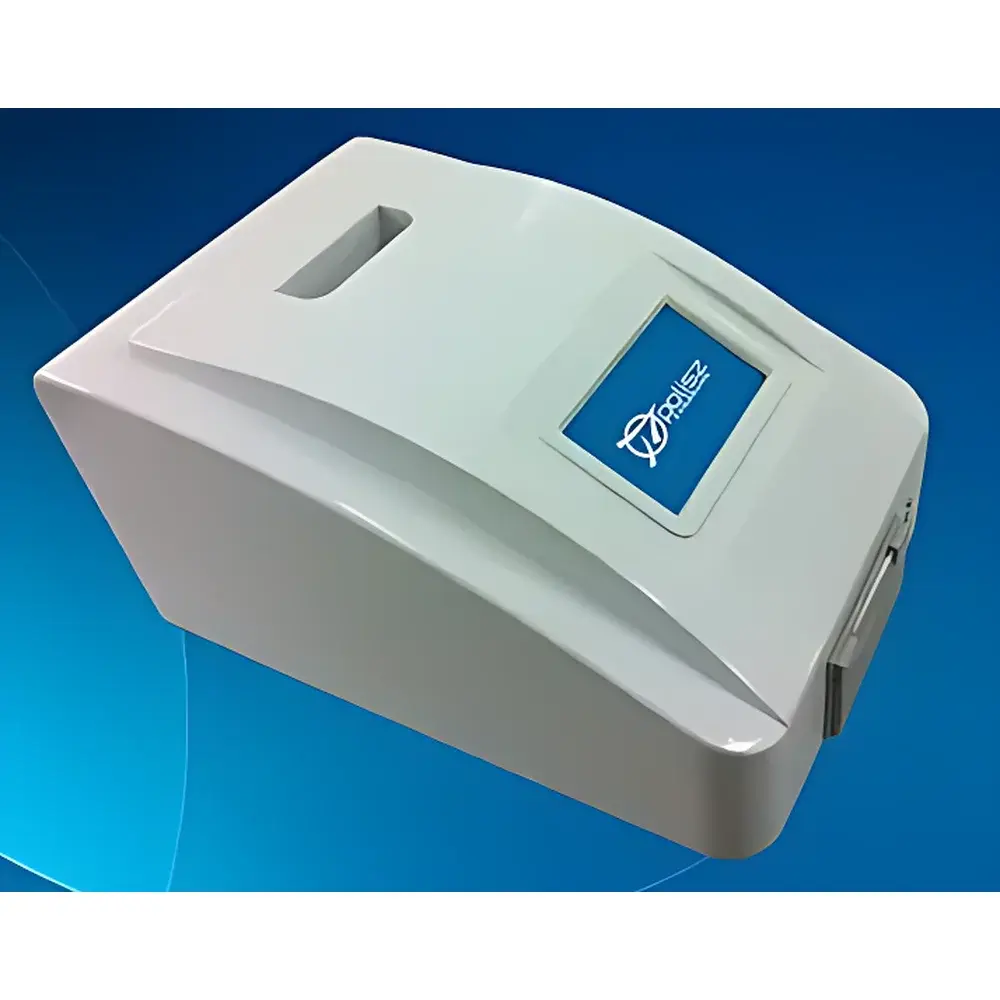
All Precision Instrument BQS-19 Portable Automated Filter Integrity Tester
| Key | Brand: All Precision Instrument |
|---|---|
| Model | BQS-19 |
| Origin | Beijing, China |
| Manufacturer Type | OEM Manufacturer |
| Power Supply | 170–240 V AC, 50/60 Hz, 100 W |
| Max Operating Pressure | 7999 mbar |
| Min Inlet Pressure | 3000 mbar |
| Test Pressure Range | 500–6900 mbar |
| Pressure Sensitivity | ±1.0 mbar |
| Bubble Point Accuracy | ±60 mbar |
| Dimensions (W×D×H) | 240 × 320 × 260 mm |
| Display | 5.7–7″ color touchscreen (256 colors), GUI in English/Chinese |
| Operating Environment | 0–50 °C, 10–80% RH |
| Data Storage | 32 GB internal (≥1 million test records) |
| Communication Interface | RS232/USB/Ethernet (with PC software for remote control & audit trail) |
| Compliance | Designed to support GMP, FDA 21 CFR Part 11, and ISO 13408-2 requirements |
| Test Modes | Bubble Point, Diffusion Flow, Water Intrusion |
| Typical Test Duration | Bubble Point (2 ± 2 min), Diffusion Flow (7 ± 2 min), Water Intrusion (7 ± 2 min), System Leak Check (3 ± 1 min) |
| Printing | Integrated thermal printer (bilingual report with test parameters, results, and real-time curve) |
Overview
The All Precision Instrument BQS-19 Portable Automated Filter Integrity Tester is an engineered solution for quantitative, non-destructive assessment of membrane filter integrity in regulated biopharmaceutical, sterile manufacturing, and upstream/downstream processing environments. It operates on three internationally recognized physical principles: bubble point testing (capillary flow theory), diffusion flow measurement (Fick’s law of gas dissolution and molecular diffusion across wetted membranes), and water intrusion testing (hydrophobic pore penetration under sub-critical pressure). Unlike qualitative visual inspection or manual pressure decay methods, the BQS-19 implements closed-loop digital pneumatic control based on ARM9 architecture and Windows CE 6.0 real-time OS—enabling precise, repeatable, and traceable execution of ASTM F838-22, ISO 13408-2, and PDA Technical Report No. 26-compliant protocols. Its portable form factor (240 × 320 × 260 mm) and integrated thermal printer support both at-line verification during filter validation and mobile deployment across cleanroom suites.
Key Features
- Digital Automatic Gas Control Subsystem: Replaces legacy mechanical throttling valves with a feedback-controlled solenoid manifold—ensuring stable pressure ramping and accurate endpoint detection even under variable supply pressure (3000–7999 mbar).
- Auto-Exit Upon Pass Condition: Terminates test sequence immediately after meeting pre-defined pass criteria—reducing unnecessary exposure of sensitive filters to elevated pressure and extending service life.
- Bilingual Touchscreen Interface (English/Chinese): 5.7–7″ high-contrast display with contextual on-screen prompts and “one-touch repeat” functionality for standardized test re-execution.
- GMP-Compliant User Management: Role-based access control (operator, supervisor, administrator) with password customization, session logging, and parameter lockout for critical settings.
- Integrated Thermal Printer: Generates auditable reports including test type, pressure profile, pass/fail status, timestamp, operator ID, and real-time pressure decay curve—fully compliant with ALCOA+ data integrity principles.
- 32 GB Internal Flash Storage: Retains ≥1 million full test records (including raw pressure vs. time datasets, metadata, and graphical traces); supports unlimited archival via USB or Ethernet to validated LIMS or ELN systems.
- Multi-Protocol Support: Validated for disc membranes (Φ25–Φ300 mm), standard cartridges (2.5″–40″, 1–9 core), capsule filters, mini-cartridges, and hydrophobic air/gas vent filters.
Sample Compatibility & Compliance
The BQS-19 accommodates a broad spectrum of filtration configurations without hardware modification. It supports wetted testing of hydrophilic membranes (e.g., PVDF, PES, nylon) using aqueous buffers and hydrophobic membranes (e.g., PTFE, PP) via water intrusion—eliminating reliance on hazardous organic solvents such as IPA. This enables post-sterilization (SIP) integrity verification while preserving filter hydrophobicity and installation integrity. The system meets foundational requirements for compliance with EU Annex 1 (2022), USP , ISO 13408-2, and FDA Guidance for Industry: Sterile Drug Products Produced by Aseptic Processing (2004). Audit trail functionality—including user actions, parameter changes, and electronic signatures—is structured to align with FDA 21 CFR Part 11 Subpart C technical controls for electronic records and signatures.
Software & Data Management
The embedded Windows CE 6.0 platform hosts a deterministic real-time test engine with millisecond-level pressure sampling resolution. All test data—including raw analog-to-digital converter outputs, calculated diffusion rates (mL/min), bubble point thresholds (mbar), and water intrusion slopes (mL/min/mbar)—are stored with immutable timestamps and operator identifiers. The included PC application provides secure bidirectional communication (RS232/USB/Ethernet), enabling remote initiation, live monitoring, batch export, and PDF report generation. Data exports conform to CSV and XML formats compatible with industry-standard validation tools (e.g., JMP, Minitab, LabArchives). System-generated logs include boot diagnostics, pressure sensor calibration history, and automatic safety interlock events—critical for regulatory inspections and periodic review per ICH Q5A(R2) and WHO TRS 986 Annex 6.
Applications
The BQS-19 serves as a primary tool for process validation and routine release testing across multiple unit operations: pre-use post-sterilization (PUPSIT) integrity verification of final fill filters; in-process checks of tangential flow filtration (TFF) cassettes; qualification of vent filters in bioreactor and storage tank applications; and end-of-life assessment of compressed air and nitrogen line filters. Its water intrusion capability uniquely supports regulatory expectations for hydrophobic filter integrity confirmation after steam sterilization—addressing limitations of traditional IPA-based methods per PDA TR75. In vaccine and monoclonal antibody manufacturing, it directly supports risk-based approaches outlined in ICH Q5D and Q9 by providing quantitative metrics correlated to microbial retention performance (e.g., log reduction value, LRVC).
FAQ
What regulatory standards does the BQS-19 support?
It is designed to facilitate compliance with ISO 13408-2, USP , ASTM F838-22, EU GMP Annex 1 (2022), and FDA 21 CFR Part 11 when deployed within a validated environment with documented SOPs.
Can the instrument perform water intrusion testing on hydrophobic filters post-SIP?
Yes—water intrusion mode operates below the water breakthrough pressure and requires no solvent handling, making it suitable for in-situ verification after steam-in-place cycles.
How is data integrity ensured during electronic record storage?
All records include cryptographic hash signatures, immutable timestamps, user authentication logs, and automated backup triggers—meeting ALCOA+ and Part 11 technical control requirements.
Does the system support multi-user permission levels?
Yes—three-tier role management (Operator, Supervisor, Administrator) enforces parameter edit restrictions, password policy enforcement, and audit trail visibility controls.
What is the maximum allowable upstream volume for diffusion flow testing?
The system dynamically calculates diffusion rate (D = ΔP·V / T·Pa) and supports configurable upstream volumes up to 10 L via external vessel integration; default internal chamber volume is 120 mL.






