
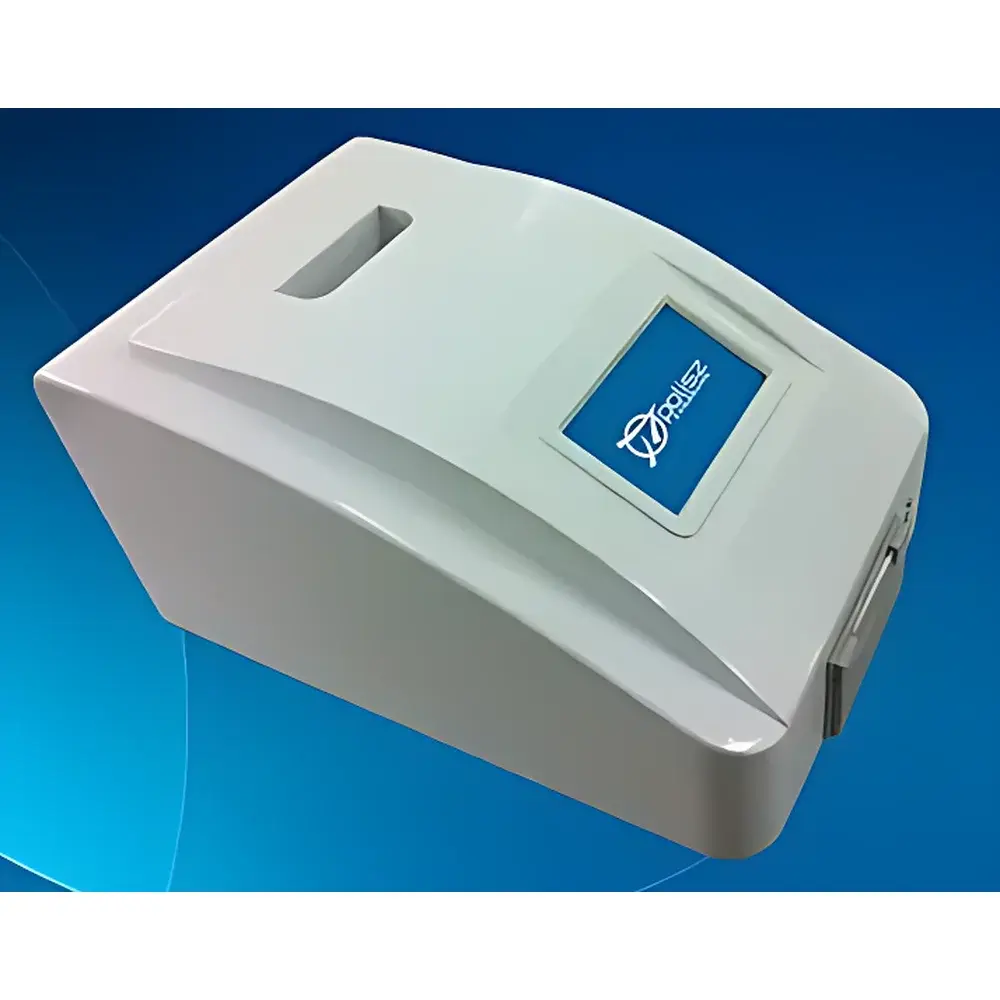
All Precision Instrument BQS Filter Integrity Tester
| Brand | All Precision Instrument |
|---|---|
| Origin | Beijing, China |
| Manufacturer Type | Manufacturer |
| Country of Origin | China |
| Model | BQS |
| Price Range | USD 1,400 – 2,800 |
| Power Supply | 100–240 V AC, 50/60 Hz, 100 W |
| Max Operating Pressure | 9000 mbar (145 psi) |
| Min Inlet Pressure | 4000 mbar (58 psi) |
| Dimensions | 400 × 380 × 335 mm (W × D × H) |
| Test Pressure Range | 100–8000 mbar (1.5–116 psi) |
| Accuracy | Net Volume Test ±4% |
| Environmental Conditions | 15–35 °C |
| Test Duration | Net Volume Test 5±2 min |
| Water Intrusion Test | Set Time + 5±2 min |
| Display | 5.7″ backlit monochrome LCD |
| Data Interface | RS232 serial port |
| Language Options | English / Chinese |
| Storage Capacity | 500 test records (incl. curves) |
| Print Output | Dot-matrix printer (Chinese/English), full parameter + result + curve |
| Sample Compatibility | Disc membranes Φ25–Φ300 mm |
Overview
The All Precision Instrument BQS Filter Integrity Tester is an engineered solution for quantitative, non-destructive integrity verification of hydrophilic and hydrophobic sterile-grade filtration assemblies used in pharmaceutical, biotechnology, and medical device manufacturing. It operates on three internationally recognized physical principles—bubble point, diffusive flow, and water intrusion—each aligned with ISO 13408-2, ASTM F838-22, and USP guidelines for filter validation. Unlike legacy pressure-decay instruments, the BQS employs advanced apparent diffusive flow analysis, which correlates quantitatively with microbial challenge data per HIMA (Hydrophobic Interaction Microbial Assay) and PDA TR26. This methodology enables predictive assessment of pore structure integrity—not merely binary pass/fail outcomes—by resolving subtle changes in membrane tortuosity, wetting uniformity, and seal integrity. The system integrates digital pneumatic control architecture to maintain stable upstream pressure despite inlet supply fluctuations, ensuring reproducible results across variable plant air networks.
Key Features
- Multi-method integrity testing: bubble point, diffusive flow (at 80% of bubble point pressure), combined bubble point + diffusive flow, pressure hold, and water intrusion for hydrophobic filters
- Digital automatic gas inlet control subsystem—replacing mechanical needle valves—to guarantee consistent pressure ramping and stabilization under varying supply conditions
- Real-time graphical display of upstream pressure vs. diffusive flow rate during test execution, enabling immediate visual diagnosis of membrane behavior
- Auto-exit function upon successful test completion, minimizing unnecessary exposure of validated filters to over-pressurization
- Full GMP-compliant audit trail: user-level access control (operator, supervisor, administrator), password customization, and timestamped parameter logging
- Onboard storage of 500 complete test records—including raw pressure/time curves, test parameters, and pass/fail verdicts—with export capability via RS232 to LIMS or SCADA systems
- Integrated thermal dot-matrix printer supporting bilingual (English/Chinese) output of test reports compliant with FDA 21 CFR Part 11 requirements for electronic records
- Self-diagnostic routine verifying system leak integrity, sensor calibration status, and safety interlock functionality prior to each test cycle
- ARM9-based embedded controller running Windows CE 6.0 OS, supporting deterministic real-time response and firmware upgradability
Sample Compatibility & Compliance
The BQS accommodates a comprehensive range of sterile filtration configurations without requiring disassembly from process lines: disc membranes (Φ25–Φ300 mm), standard pleated cartridges (2.5″–40″, 1–9 core), capsule filters, mini-cartridges, tank vent filters, and compressed gas sterilizing assemblies. Its high-resolution transducer array and low-noise signal processing module enable accurate measurement even on large-surface-area filters (>10 m²), where conventional instruments suffer from volumetric uncertainty. All test methods comply with ISO 13408-2 Annex A (integrity test selection), ASTM F838-22 (bacterial retention testing correlation), and USP and (sterile filtration assurance). Water intrusion mode satisfies the requirements for post-sterilization hydrophobic filter verification per PDA Technical Report No. 26 and EMA Annex 1 (2022), eliminating reliance on hazardous solvents such as IPA.
Software & Data Management
The BQS includes a Windows-based PC application for remote configuration, centralized test scheduling, and historical data aggregation across multiple instruments. Data exports are structured in CSV and PDF formats, preserving metadata including operator ID, timestamp, environmental conditions, and instrument serial number. Audit trails record all parameter modifications, user logins/logouts, and test initiation/termination events with SHA-256 hashing for tamper-evidence. The system supports 21 CFR Part 11 compliance through electronic signatures, role-based permissions, and immutable record retention. Optional integration with MES or SAP QM modules is available via OPC UA or Modbus TCP protocols.
Applications
- Pre- and post-sterilization integrity verification of liquid sterilizing filters in API and finished dosage form manufacturing
- Validation of compressed air and nitrogen filtration systems serving Grade A cleanrooms
- Integrity testing of vent filters on stainless-steel bioreactors, media tanks, and WFI storage vessels
- Final filter release testing for parenteral drug products prior to filling
- Water-for-injection (WFI) point-of-use filter qualification in purified water distribution loops
- Supporting regulatory submissions (FDA, EMA, PMDA) with documented evidence meeting Annex 1, ICH Q5A(R2), and ISO 13485 requirements
FAQ
What regulatory standards does the BQS support?
It meets ISO 13408-2, ASTM F838-22, USP , PDA TR26, EU GMP Annex 1 (2022), and FDA 21 CFR Part 11 for electronic records and signatures.
Can the BQS test hydrophobic filters without IPA?
Yes—the water intrusion method eliminates solvent use and permits post-steam sterilization testing while confirming both pore integrity and correct installation.
How does diffusive flow testing improve reliability over bubble point alone?
Diffusive flow provides a quantitative metric correlated with microbial retention performance, detects gradual degradation undetectable by bubble point, and reduces mechanical stress on filters by operating below the critical bubble point pressure.
Is remote monitoring supported?
Yes—via RS232 interface and included PC software, enabling centralized control, real-time status viewing, and automated report generation across distributed manufacturing sites.
Does the instrument support GMP audit requirements?
Yes—it enforces user authentication, logs all critical actions with timestamps, prevents unauthorized parameter changes, and generates printable, tamper-resistant reports with full traceability.







