
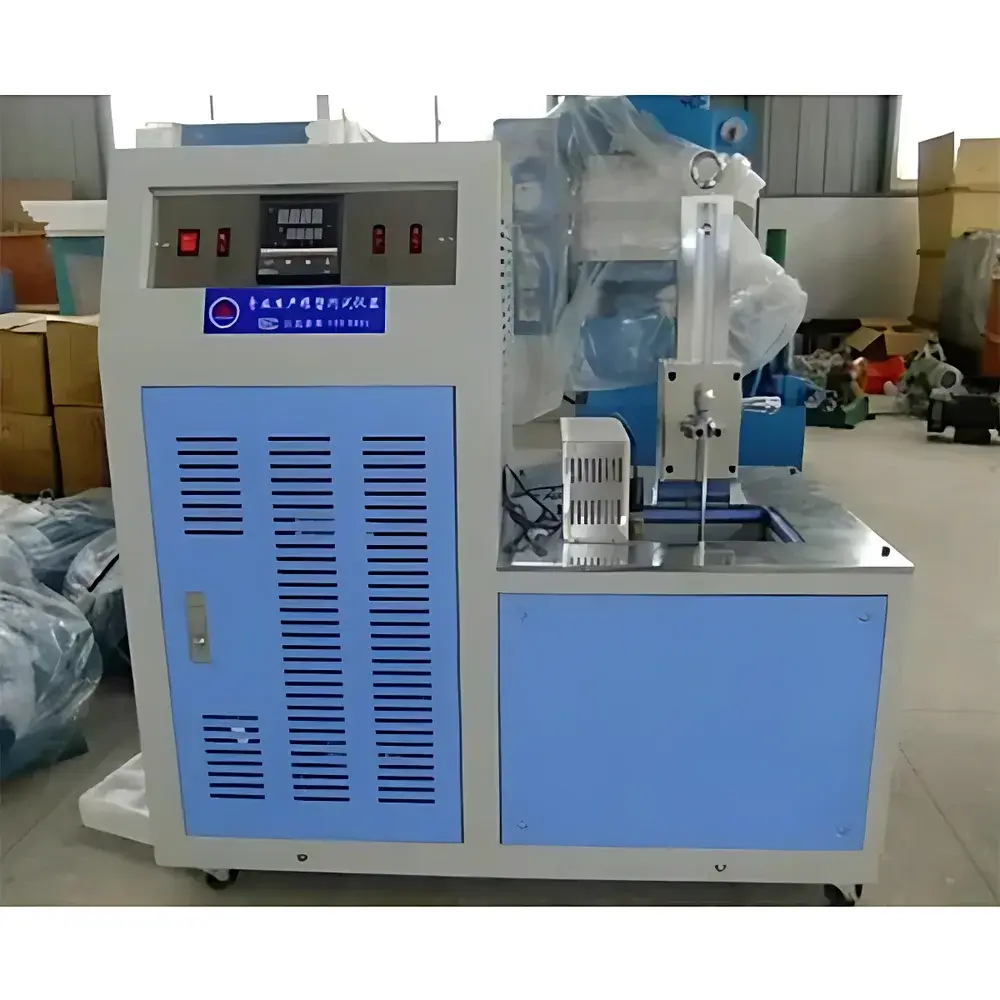
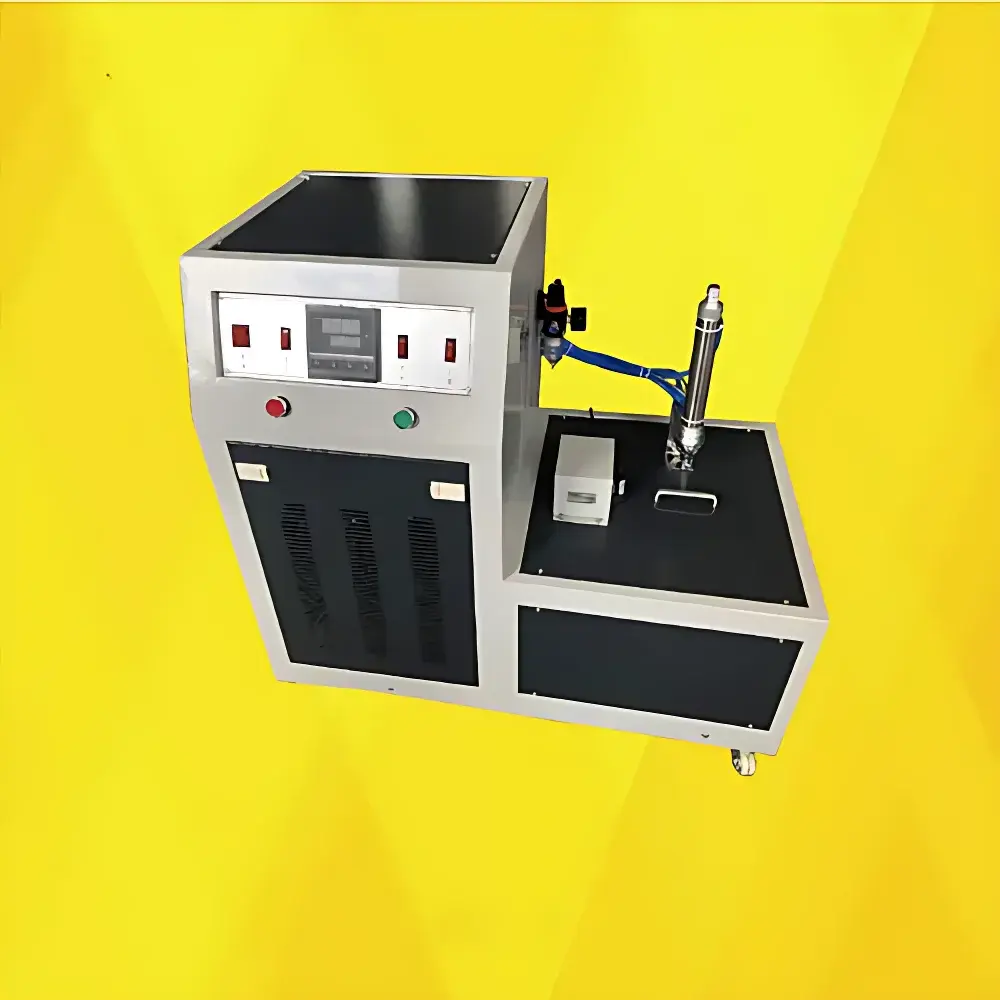
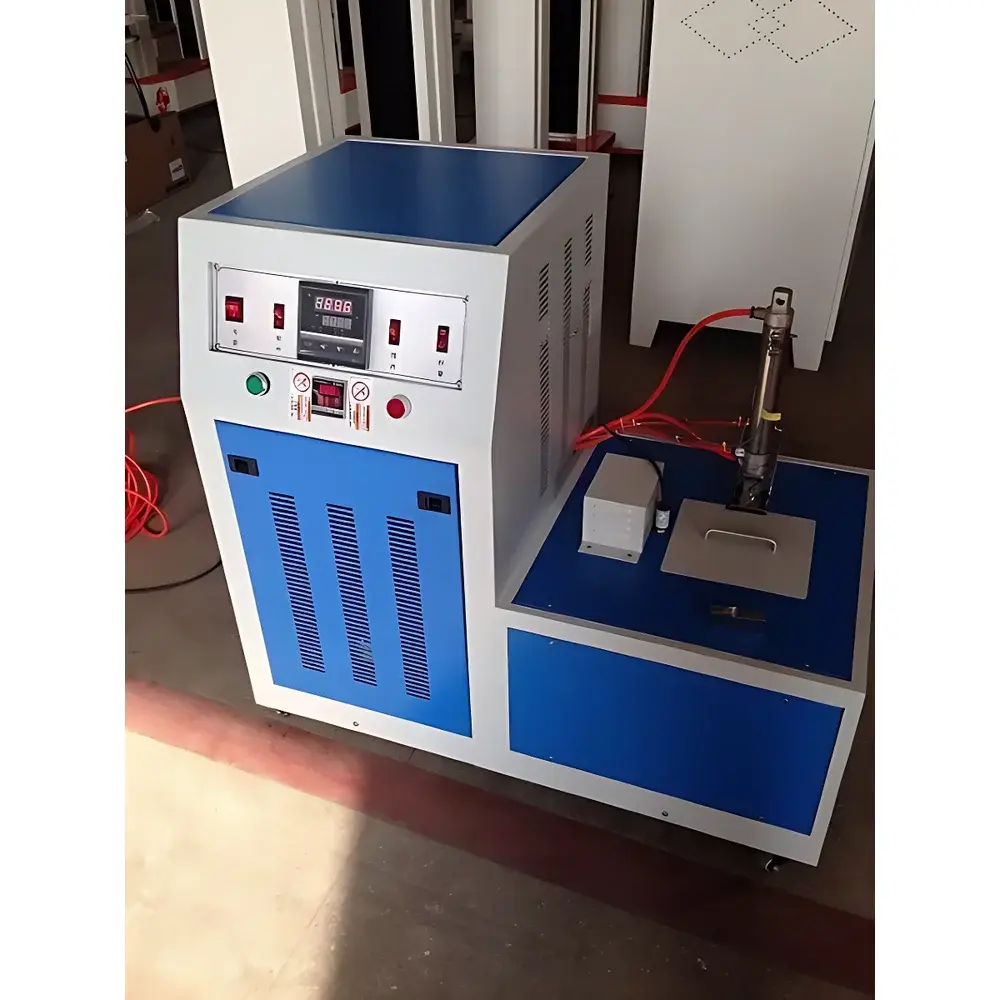
All Precision Instrument BWD-D Cryogenic Brittleness Tester for Vulcanized Rubber
| Brand | All Precision Instrument |
|---|---|
| Origin | Beijing, China |
| Manufacturer Type | Direct Manufacturer |
| Country of Origin | China |
| Model | BWD-D |
| Temperature Control Range | Ambient to –70 °C (ambient ≤25 °C) |
| Temperature Stability | ±0.3 °C |
| Cooling Rate | ~2.5 °C/min (0 °C to –30 °C) |
| Internal Chamber Dimensions | 280 × 170 × 120 mm (L×W×H) |
| External Dimensions | 900 × 500 × 800 mm (L×W×H) |
| Sample Capacity | 1 test fixture (4 rubber specimens or 15 plastic specimens per test cycle) |
| Timer Range | 0–99 min, 1-s resolution |
| Cooling Medium | Ethanol or other non-freezing liquid |
| Stirring Motor Power | 8 W |
| Power Supply | 220–240 V AC, 50 Hz, 1.5 kW |
| Operating Ambient Limit | ≤25 °C |
| Impact Head Radius | 1.6 ± 0.1 mm |
| Impact Gap (head to specimen holder) | 6.4 ± 0.3 mm |
| Horizontal Offset (impact centerline to holder centerline) | 8 ± 0.3 mm |
Overview
The All Precision Instrument BWD-D Cryogenic Brittleness Tester is a precision-engineered apparatus designed to determine the brittle temperature of vulcanized rubber and thermoplastic polymers under controlled low-temperature conditions. It operates on the principle of impact-induced fracture assessment in accordance with standardized cryogenic shock testing protocols. The instrument implements a dual-mode thermal regulation system—combining vapor-compression refrigeration with proportional electric heating—to achieve stable, reproducible sub-zero environments. Its mechanical design integrates a vertically actuated impact mechanism, a precisely dimensioned specimen holder, and a thermally homogeneous cooling bath, enabling compliance with internationally recognized test methods including GB 1682, GB 5470–2008, and HG 2-162–1965. The device delivers high repeatability in brittle point determination by maintaining tight thermal uniformity (±0.3 °C) and precise mechanical alignment across repeated test cycles—critical for quality control laboratories performing material qualification in automotive, aerospace, and industrial sealing applications.
Key Features
- Integrated refrigeration system with adjustable cooling rate profiles across three temperature zones (0 °C to –30 °C, –30 °C to –40 °C, –40 °C to –70 °C), optimized for both rapid cooldown and fine-tuned stabilization
- Proportional heating compensation circuitry that dynamically offsets residual refrigeration load near setpoint, ensuring ±0.3 °C thermal stability during specimen dwell periods
- Stainless-steel cooling bath with submerged impeller-driven circulation (8 W motor) to eliminate thermal stratification and ensure uniform medium temperature throughout the 280 × 170 × 120 mm working volume
- Dual-specimen-holder configuration: accommodates either four rubber test pieces (per ASTM D1043 / GB 1682 geometry) or fifteen plastic specimens (per GB 5470–2008 layout) in a single fixture
- Mechanically gated impact assembly with calibrated drop height, fixed 1.6 ± 0.1 mm hemispherical impactor tip, and repeatable 6.4 ± 0.3 mm clearance between impactor and specimen surface
- Digital timer with 1-second resolution and automatic start/stop triggering synchronized to specimen immersion and impact events
- Over-temperature and low-level coolant alarm circuitry for operational safety and protocol integrity
Sample Compatibility & Compliance
The BWD-D supports standard dumbbell- or strip-shaped specimens conforming to GB 1682 (vulcanized rubber) and GB 5470–2008 (plastics). Specimen dimensions must comply with nominal thicknesses of 2.0 ± 0.2 mm and width of 5.0 ± 0.2 mm. The instrument’s mechanical tolerances—including impactor radius (1.6 ± 0.1 mm), gap distance (6.4 ± 0.3 mm), and lateral offset (8 ± 0.3 mm)—are traceably aligned to national metrological verification requirements. Test reports generated using this system are admissible in GLP-compliant environments when paired with documented calibration records for temperature sensors (PT100 class B), timer accuracy (NIST-traceable stopwatch validation), and impact energy verification (via pendulum calibration per ISO 179-1). The system meets electromagnetic compatibility (EMC) requirements per GB/T 18268.1 and electrical safety standards per GB 4793.1.
Software & Data Management
While the BWD-D operates as a standalone benchtop instrument without embedded firmware or PC connectivity, its operational sequence is fully manual and protocol-driven—ensuring full auditability under FDA 21 CFR Part 11 Annex 11 principles when used within paper-based or validated LIMS-integrated workflows. All test parameters—including bath temperature readings, dwell time, impact timing, and pass/fail observations—are recorded manually in laboratory notebooks or electronic lab notebooks (ELNs) with controlled access and version history. For laboratories requiring digital data capture, optional external PT100 data loggers (e.g., Omega OM-DAQPRO-5300) may be interfaced via analog voltage output (0–5 V) from the internal temperature controller. Calibration certificates for all critical subsystems—including temperature sensor, timer, and impact geometry—must be retained for minimum five years per ISO/IEC 17025:2017 clause 7.7.
Applications
This tester is routinely deployed in polymer formulation development, incoming raw material inspection, and final product release testing. Key use cases include: evaluating low-temperature performance of EPDM seals in automotive door modules; verifying cold-flexibility specifications for silicone hoses in HVAC systems; screening nitrile rubber compounds for oilfield downhole tool applications; assessing impact resistance retention in TPU-based medical tubing after gamma sterilization; and validating brittle point shifts following accelerated aging per ASTM D573 or ISO 188. Its adherence to GB 1682 makes it suitable for regulatory submissions to CNCA and SAMR in China, while its dimensional and procedural fidelity enables cross-referencing with ISO 974 and ASTM D746 for international equivalency assessments.
FAQ
What cooling medium is recommended for routine operation?
Industrial-grade anhydrous ethanol is the default medium specified in GB 1682. Alternatives such as propylene glycol–water mixtures or commercial low-temperature heat transfer fluids may be used if verified for thermal stability and non-reactivity with stainless-steel bath components.
Can the BWD-D perform tests below –70 °C?
No. The system’s certified operating range is ambient to –70 °C, with thermal stability guaranteed only within this span. Attempting operation beyond this limit risks compressor overload, refrigerant phase imbalance, and loss of ±0.3 °C control accuracy.
Is calibration traceable to national standards?
Yes—temperature sensors are calibrated against NIM (National Institute of Metrology, China)-certified reference thermometers; timer accuracy is verified using a Fluke 9500B timebase standard; mechanical dimensions are confirmed via coordinate measuring machine (CMM) inspection per GB/T 19062.
How often should the cooling medium be replaced?
Ethanol should be replaced after every 50 test cycles or quarterly—whichever occurs first—to prevent water absorption, viscosity increase, and reduced thermal conductivity.
Does the instrument support automated data export?
Not natively. However, analog outputs allow integration with third-party data acquisition systems for continuous temperature logging, provided the user implements appropriate validation per GAMP 5 Category 3 software guidelines.



