
All Precision Instrument BWR-300 Series Heat Deflection Temperature (HDT) and Vicat Softening Temperature (VST) Tester
| Brand | All Precision Instrument |
|---|---|
| Origin | Beijing, China |
| Manufacturer Type | OEM Manufacturer |
| Model | BWR-300 Series |
| Temperature Range | Ambient to 300 °C |
| Heating Rate Options | 120 ±5 °C/h or 50 ±3 °C/h |
| Temperature Resolution | 0.01 °C |
| Max. Temp. Accuracy | ±0.5 °C |
| Deformation Measurement | Digital Dial Gauge (Grating-Type) |
| Deformation Range | –0.1 to 5.0 mm |
| Deformation Accuracy | ±0.01 mm |
| Sample Stations | 3 independent test positions per bath |
| Heating Medium | Methyl Silicone Oil (flash point ≥300 °C, kinematic viscosity 200 cSt) |
| Heating Power | 2.5 kW |
| Cooling Method | Natural air cooling above 150 °C |
| Load Capacity | VST: 10 N ±0.2 N or 50 N ±1 N |
| HDT | configurable for ASTM D648 / ISO 75 stress levels (0.45, 1.80, or 8.00 MPa) |
| Span Options | 64 ±1 mm (flatwise) or 100 ±1 mm (edgewise) |
| Power Supply | AC 220 V ±10%, 50 Hz, 30 A |
Overview
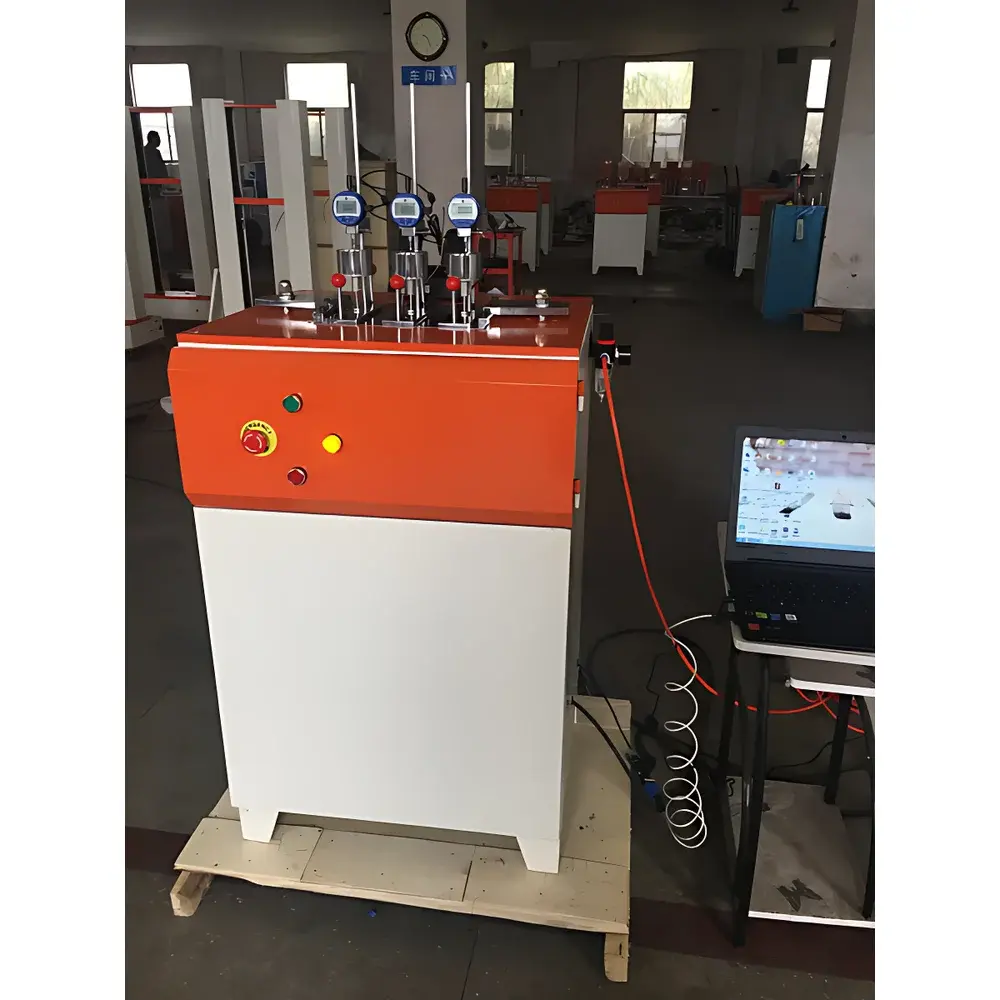
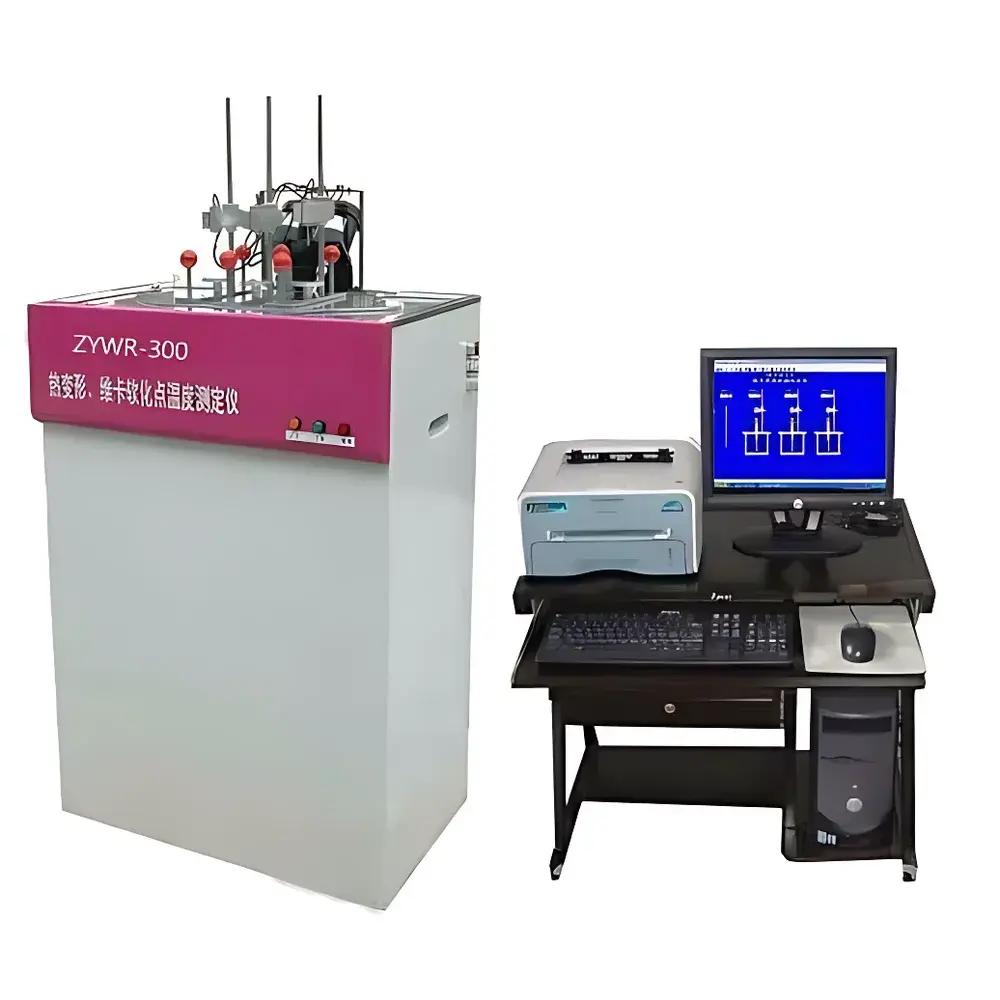
The All Precision Instrument BWR-300 Series Heat Deflection Temperature (HDT) and Vicat Softening Temperature (VST) Tester is a precision thermal-mechanical testing system engineered for standardized determination of thermoplastic and thermoset polymer softening behavior under controlled load and uniform heating conditions. It operates in strict compliance with international standards including ISO 306 (Vicat), ISO 75 (HDT), ASTM D1525 (Vicat), and ASTM D648 (HDT). The instrument employs a liquid-bath heating method—typically using methyl silicone oil—as the thermal medium, ensuring homogeneous temperature distribution across multiple test stations. Its core measurement principle relies on real-time monitoring of dimensional response: for VST, it records the temperature at which a standardized needle penetrates 1 mm into a specimen under constant force (10 N or 50 N); for HDT, it determines the temperature at which a loaded specimen deflects by a predefined amount (e.g., 0.34 mm for flatwise placement per ISO 75-2) under three-point bending at specified flexural stresses (0.45, 1.80, or 8.00 MPa). Designed for high reproducibility and traceable calibration, the BWR-300 integrates microprocessor-based closed-loop temperature control, high-resolution deformation sensing, and programmable ramp profiles to meet GLP and quality assurance requirements in R&D labs and QC environments.
Key Features
- Triple independent test stations operating simultaneously within a single thermal bath—enabling comparative analysis of up to three specimens under identical thermal conditions.
- Programmable dual heating rates (120 ±5 °C/h and 50 ±3 °C/h) with digital setpoint accuracy and real-time feedback control, ensuring adherence to ISO/ASTM ramp tolerances.
- High-stability grating-type digital dial gauges (0.01 mm resolution, ±0.01 mm accuracy) mounted directly above each load station for precise, drift-resistant deformation tracking.
- Dual-mode cooling architecture: natural convection cooling above 150 °C; integrated rapid water-cooling module (self-contained, no external faucet required) for accelerated cooldown cycles below 150 °C.
- Patented negative-pressure fume extraction system—eliminates need for external hoods while preventing oil vapor accumulation and maintaining ISO Class 8 cleanroom-compatible lab air quality.
- Overflow oil recovery reservoir and adjustable upper-temperature limit protection (user-definable up to 300 °C) safeguard against thermal runaway and fluid loss during extended tests.
- Motorized sample rack lift mechanism (optional) enables hands-free specimen loading/unloading, minimizing operator exposure to hot oil and improving workflow ergonomics.
Sample Compatibility & Compliance
The BWR-300 supports standard test geometries defined in ISO 75-2 and ASTM D648, including flatwise (64 ±1 mm span) and edgewise (100 ±1 mm span) configurations—with flatwise placement designated as the preferred method per current revision cycles. Specimens must conform to nominal dimensions of 80 × 10 × 4 mm (L × W × H) for HDT, or cylindrical/tubular cuts meeting ISO 306 thickness requirements for VST. The system accommodates both rigid and semi-crystalline thermoplastics (e.g., PP, PE, ABS, PC, PEEK), thermosets (epoxies, phenolics), and filled composites. All mechanical and thermal calibrations are traceable to national metrology institutes. The instrument’s software architecture supports audit trails and electronic signatures compliant with FDA 21 CFR Part 11 when paired with validated computing hardware and network policies.
Software & Data Management
The embedded Windows-based control software provides full automation of test sequencing, data acquisition, and reporting. Users define test parameters—including load type (VST A/B or HDT A/B/C), heating rate, target deflection, and safety limits—via an intuitive GUI. Real-time curves display temperature vs. deformation for all three channels simultaneously on a color CRT interface. Data are stored in structured binary format with timestamping, instrument ID, operator ID, and environmental metadata. Export functions support CSV for statistical analysis and native .docx report generation—including customizable templates with company logo, test standard references, raw data tables, and pass/fail evaluation per ISO 306:2020 Annex A or ASTM D648–22 Section 9. Optional network connectivity enables centralized data archiving and integration with LIMS platforms via secure FTP or OPC UA protocols.
Applications
This tester serves critical roles across polymer development, manufacturing QA/QC, regulatory submission support, and academic materials science. Typical use cases include: qualification of heat-resistant grades for automotive under-hood components; verification of processing stability in extrusion and injection molding batches; comparative ranking of flame-retardant formulations; validation of post-cure thermal performance in aerospace composites; and failure analysis of thermally degraded insulation materials. Its ability to run parallel VST and HDT tests accelerates material screening workflows, while its compliance-ready documentation framework satisfies ISO/IEC 17025 accreditation requirements for testing laboratories.
FAQ
What heating medium is required, and why is methyl silicone oil specified?
Methyl silicone oil with a flash point ≥300 °C and kinematic viscosity of 200 cSt is mandatory to ensure thermal stability, low volatility, and consistent heat transfer across the 20–300 °C operational range. Alternatives such as mineral oil or glycerol are excluded due to oxidation risk and inadequate high-temperature viscosity retention.
Can the BWR-300 perform both HDT and VST tests without hardware reconfiguration?
Yes—the system includes interchangeable test fixtures: rounded-tip indenters for HDT three-point bending and needle-type probes for VST penetration, both pre-calibrated and supplied as matched sets per station.
Is the instrument suitable for GLP-regulated environments?
When deployed with validated software, access-controlled user accounts, electronic signature modules, and full audit trail logging enabled, the BWR-300 meets core GLP principles outlined in OECD Principles of Good Laboratory Practice (ENV/MC/CHEM(98)17) and supports 21 CFR Part 11 compliance through documented validation packages.
How is temperature uniformity verified across the three test stations?
Calibration includes multi-point mapping using NIST-traceable PT100 sensors at representative locations within the oil bath, confirming ≤±0.3 °C spatial deviation at 100 °C and ≤±0.5 °C at 300 °C per ISO/IEC 17025 clause 6.4.3.
What maintenance is required to sustain long-term measurement accuracy?
Annual recalibration of temperature sensors and dial gauges is recommended; routine cleaning of oil bath and replacement of silicone oil every 18–24 months (or after 500 cumulative test hours) maintains thermal consistency and prevents residue buildup affecting probe movement.



