
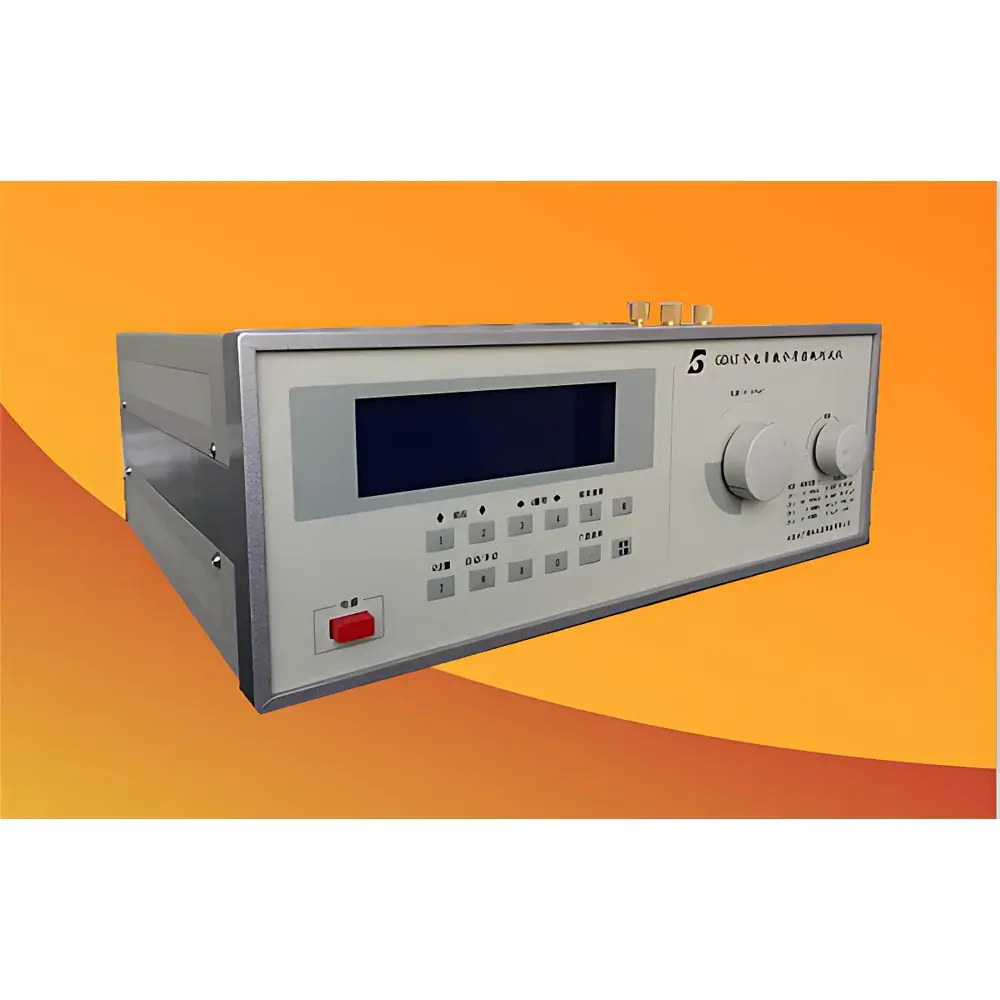
All Precision Instrument GDA-A Dielectric Constant and Loss Tangent Analyzer
| Brand | All Precision Instrument |
|---|---|
| Origin | Beijing, China |
| Manufacturer Type | Manufacturer |
| Product Origin | Domestic (China) |
| Model | GDA-A |
| Price | USD 2,500 (approx.) |
Overview
The All Precision Instrument GDA-A Dielectric Constant and Loss Tangent Analyzer is a precision measurement system engineered for the quantitative characterization of dielectric properties in solid insulating materials. It operates on the principle of series-resonant Q-meter methodology, as specified in GB/T 1409–2006, ASTM D150, and IEC 60250. The instrument determines both the relative permittivity (εr) and the dielectric loss tangent (tan δ) by integrating a calibrated parallel-plate capacitor fixture (BH916), a high-stability RF Q-meter (GDAT), an automated data acquisition and tan δ calculation module, and a matched set of high-Q inductors (LKI-1). This configuration enables traceable, frequency-dependent evaluation of polarization behavior and energy dissipation mechanisms in dielectrics—critical parameters for material selection in high-frequency PCB substrates, capacitor dielectrics, transformer insulation, and advanced electronic packaging. Measurement frequency coverage spans 20 kHz to 60 MHz (extendable to 160 MHz), with resolution and repeatability optimized for compliance-driven R&D and quality control environments.
Key Features
- Integrated BH916 precision parallel-plate test fixture with Φ50 mm electrodes, micrometer-adjustable gap (≥15 mm range), and LCD digital thickness readout (0.001 mm resolution)
- GDAT high-frequency Q-meter featuring direct digital synthesis (DDS) signal generation, frequency accuracy ±3×10⁻⁵ ±1 digit, and dual-scan capability (frequency & capacitance)
- Automated tan δ and εr computation via embedded microprocessor-controlled software module—eliminates manual interpolation and reduces operator-induced error
- LKI-1 inductor set comprising nine individually calibrated, high-Q (Q > 150 at 1 MHz) air-core inductors, enabling optimal resonance matching across the full operating band
- Compliance-ready architecture: supports audit trails, parameter logging, and exportable measurement records aligned with GLP/GMP documentation requirements
- Fixture-specific loss contribution ≤4×10⁻⁴ at 1 MHz, ensuring minimal systematic bias in low-loss material evaluation
Sample Compatibility & Compliance
The GDA-A accommodates rigid and semi-rigid solid dielectric specimens—including polymer films, ceramic wafers, epoxy laminates, rubber sheets, and composite insulation boards—with thicknesses from 0.1 mm to 15 mm and diameters up to 50 mm. Specimen flatness and surface parallelism are critical; samples must be free of voids, delamination, or conductive contamination. The system adheres strictly to the test geometry and procedural constraints defined in GB/T 1409–2006 (equivalent to IEC 60250 Ed. 3.0) and ASTM D150–18a. These standards mandate electrode configuration, edge correction protocols, ambient temperature/humidity control (23±2°C, 50±5% RH), and calibration traceability to national metrology institutes. The BH916 fixture’s zero-reset function and digital gap measurement mitigate mechanical hysteresis and parallax errors inherent in analog vernier systems—directly supporting ISO/IEC 17025-compliant uncertainty budgets.
Software & Data Management
The embedded GDAT firmware includes a dedicated tan δ calculation engine that applies standard correction algorithms per IEC 60250 Annex B (edge effect compensation) and computes εr using the fundamental relation εr = Cd/(ε0S), where C is measured capacitance, d is specimen thickness, S is effective electrode area (π×25² mm²), and ε0 = 8.854 pF/m. Raw Q, L, C, f, and resonance slope data are timestamped and stored internally. Export options include CSV and XML formats compatible with LIMS integration. While the base system does not implement FDA 21 CFR Part 11 electronic signature controls, its deterministic measurement workflow and immutable data logs meet foundational ALCOA+ principles (Attributable, Legible, Contemporaneous, Original, Accurate, Complete, Consistent, Enduring, Available) required for regulated QC laboratories.
Applications
- Quality assurance of polyimide, PTFE, and liquid crystal polymer (LCP) films for 5G antenna substrates
- Evaluation of BaTiO3-based ceramics for multilayer ceramic capacitors (MLCCs)
- Comparative screening of epoxy-anhydride vs. epoxy-amine formulations for aerospace-grade prepregs
- Dielectric aging studies under thermal cycling (per IEC 60270) in transformer solid insulation
- Research into ferroelectric phase transitions via temperature-dependent εr(f) dispersion analysis
- Validation of computational electromagnetics models (e.g., CST Studio Suite, HFSS) with empirical broadband permittivity datasets
FAQ
What frequency ranges does the GDA-A support for dielectric measurements?
The standard configuration covers 20 kHz to 60 MHz; optional GDAT variants extend this to 200 kHz–160 MHz for millimeter-wave material characterization.
Is the BH916 fixture compatible with non-circular samples?
No—electrode geometry is fixed at Φ50 mm. Non-circular specimens must be trimmed or evaluated using alternative fixtures (e.g., coaxial probe or waveguide cavity) outside this system’s scope.
Does the system comply with ISO/IEC 17025 calibration requirements?
Yes—the GDAT Q-meter and BH916 fixture are supplied with factory calibration certificates traceable to NIM (National Institute of Metrology, China); users must perform periodic verification per ISO/IEC 17025 Clause 6.6.
Can tan δ be measured below 10−4?
The system’s base uncertainty floor is ~2×10⁻⁴ at 1 MHz due to fixture residual loss; lower values require cryogenic or vacuum chamber integration to suppress environmental noise.
Is software validation documentation available for regulated industries?
A Software Requirements Specification (SRS) and Installation/Operational Qualification (IQ/OQ) protocol package is available upon request for pharmaceutical and medical device manufacturers subject to 21 CFR Part 11.



