
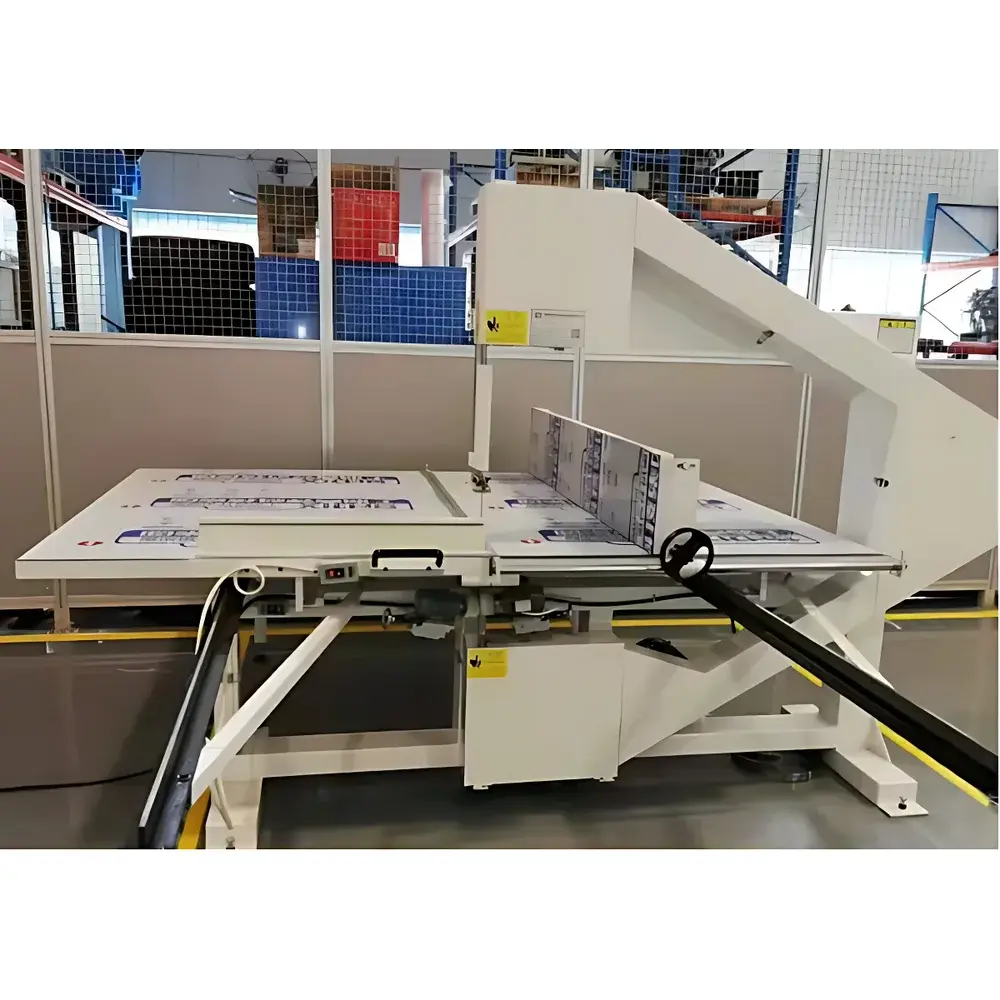
All Precision Instrument HMQG-100 Foam & Sponge Cutting System
| Brand | All Precision Instrument |
|---|---|
| Origin | Beijing, China |
| Manufacturer Type | Direct Manufacturer |
| Equipment Category | Domestic |
| Model | HMQG-100 |
| Instrument Type | Metallographic Cutting System |
| Cutting Display Resolution | 0.01 mm |
| Dimensional Accuracy | ±1 mm |
| Internal Worktable Dimensions | 600 × 600 mm |
| X-Axis Travel Range | 1000 mm |
| Minimum Specimen Size | 25 × 25 × 5 mm |
| Maximum Specimen Thickness | 400 mm |
| Power Supply | 220 V AC |
| Rated Power | 2.2 kW |
Overview
The All Precision Instrument HMQG-100 Foam & Sponge Cutting System is a precision-engineered laboratory cutting platform designed specifically for the reproducible, dimensionally controlled sectioning of low-density polymeric cellular materials—including flexible and rigid polyurethane foams, ethylene-vinyl acetate (EVA), expanded polystyrene (EPS), polyethylene (PE) foams, and other compliant elastomeric or porous substrates. Unlike general-purpose saws or abrasive cutters, this system employs a continuous-band blade driven by a regulated AC motor and guided by a rigid, vibration-damped frame architecture—ensuring minimal thermal distortion, edge compression, or surface delamination during feed. The core cutting principle relies on controlled linear motion combined with vacuum-assisted specimen immobilization and digital position feedback, enabling repeatable cross-sectional preparation for physical testing (e.g., compression, tensile, or indentation), microscopy, density analysis, or quality control sampling per ASTM D3574, ISO 1856, or GB/T 6342. Its design prioritizes metrological traceability in sample geometry—a critical requirement for standardized mechanical property evaluation in R&D labs, QC departments, and third-party testing facilities.
Key Features
- Vacuum-based negative-pressure worktable (600 × 600 mm internal area) ensures uniform clamping of irregular or low-modulus foam surfaces without deformation.
- Digital caliper-integrated positioning system with 0.01 mm resolution display provides real-time, operator-verified dimensional feedback during setup and adjustment.
- 1000 mm travel range along the X-axis accommodates large-format foam blocks while maintaining ±1 mm dimensional accuracy across full stroke.
- Integrated noise-reduction architecture: blade contact wheels fitted with wear-resistant rubber bushings; mechanical damping mounts isolate drive train vibrations.
- On-machine blade sharpening capability eliminates disassembly—sandwheel assembly mounts directly to the carriage for in-situ edge restoration.
- Fail-safe dual-mode braking: electromagnetic brake engages automatically on power loss; red emergency manual brake overrides all active controls for immediate stop.
- Modular tooling interface supports rapid blade replacement and optional accessories including dust extraction nozzles and custom jig fixtures.
Sample Compatibility & Compliance
The HMQG-100 is validated for use with soft-to-medium density cellular polymers ranging from 10–300 kg/m³, including open-cell and closed-cell formulations. It accommodates specimens up to 400 mm thick and as small as 25 × 25 × 5 mm—making it suitable for both bulk material sampling and microspecimen preparation. Vacuum hold-down prevents lateral shift during cutting, eliminating inconsistencies caused by surface topography or compressibility. The system complies with CE machinery safety directives (2006/42/EC) and meets electrical safety standards IEC 61000-6-2 (immunity) and IEC 61000-6-4 (emission). While not certified to ISO/IEC 17025, its dimensional repeatability supports GLP-compliant documentation when integrated into validated lab workflows. Traceable calibration of the digital scale is achievable using NIST-traceable gauge blocks.
Software & Data Management
The HMQG-100 operates as a standalone electromechanical system with no embedded firmware or proprietary software stack. All positional data are captured via the integrated digital scale, which outputs values in millimeters with two-decimal-place resolution. Operators manually record settings and outcomes in laboratory notebooks or LIMS-compatible spreadsheets. For audit readiness, users may integrate external USB-connected digital calipers or machine vision systems (e.g., Keyence CV-X series) to log coordinates and timestamps—enabling alignment with FDA 21 CFR Part 11 requirements when paired with electronic signature-capable documentation platforms. No cloud connectivity or remote diagnostics are included; all maintenance logs and calibration records remain under full user control.
Applications
- Preparation of standardized test specimens for ASTM D1621 (compressive properties of rigid cellular plastics) and ISO 844 (rigid cellular plastics — determination of compression properties).
- Cutting of foam cores for sandwich composite testing per ASTM C273 or EN 13123.
- Sectioning of cushioning materials for automotive seating validation (SAE J2779, FMVSS 302).
- Dimensional sampling of acoustic insulation foams prior to impedance tube measurement (ASTM E1050).
- Production of uniform slices for SEM/EDS cross-section analysis of cell morphology and additive distribution.
- QC slicing of packaging foams to verify thickness consistency and density homogeneity per ISO 845.
FAQ
Is the HMQG-100 compatible with flame-retardant or halogen-free foams?
Yes—provided the material’s Shore hardness does not exceed 80A and its melting point remains above 60°C under sustained blade friction. Ventilation and dust extraction are recommended for thermally sensitive formulations.
Can the machine cut non-foam materials such as rubber or gel pads?
Limited compatibility exists for homogeneous elastomers with elongation at break >200% and tensile strength <5 MPa. Harder or filled rubbers may require custom blade geometry and reduced feed rate.
What maintenance intervals are recommended for the vacuum pump and drive motor?
Vacuum pump oil should be changed every 500 operating hours; motor bearings require greasing every 2,000 hours. A maintenance log template is provided in the operation manual.
Does the system support automated batch cutting sequences?
No—this is a manually operated, operator-guided system. Programmable motion control is not implemented; repeatability relies on procedural discipline and digital scale verification.
Is technical training included with installation?
Yes—All Precision Instrument provides on-site commissioning, safety briefing, and hands-on operational training covering setup, vacuum calibration, blade alignment, and emergency procedures. Training duration is typically 4–6 hours.
Related Products



