
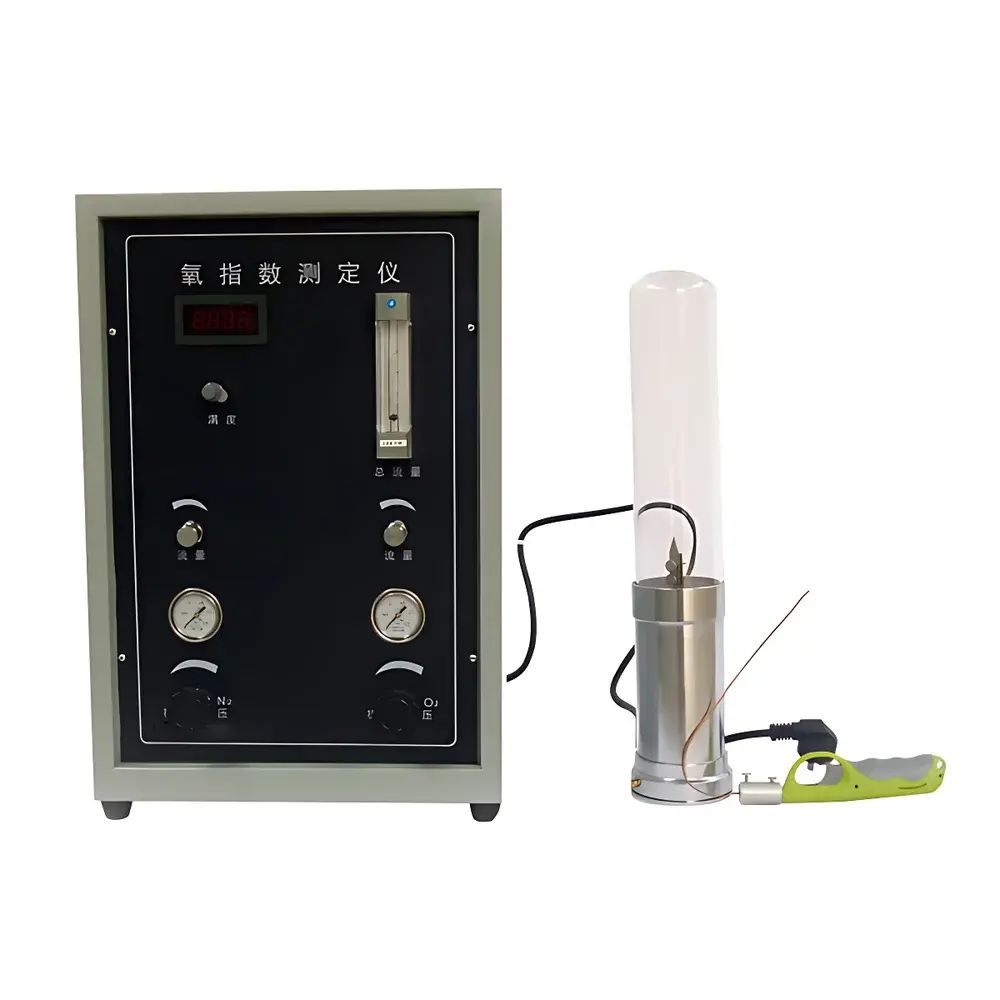
All Precision Instrument JF-5 Automated Oxygen Index Tester with Full-Color Touchscreen Control
| Brand | All Precision Instrument |
|---|---|
| Origin | Beijing, China |
| Manufacturer Type | Direct Manufacturer |
| Model | JF-5 |
| Oxygen Sensor Range | 0–100% O₂ |
| Resolution | ±0.1% |
| Accuracy Class | 0.1 |
| Flow Control Range | 0–20 L/min (0–1200 L/h) |
| Combustion Tube Internal Diameter Options | ≥75 mm or ≥85 mm |
| Gas Linear Velocity in Tube | 40 ± 2 mm/s |
| Input Pressure | 0.25–0.3 MPa |
| Operating Pressure (N₂/O₂) | 0.15–0.20 MPa |
| Power Supply | AC 220 V ±10%, 50 Hz |
| Max Power Consumption | 150 W |
| Ambient Temp | Room Temp to 40 °C |
| Relative Humidity | ≤70% |
| Ignition Flame Length | 16 ± 4 mm (adjustable 5–60 mm) |
| Compliance Standard | GB/T 2406.2–2009 |
Overview
The All Precision Instrument JF-5 Automated Oxygen Index Tester is a fully integrated, microprocessor-controlled combustion analysis system engineered for precise determination of the Limiting Oxygen Index (LOI) according to GB/T 2406.2–2009 — the Chinese national standard aligned with ISO 4589-2 and ASTM D2863. LOI is defined as the minimum volume percent of oxygen in a nitrogen–oxygen mixture required to support candle-like burning of a vertically oriented specimen under specified test conditions. The JF-5 implements closed-loop proportional control of gas flow via high-resolution stepper-driven mass flow valves, enabling real-time oxygen concentration stabilization during active combustion — a critical advancement over open-loop systems where drift compromises repeatability. Its core measurement architecture centers on a calibrated electrochemical oxygen sensor (imported, digital output), delivering direct, calculation-free O₂ readouts across the full 0–100% range with ±0.1% resolution and 0.1-class metrological accuracy. Designed for laboratory-grade reproducibility, the instrument maintains gas velocity at 40 ± 2 mm/s within standardized quartz combustion tubes (75 mm or 85 mm ID), ensuring laminar flow profiles essential for compliant flame propagation assessment.
Key Features
- Full-color 7-inch capacitive touchscreen interface with intuitive icon-based navigation — eliminates manual analog adjustments and reduces operator training time.
- Real-time closed-loop oxygen concentration regulation: automatic correction of O₂ drift during test execution, maintaining target setpoint within ±0.2% tolerance.
- Dual-mode sample holder system: rigid vertical clamp for self-supporting materials (e.g., rigid plastics, composites) and frame-mounted dual-edge fixture for non-self-supporting specimens (e.g., textiles, foams, thin films).
- Integrated safety diagnostics: audible/visual alerts for gas source misconnection (O₂/N₂ swap), sensor aging, pressure loss, and ignition gas failure.
- Propane/air ignition system with adjustable metal nozzle (Φ2 ±1 mm), flame length 16 ±4 mm, and continuous 5–60 mm height tuning for consistent ignition energy delivery.
- Onboard data management: timestamped storage of up to 1,000 test records; searchable history with export-ready CSV format via USB port.
- Configurable combustion tube geometry: selectable quartz cylinder diameter (75 mm or 85 mm) to accommodate diverse specimen dimensions per GB/T 2406.2 requirements.
- One-touch calibration and gas ratio initialization routines — traceable to certified reference gases (≥99% purity O₂/N₂).
Sample Compatibility & Compliance
The JF-5 supports standardized testing of solid polymeric materials, building products (e.g., insulation boards, ceiling tiles), electrical enclosures, textile fabrics, and fire-rated door assemblies. Specimen dimensions adhere strictly to GB/T 2406.2–2009: 150 mm × 10 mm × 10 mm (or thickness ≤10.5 mm) for rigid samples; flexible materials are mounted using the optional dual-edge frame to prevent sagging. The instrument meets mechanical and procedural requirements for LOI determination under ISO 4589-2:2017 and ASTM D2863–22, including gas purity verification (≥99% O₂, ≥99% N₂), pressure regulation (0.15–0.20 MPa working pressure), and thermal environment control (23 ± 2 °C ambient, RH ≤70%). All firmware logic and data logging functions comply with GLP principles: audit-trail-enabled event logs, user-access levels, and immutable test record timestamps.
Software & Data Management
The embedded Linux-based control firmware provides deterministic real-time response for gas flow actuation and sensor sampling (10 Hz update rate). Test parameters — including target O₂%, burn duration, specimen ID, operator name, and environmental conditions — are stored with cryptographic integrity. Data export is supported via USB 2.0 to FAT32-formatted drives; no proprietary software installation is required on host PCs. The system supports FDA 21 CFR Part 11–compatible configurations upon request (electronic signatures, role-based access, and full audit trail generation), making it suitable for regulated quality control environments in medical device manufacturing and construction material certification labs.
Applications
This instrument is routinely deployed in R&D laboratories evaluating flame-retardant additive efficacy in thermoplastics (e.g., ABS, PC, PP), assessing fire performance of cable jacketing compounds, verifying compliance of architectural panels against GB 8624–2012 classifications, and supporting UL 94 pre-screening protocols. Its precision gas control enables comparative studies of nanocomposite flame retardancy, intumescent coating efficiency, and halogen-free phosphorus-based formulations. Universities utilize the JF-5 for teaching polymer flammability fundamentals and validating computational combustion models against empirical LOI benchmarks.
FAQ
What gas purity is required for compliant testing?
Industrial-grade oxygen and nitrogen with ≥99% purity are mandatory. Typical commercial oxygen from certified gas suppliers ranges from 99.2% to 99.3% — acceptable per GB/T 2406.2–2009.
Can the JF-5 be used for research beyond standard LOI?
Yes. Its programmable O₂ ramping, high-resolution flow control, and real-time data logging support custom combustion kinetics studies, such as time-to-ignition mapping under sub-LOI atmospheres.
Is external PC connectivity required for operation?
No. All functions — setup, execution, analysis, and reporting — are fully autonomous via the onboard touchscreen. PC connection is optional and limited to data export.
How often must the oxygen sensor be calibrated?
Factory calibration is valid for 12 months under normal use. Field recalibration is performed in <1 minute using zero-air and certified 21% O₂ reference gases — a procedure guided stepwise on screen.
Does the system meet international regulatory requirements for quality assurance?
Out-of-the-box, it satisfies ISO/IEC 17025 technical competence criteria for LOI testing. With optional firmware upgrade, it achieves full 21 CFR Part 11 compliance for electronic records in pharmaceutical and aerospace QC applications.



