
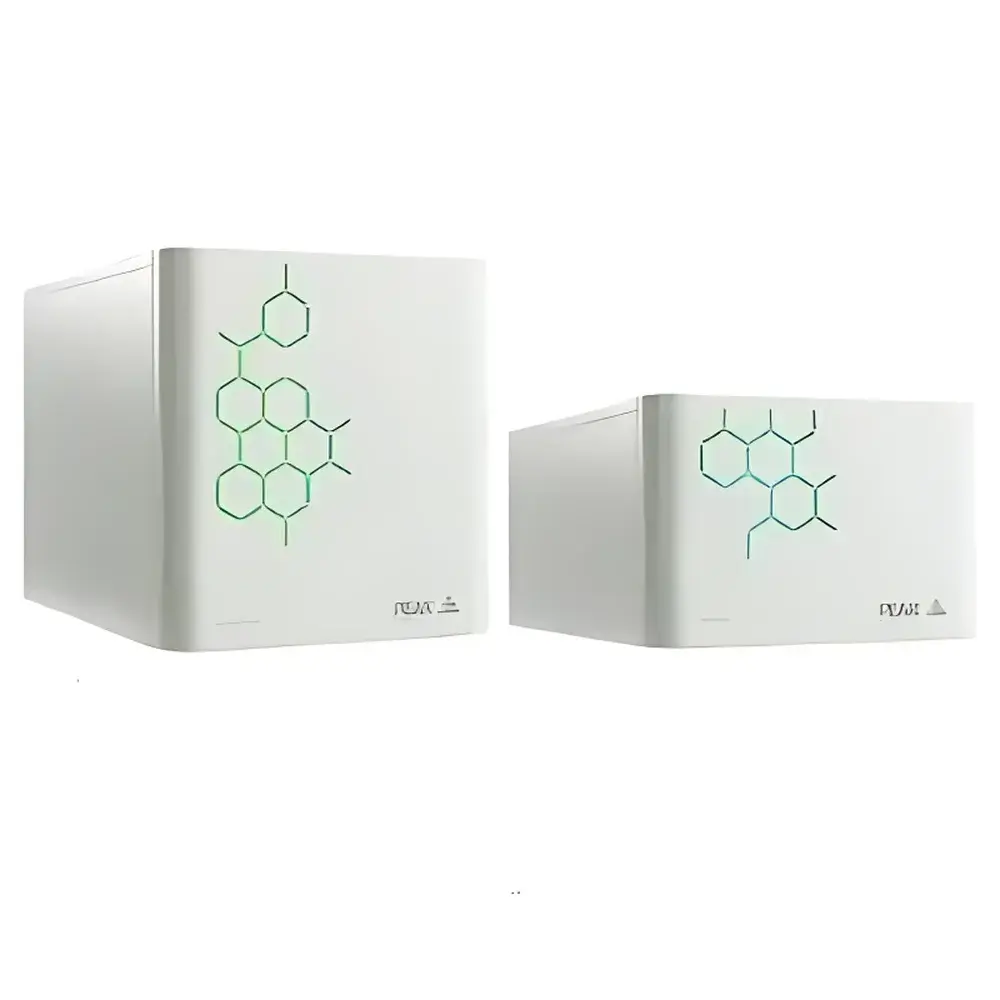
Precision Nitrogen Trace by PEAK Scientific
| Brand | PEAK |
|---|---|
| Origin | United Kingdom |
| Manufacturer Type | Original Equipment Manufacturer (OEM) |
| Import Status | Imported |
| Model | Precision Nitrogen Trace |
| Nitrogen Generation Principle | Pressure Swing Adsorption (PSA) using Carbon Molecular Sieve (CMS) |
| Output Flow Rates | 250 mL/min, 600 mL/min, 1000 mL/min |
| Output Pressure | 80 psi (5.5 bar) |
| Nitrogen Purity | 99.9999% (≤0.1 ppm O₂, ≤0.1 ppm H₂O) |
| Dew Point | –70 °C (at 1 atm) |
| Hydrocarbon Removal | Catalytic Methane Scrubber (CH₄ < 0.05 ppm) |
| Air Feed Requirement | Oil-free, dried compressed air (ISO 8573-1 Class 1.2.1 or better) |
Overview
The Precision Nitrogen Trace by PEAK Scientific is an ultra-high-purity nitrogen generator engineered specifically for volatile organic compound (VOC) analysis applications—particularly in gas chromatography–mass spectrometry (GC–MS), purge-and-trap systems, and thermal desorption instrumentation. It employs a dual-stage purification architecture based on pressure swing adsorption (PSA) with carbon molecular sieve (CMS) technology, followed by catalytic hydrocarbon removal and deep desiccation. This configuration ensures consistent delivery of nitrogen meeting stringent analytical requirements: ≥99.9999% purity (≤0.1 ppm residual oxygen, ≤0.1 ppm water vapor), –70 °C dew point, and total hydrocarbons <0.05 ppm (as methane). Unlike liquid nitrogen or high-pressure cylinder supply, the system generates nitrogen on-demand from clean, oil-free compressed air—eliminating logistical constraints, safety hazards, and supply-chain variability. Its compact footprint and stackable design support modular laboratory integration, especially in regulated environments where trace-level VOC quantification demands stable, contamination-free carrier and purge gases.
Key Features
- Triple-stage purification: CMS-based O₂/H₂O removal → catalytic CH₄ oxidation → final ultra-dry polishing
- Three selectable flow rates (250 / 600 / 1000 mL/min) optimized for single-instrument or multi-port GC configurations
- Integrated air dryer and coalescing pre-filters ensure robust performance with ISO Class 1.2.1 compressed air input
- Self-diagnostic control panel with real-time pressure, purity, and system status monitoring
- Startup time <5 minutes; full spec output achieved within 15 minutes of power-on
- No consumables beyond annual filter cartridge replacement—no CMS bed replacement required under normal operation
- Compliant with IEC 61010-1 for laboratory electrical safety and CE-marked for EMC and RoHS
Sample Compatibility & Compliance
The Precision Nitrogen Trace is validated for use with EPA Methods 502.2, 524.2, 8260D, and 8270E, as well as ASTM D5504 and ISO 16000-6. Its output meets the gas quality specifications defined in USP , ISO 8573-1:2010 Class 1.1.1 (for particulates, water, and oil), and EU GMP Annex 1 requirements for inert gas supply in controlled environments. The catalytic hydrocarbon scrubber is calibrated and verified against certified methane standards traceable to NIST SRM 1648a. All firmware and hardware configurations support audit-ready operation under 21 CFR Part 11-compliant data integrity frameworks when paired with PEAK’s optional IQ/OQ documentation package.
Software & Data Management
While the Precision Nitrogen Trace operates as a standalone unit with analog status outputs, it integrates seamlessly into centralized lab infrastructure via 4–20 mA pressure/purity analog signals and dry-contact fault alarms. Optional RS-232 or Ethernet connectivity enables remote monitoring through third-party LIMS or building management systems. PEAK’s proprietary service software (accessible via secure web interface) logs runtime hours, filter life, pressure cycles, and alarm history—supporting GLP-compliant maintenance records and predictive service scheduling. Firmware updates are delivered via encrypted USB key or authenticated cloud push, maintaining version control and change history per ISO/IEC 17025 clause 5.9.2.
Applications
- Carrier gas for capillary GC and GC–MS in environmental VOC testing (soil, water, air)
- Purge gas in automated purge-and-trap concentrators (e.g., Tekmar, OI Analytical)
- Blank gas and calibration gas dilution in EPA Method 8260D workflows
- Instrument purge and detector cooling in triple-quadrupole and high-resolution mass spectrometers
- Inert atmosphere generation for headspace vial pressurization and sample transfer lines
- Zero-air equivalent generation when combined with PEAK’s Zero Air Trace system
FAQ
What compressed air quality is required for optimal operation?
Oil-free, desiccated air meeting ISO 8573-1:2010 Class 1.2.1 (≤0.01 µm particles, ≤−40 °C pressure dew point, ≤0.01 mg/m³ total oil) is mandatory. Integrated pre-filtration handles minor deviations but does not replace upstream air treatment.
Is the system compatible with Agilent, Thermo Fisher, or Waters GC–MS platforms?
Yes—PEAK is an authorized global OEM partner for all major GC–MS manufacturers. The Precision Nitrogen Trace meets OEM-specified inlet gas requirements for Agilent 5977/8890, Thermo ISQ EC, and Waters Xevo TQ-S micro systems.
How often must filters be replaced, and what is included in the annual service kit?
Pre-filter, coalescing filter, and final particulate filter cartridges require replacement every 12 months or 8,000 operating hours—whichever occurs first. The official PEAK service kit (P/N: PN-TR-12M-KIT) includes all three elements plus calibration verification report.
Can output purity be independently verified onsite?
Yes—integrated test ports allow connection of portable electrochemical O₂ analyzers (0–10 ppm range) and chilled-mirror hygrometers. PEAK provides traceable calibration certificates for all factory verification tests.
Does the system support 21 CFR Part 11 compliance for electronic records?
The base unit does not include electronic signature capability, but when deployed with PEAK’s IQ/OQ validation package and integrated into a validated LIMS environment, full Part 11 compliance—including audit trail, user access control, and electronic signatures—is achievable.



