
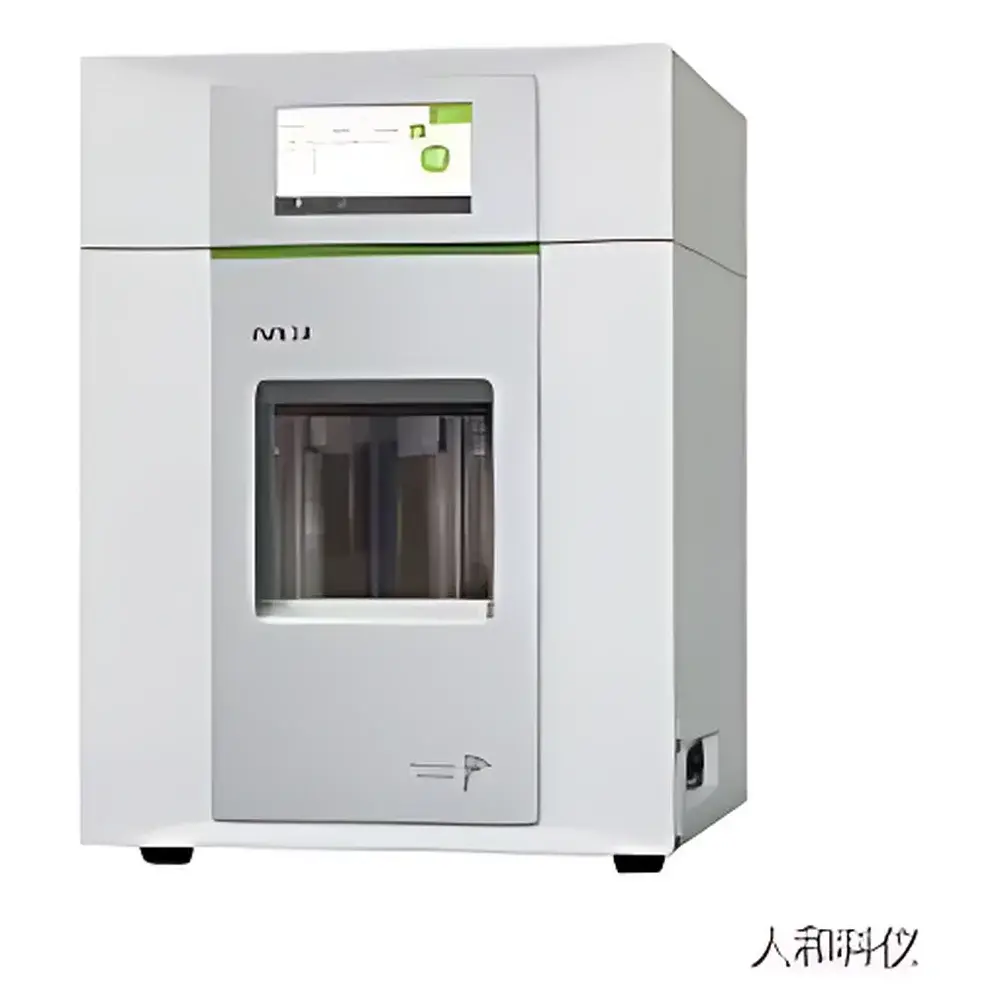
PreeKem M3 Microwave Digestion System
| Brand | PreeKem |
|---|---|
| Origin | Shanghai, China |
| Manufacturer Type | Authorized Distributor |
| Country of Origin | China |
| Model | M3 |
| Price Range | USD 21,000 – 28,000 |
| Cavity Class | Industrial-Grade |
| Sample Capacity | 16 vessels |
| Microwave Source | Magnetron |
| Max Temperature | 330 °C |
| Max Pressure | 1500 psi |
| Display | 7″ High-Resolution Color Touchscreen |
| Microwave Frequency | 2450 MHz |
| Power Output Mode | Non-pulsed Continuous Microwave |
| Cavity Material | 316L Stainless Steel with Laser Welding & Multi-layer PTFE Coating |
| Cooling System | Twin Air Dual-Direction Rapid Cooling |
| Safety Door | Independent Floating Buffer Safety Door with Interlock |
| Control Architecture | Full-Vessel Temperature & Pressure Monitoring |
| Regulatory Compliance | Designed for GLP/GMP environments |
Overview
The PreeKem M3 Microwave Digestion System is an industrial-grade sample preparation instrument engineered for precise, reproducible, and safe closed-vessel microwave-assisted acid digestion. It operates on the principle of dielectric heating, where microwave energy (2450 MHz) is coupled into polar molecules—primarily HNO₃, HCl, HF, and H₂O—within sealed quartz or high-purity PTFE-TFM digestion vessels. The system employs non-pulsed continuous microwave output via a robust magnetron source, enabling stable power delivery and minimizing thermal overshoot during ramp segments. Its resonant cavity—optimized through electromagnetic field modeling—ensures uniform energy distribution across all 16 positions, critical for inter-vessel consistency in multi-sample workflows. Designed for laboratories requiring regulatory compliance, the M3 integrates dual-parameter real-time monitoring (temperature and pressure per vessel), automatic interlock logic, and hardware-level safety redundancies—including pressure-relief venting via a floating-buffer safety door and microswitch-enabled microwave inhibition until full door closure.
Key Features
- Full-vessel temperature and pressure control: Each digestion vessel is independently monitored using infrared-based non-contact temperature sensing (upgradable to latest-generation IR sensors) and piezoresistive pressure transducers—eliminating reliance on consumable Pt resistance probes, rupture discs, or venting membranes.
- Industrial-class 316L stainless steel cavity: Fabricated via laser seam welding and coated with multi-layer PTFE for exceptional corrosion resistance against aggressive acid mixtures (e.g., aqua regia, HF-containing media) and long-term structural integrity.
- Twin Air dual-direction rapid cooling system: Integrates intelligent airflow modulation and optimized duct geometry to achieve sub-60-minute total cycle time (digestion + cooling) for food, environmental, pharmaceutical, and geological matrices—without manual fan adjustment.
- Intuitive 7″ color touchscreen interface: Supports method-driven operation with pre-validated, application-specific protocols stored in an embedded library (e.g., EPA Method 3051A, ISO 11466, GB/T 5009 series), enabling one-touch launch and parameter recall.
- Modular rotor architecture: Enables seamless transition between high-throughput (16-position) and high-pressure (up to 1500 psi) configurations without tooling—supporting both routine QC and demanding research applications.
- Comprehensive safety architecture: Includes automatic cavity self-diagnostic at startup, real-time microwave emission cutoff upon door displacement >0.5 mm, and mechanical pressure relief via calibrated deformation zones in the safety door assembly.
Sample Compatibility & Compliance
The M3 accommodates standard 55 mL and 100 mL high-purity TFM-PTFE or quartz digestion vessels compatible with USP , ASTM D5683, and ISO/IEC 17025-accredited workflows. It meets mechanical and electromagnetic safety requirements per IEC 61000-6-3 (EMC) and IEC 61010-1 (electrical safety). While not certified to FDA 21 CFR Part 11 out-of-the-box, its method storage, timestamped run logs, and user-access-controlled parameter modification support validation under GLP and GMP frameworks. Vessel compatibility extends to organic-rich samples (biological tissues, polymers), siliceous matrices (soils, sediments, ceramics), and refractory metals (steels, alloys), provided appropriate acid selection and ramp profiles are applied per ISO 15587-1.
Software & Data Management
The embedded operating system stores ≥500 method templates with editable ramp/hold segments, power limits, and safety thresholds. All runs generate timestamped records containing vessel ID, max temperature/pressure, total irradiation time, and cooling duration—exportable via USB to CSV or PDF. Audit trail functionality (enabled via optional firmware upgrade) logs user login events, method edits, and parameter overrides with digital signatures, satisfying traceability requirements for ISO/IEC 17025 Clause 7.7 and FDA-aligned internal SOPs. No cloud dependency or third-party software licensing is required for basic operation or data retrieval.
Applications
The M3 is routinely deployed in accredited environmental labs for heavy metal analysis in soils (EPA SW-846 Method 3051A/3052), food safety testing (As, Cd, Pb in cereals per GB 5009.12), pharmaceutical quality control (residual catalysts in APIs), geochemical exploration (multi-element digestion of rock powders), and metallurgical R&D (dissolution of stainless steels and Ni-based superalloys). Its consistent 330 °C / 1500 psi capability enables complete decomposition of recalcitrant organics and silicates—reducing post-digestion filtration needs and improving ICP-MS/OES detection sensitivity.
FAQ
Does the M3 support remote monitoring or network connectivity?
No—network interfaces (Ethernet/Wi-Fi) are omitted to maintain electromagnetic isolation and simplify 21 CFR Part 11 validation; data transfer occurs exclusively via USB 2.0.
What vessel types are validated for use with the M3?
PreeKem-certified 55 mL and 100 mL TFM-PTFE vessels (Model PT-16) and quartz vessels (Model QZ-16); third-party vessels are not supported due to unverified pressure-temperature response characteristics.
Is method validation documentation available?
Yes—application notes covering EPA 3051A, ISO 11466, and GB/T 5009.12 are supplied with the system, including recovery studies, precision data (RSD <3% for Cr in spinach CRM), and cross-contamination assessments.
How often does the system require calibration verification?
Temperature and pressure sensors are factory-calibrated; users perform quarterly verification using NIST-traceable reference standards (e.g., melting point standards for temp, dead-weight testers for pressure) per ISO/IEC 17025 Section 6.5.
Can the M3 be integrated into LIMS environments?
Direct LIMS integration is not supported; however, exported CSV reports contain structured fields (sample ID, digest time, final temp/pressure) compatible with common LIMS import modules via batch upload.



