
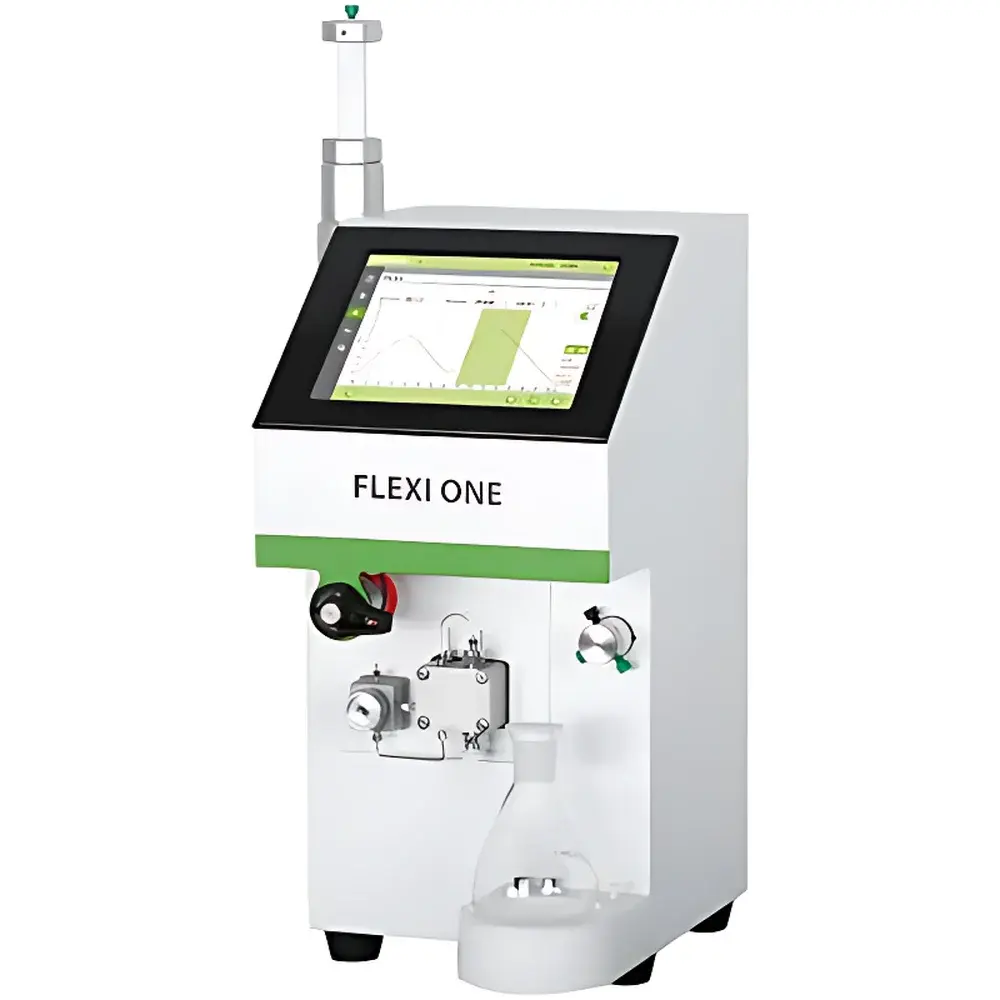
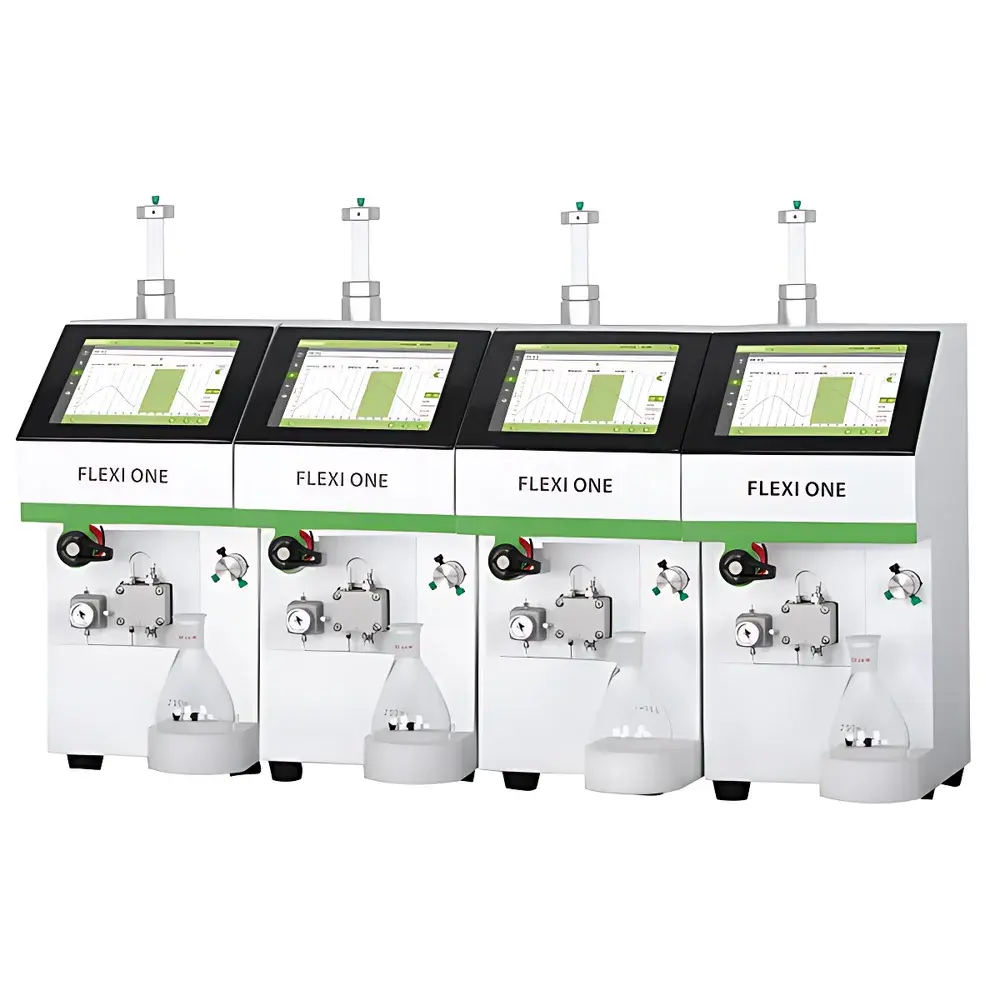
PreeKem Yitao FLEXI ONE Gel Permeation Chromatography (GPC) System
| Brand | PreeKem / Yitao |
|---|---|
| Origin | Shanghai, China |
| Manufacturer Type | Original Equipment Manufacturer (OEM) |
| Regional Classification | Domestic (China) |
| Model | FLEXI ONE |
| Flow Rate Range | 0.01–49.99 mL/min |
| Maximum Pressure | 25 MPa |
| Flow Stability | RSD < 1% |
| Auto-Sampler Volume | 10 mL |
| Auto-Sampler Positions | 1–4 |
Overview
The PreeKem Yitao FLEXI ONE Gel Permeation Chromatography (GPC) System is a compact, modular gel filtration chromatography platform engineered for high-reproducibility sample cleanup in complex matrices. Based on size-exclusion separation principles, the system separates analytes from interfering macromolecules—such as lipids, proteins, pigments, and polymeric residues—by differential elution through porous gel media. Unlike conventional HPLC systems optimized for analytical resolution, the FLEXI ONE is purpose-built for preparative-scale purification prior to downstream analysis (e.g., GC-MS, LC-MS, ICP-MS), ensuring robust removal of co-extracted interferences without analyte loss or degradation. Its design aligns with standardized gel permeation chromatographic workflows defined in EPA Method 3640A (SW-846), AOAC Official Methods of Analysis®, and Chinese Pharmacopoeia 2020 Edition (ChP), making it suitable for regulated laboratories operating under GLP or ISO/IEC 17025 frameworks.
Key Features
- Modular architecture enabling flexible configuration: pump module, UV detection module, fraction collector, and column oven can be deployed independently or integrated into a single workflow.
- Integrated dual-piston reciprocating pump delivering low-pulsation flow across the full range (0.01–49.99 mL/min) with pressure tolerance up to 25 MPa—engineered for compatibility with both rigid silica-based and soft polymer-based GPC columns.
- 8-inch color touchscreen interface supporting real-time chromatogram display, method editing, and system status monitoring; optionally controllable via Ethernet-connected PC for centralized multi-instrument management.
- Automated fraction switching logic with programmable collection criteria (time-, peak-, or threshold-based), eliminating manual intervention during extended runs.
- Dedicated column protection housing with thermal insulation and mechanical shielding to minimize column damage during handling and operation.
- Onboard solvent volume monitoring with audible and visual alerts when mobile phase levels fall below user-defined thresholds.
- Method storage capacity for up to 48 user-defined protocols, each configurable with gradient profiles, collection schemes, detector settings, and pump parameters.
Sample Compatibility & Compliance
The FLEXI ONE supports diverse biological and environmental sample types—including edible oils, cereal grains, soil extracts, herbal matrices, animal tissues, and wastewater concentrates—without requiring derivatization or extensive pre-filtration. Its 10 mL loop injection capability accommodates viscous or particulate-laden extracts commonly encountered in food safety and environmental residue analysis. The system complies with key regulatory methodologies: EPA SW-846 Method 3640A for pesticide residue cleanup in fatty matrices; AOAC 2007.01 and related protocols for mycotoxin decontamination; and ChP General Chapter 0512 (Gel Filtration Chromatography) for pharmaceutical excipient purity assessment. All hardware and software components are designed to support audit-ready documentation practices aligned with FDA 21 CFR Part 11 requirements when paired with validated data acquisition software.
Software & Data Management
Data acquisition and instrument control are managed via embedded firmware with optional PC-based software extension. Chromatographic data—including absorbance traces, pressure logs, and fraction trigger events—are timestamped and stored internally or exported via USB 2.0 to CSV or PDF formats. Direct thermal printer connectivity enables hard-copy generation of run reports including method ID, operator name, date/time stamp, and calibration verification records. Audit trail functionality (when enabled via external software) captures all parameter changes, method executions, and user logins—supporting traceability in quality-controlled environments. Data files adhere to open-format conventions compatible with third-party LIMS integration.
Applications
- Cleanup of lipid-rich extracts prior to pesticide multiresidue analysis by GC-MS/MS or LC-MS/MS.
- Removal of chlorophyll and waxes from plant-derived samples for cannabinoid or alkaloid quantification.
- Depletion of humic substances and fulvic acids from environmental water and sediment extracts prior to heavy metal speciation.
- Isolation of low-MW bioactive compounds (e.g., flavonoids, saponins) from crude herbal decoctions.
- Preparative desalting of protein hydrolysates prior to amino acid profiling.
- Standardized sample preparation for certified reference material (CRM) characterization in proficiency testing programs.
FAQ
What column dimensions and packing materials are supported?
The system accommodates standard GPC glass columns (e.g., 15 × 300 mm, 25 × 600 mm) packed with cross-linked polystyrene-divinylbenzene (PS-DVB) gels (e.g., Bio-Beads S-X3, Envirobeads SX-3) or silica-based SEC media. Column protection housings accept inner diameters from 10 mm to 25 mm.
Is the system compatible with organic solvents such as THF, chloroform, or toluene?
Yes—the fluidic path is constructed from chemically resistant materials (e.g., PEEK, stainless steel 316, sapphire plunger seals) rated for continuous use with common GPC mobile phases including tetrahydrofuran (THF), chloroform, and toluene at ambient temperature.
Can the FLEXI ONE be integrated into an automated laboratory workflow?
It supports RS-232 and Ethernet communication protocols, enabling remote triggering, status polling, and method upload via Lab Automation Middleware (LAM) platforms compliant with ASTM E1578 and ISO/IEC 17025 Annex A.2.
Does the system meet requirements for regulated pharmaceutical testing?
While the base configuration meets mechanical and functional specifications outlined in USP <621> and ChP 0512, full compliance with GMP data integrity expectations requires validation of the complete software stack—including electronic signatures, audit trails, and backup procedures—as part of the user’s qualification protocol.



