
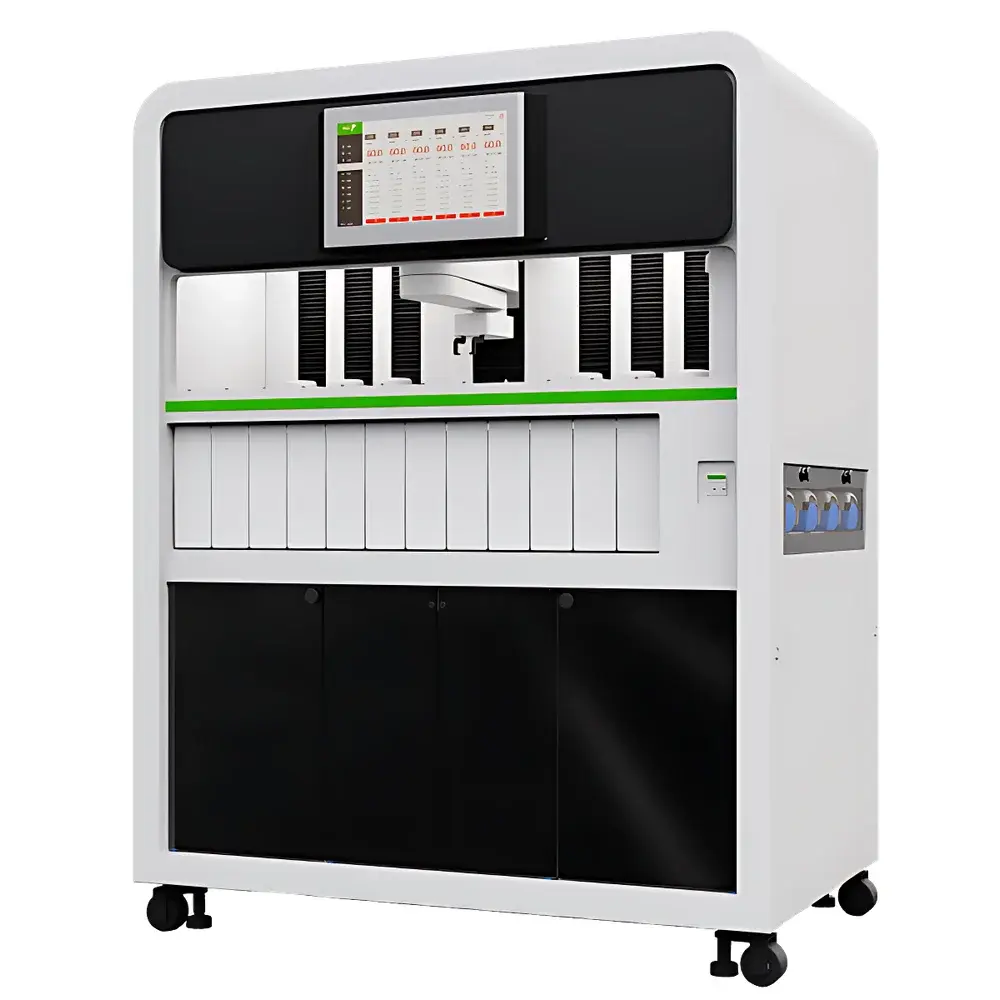
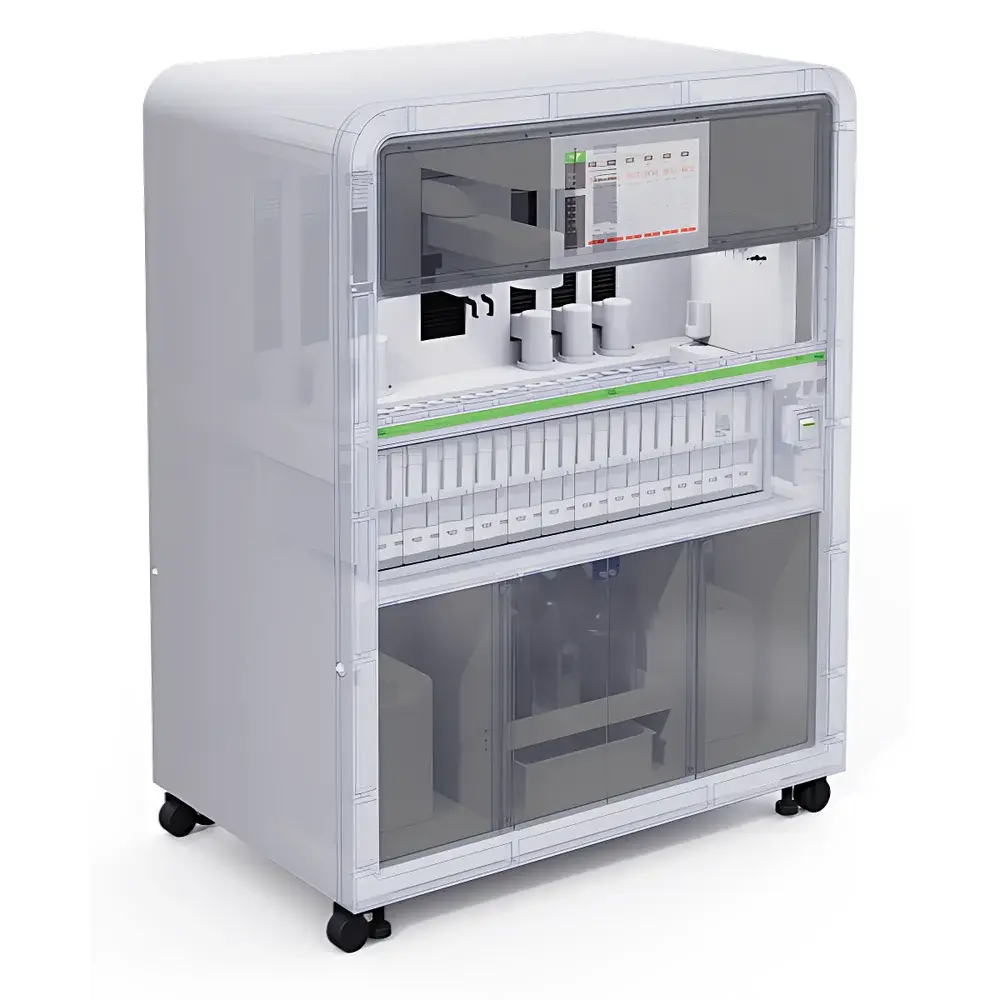
PreeKem Yitao P6 Ultra-Performance Microwave Robotics System
| Brand | PreeKem / Yitao Technology |
|---|---|
| Origin | Shanghai, China |
| Manufacturer Type | Direct Manufacturer |
| Origin Category | Domestic (China) |
| Model | P6 |
| Pricing | Upon Request |
| Cavity Class | Industrial-Grade |
| Maximum Sample Capacity | 192 samples per run |
Overview
The PreeKem Yitao P6 Ultra-Performance Microwave Robotics System is an integrated, fully automated microwave-assisted sample preparation platform engineered for high-throughput, method-flexible, and traceable digestion of diverse matrices—including environmental soils, biological tissues, pharmaceutical excipients, geological samples, and polymer composites. Unlike conventional batch-mode microwave digesters, the P6 implements a hybrid architecture combining single-mode microwave cavity technology with industrial-grade robotic automation, enabling both parallel processing and individualized reaction control per sample vessel. Its core principle relies on precisely focused 2450 MHz microwave energy delivered via six independent waveguide channels, each dynamically modulated in real time based on in-situ temperature and pressure feedback from fiber-optic sensors embedded in every rotor position. This ensures stoichiometrically accurate, reproducible thermal profiles—even across heterogeneous sample loads—while maintaining full compliance with ISO 17025 method validation requirements for accredited laboratories.
Key Features
- Industrial-class floating interlock shock-absorbing cavity (Patent No. ZL2015 1 0586879.7), certified to withstand ≥100,000 operational cycles without structural fatigue or seal degradation
- High-precision collaborative robotic arm with ±0.1 mm positional repeatability, supporting autonomous weighing, vial handling, rack loading/unloading, and post-digestion transfer to ICP-MS or AAS autosamplers
- Four-channel independent acid dispensing system compatible with HNO₃, HCl, HF, H₂O₂, and aqua regia; all fluid paths constructed from PFA and sapphire components for HF resistance and sub-ppb metal leaching performance
- Six-channel single-mode microwave reactor with individual power modulation (0–1200 W per channel), enabling simultaneous execution of up to six distinct digestion protocols within one run
- Integrated orbital shaking module (200–1200 rpm, programmable acceleration ramp) for rapid reagent homogenization prior to microwave irradiation
- Smart rack recognition system using dual-mode optical + capacitive sensing to verify rack type, orientation, and occupancy status before initiation
- Forced-air ventilated reagent cabinet with segregated compartments, HEPA-filtered exhaust, and leak-detection interlocks aligned with NFPA 45 and OSHA Lab Standard 1910.1200
Sample Compatibility & Compliance
The P6 accommodates standard 55 mL quartz or high-purity PTFE-TFM digestion vessels, as well as custom-configured rotor formats supporting 12, 24, 48, and 192-sample throughput. It supports EPA Methods 3050B, 3051A, 3052; ASTM D5511, D5512; ISO 11466, 15587-1; and Chinese standard HJ 680–2013. All hardware and firmware are designed to meet electromagnetic compatibility (EMC) requirements per IEC 61326-1 and safety standards per IEC 61010-1. Audit trails—including method parameters, sensor logs, robotic actuation timestamps, and video metadata—are stored in tamper-evident binary format compliant with FDA 21 CFR Part 11 Annex 11 and GLP/GMP data integrity principles.
Software & Data Management
The P6 operates under PreeKem’s proprietary SmartDigest OS v4.2, a Windows-based platform featuring role-based user access control (RBAC), electronic signatures, and hierarchical method libraries. Each digestion cycle generates a structured .XML metadata file containing full thermal/pressure profiles, robotic event logs, acid addition volumes/timing, and synchronized 1080p video segments (H.264 encoded, AES-256 encrypted). Data export supports direct integration with LIMS via ASTM E1482-compliant interfaces or CSV/Excel templates validated for IQ/OQ documentation. Remote monitoring is enabled via TLS-secured web portal and native iOS/Android applications with push notifications for cycle completion, anomaly detection, or maintenance alerts.
Applications
- Routine QA/QC analysis of heavy metals in food contact materials (EU Regulation (EC) No 1935/2004)
- Multi-element quantification in clinical biospecimens (serum, urine, tissue) for biomonitoring studies
- Digestion of refractory catalysts and battery cathode materials (e.g., NMC, LFP) prior to ICP-OES analysis
- Preparation of certified reference materials (CRMs) requiring strict procedural consistency across production batches
- Method development for novel sample types where traditional open-vessel or multi-mode digestion yields incomplete recovery or volatile element loss
FAQ
Does the P6 support method validation according to ISO/IEC 17025?
Yes—the system provides full traceability of all critical process parameters, including raw sensor data, robotic motion logs, and video evidence, enabling comprehensive uncertainty budgeting and documented evidence for accreditation audits.
Can HF be safely used with the four-channel acid delivery system?
Yes—fluidic pathways contacting HF are exclusively fabricated from sapphire nozzles and PFA tubing, validated for continuous exposure at concentrations up to 40% w/w and temperatures up to 120 °C.
Is remote operation possible during unattended overnight runs?
Yes—secure TLS 1.3 encrypted remote access allows real-time video streaming, parameter adjustment, and emergency abort via authenticated mobile or desktop clients.
How is calibration verified for the robotic arm and dispensing modules?
Robotic repeatability is verified daily using NIST-traceable gauge blocks; acid delivery accuracy is confirmed monthly via gravimetric titration per USP and recorded in the instrument’s calibration ledger.
What cybersecurity measures protect the instrument’s network interface?
The embedded Linux controller enforces firewall rules, disables unused ports, applies quarterly security patches, and logs all authentication attempts in accordance with NIST SP 800-53 Rev. 5 IA-3 and RA-5 controls.
Related Products



