
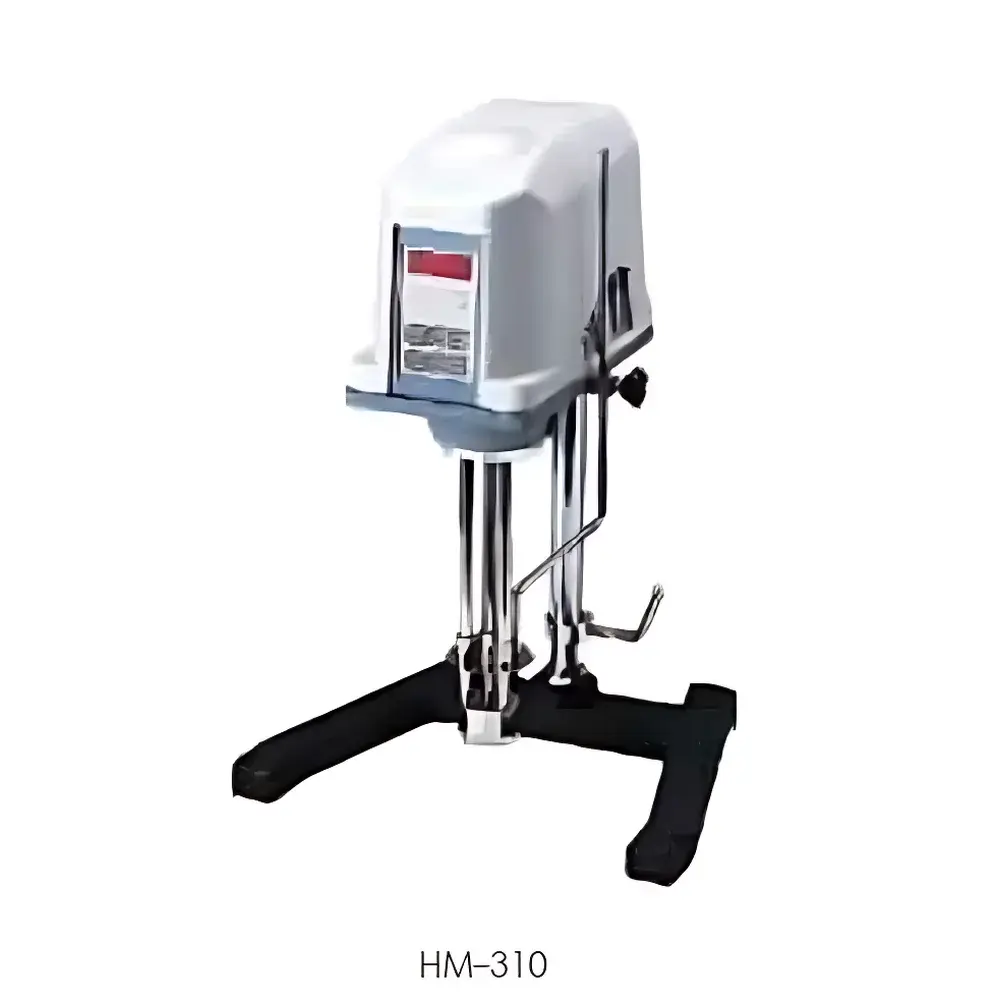
Prema HM310 Digital High-Speed Homogenizer
| Brand | Prema |
|---|---|
| Origin | Taiwan |
| Model | HM310 |
| Drive Type | Probe-type rotor-stator homogenizer |
| Dimensions (W×D×H) | 370 × 270 × 500 mm |
| Speed Range | 1,000–12,000 rpm |
| Motor Power | DC 220 W |
| Capacity | 0.1–2 L |
| Display | LED digital speed readout with feedback compensation circuit |
| Timer | Programmable up to 99 h 59 min |
| Safety Features | Thermal cut-off, overload protection, fuse |
| Construction | SUS316 stainless steel probe assembly |
| Mounting | Spring-loaded vertical lift stand |
| Optional Accessories | Automated lift system, HD-series high-shear dispersing heads |
Overview
The Prema HM310 Digital High-Speed Homogenizer is an engineered solution for laboratory-scale emulsification, dispersion, cell disruption, and homogenization of viscous or heterogeneous samples. Based on the rotor-stator principle—where a rapidly rotating probe generates intense shear forces within a stationary sleeve—the HM310 delivers consistent mechanical energy input across defined process parameters. Its core architecture integrates a brushless DC motor with closed-loop speed feedback, ensuring stable rotational velocity under variable load conditions. Designed for reproducible batch processing in research labs, QC environments, and pilot-scale formulation development, the HM310 operates within a validated speed range of 1,000–12,000 rpm, enabling precise control over shear rate magnitude and duration—critical variables in colloidal stability assessment, nanoemulsion formation, and protein extraction protocols.
Key Features
- Digitally controlled speed regulation with real-time LED display and feedback compensation circuitry, maintaining ±1.5% speed accuracy across the full operating range
- Integrated programmable timer supporting durations from 1 second to 99 hours and 59 minutes, facilitating unattended operation and protocol standardization
- Spring-loaded vertical lift stand enables rapid probe height adjustment and tool exchange without manual repositioning or locking mechanisms
- Brushless DC motor (220 W) engineered for low-noise, low-vibration performance—reducing mechanical transmission artifacts during sensitive sample handling
- SUS316 stainless steel probe assembly compliant with ISO 8504-2 and ASTM F899 standards for corrosion resistance and cleanability
- Dual-layer safety architecture: thermal cutoff switch activated at ≥75 °C motor surface temperature, plus electronic overload detection and replaceable ceramic fuse (250 V, 2 A)
- Front-panel digital interface with intuitive rotary encoder for parameter entry, eliminating membrane-button wear and tactile ambiguity
Sample Compatibility & Compliance
The HM310 accommodates liquid and semi-liquid samples ranging from low-viscosity aqueous buffers (1–10 mPa·s) to high-viscosity polymer solutions (up to ~5,000 mPa·s), provided volume remains within the 0.1–2 L operational envelope. Compatible with standard glass, polypropylene, and stainless-steel vessels (diameter ≥30 mm, depth ≥60 mm). The rotor-stator geometry supports both macro-dispersion (e.g., pigment suspension in coatings) and micro-homogenization (e.g., liposome extrusion pre-step). Device design conforms to IEC 61010-1:2010 for electrical safety in laboratory equipment; CE marking applies per EU Directive 2014/30/EU (EMC) and 2014/35/EU (LVD). Routine use aligns with GLP documentation requirements when paired with timestamped log exports (via optional RS-232 interface).
Software & Data Management
While the HM310 operates as a standalone instrument, its digital architecture supports external data capture via optional RS-232 serial output (ASCII protocol, 9600 baud). When interfaced with laboratory information management systems (LIMS) or custom Python/Excel-based logging tools, users may archive timestamped speed, timer status, and runtime events. Firmware supports audit trail generation for critical parameters—enabling traceability in regulated environments subject to FDA 21 CFR Part 11 or ISO/IEC 17025 requirements. No proprietary software is bundled; configuration remains hardware-native to minimize validation burden.
Applications
- Preparation of oil-in-water and water-in-oil emulsions for food science, pharmaceutical suspensions, and cosmetic formulations
- Cell lysis and subcellular fractionation in molecular biology workflows, including bacterial, yeast, and mammalian tissue homogenates
- Dispersion of nanomaterials (e.g., graphene oxide, TiO₂ nanoparticles) into polymer matrices or solvents
- Viscosity reduction and deagglomeration of pigment pastes in ink and paint R&D
- Homogenization of diagnostic reagent blends requiring phase uniformity prior to ELISA or PCR assay calibration
- Supporting ASTM D4290 (standard test method for particle size distribution of pigments by laser diffraction) through standardized dispersion pretreatment
FAQ
What is the maximum recommended viscosity for continuous operation?
Continuous operation is validated for samples up to 5,000 mPa·s at 6,000 rpm; above this, intermittent duty cycles (e.g., 30 s on / 60 s off) are advised to prevent thermal accumulation.
Is the HM310 suitable for sterile processing?
The SUS316 probe and detachable stator sleeve support autoclaving at 121 °C for 20 minutes; however, the main unit housing is not autoclavable and must remain outside biosafety cabinets.
Can speed be calibrated post-installation?
Yes—calibration mode is accessible via hidden service menu; requires optical tachometer verification and adjustment of internal gain coefficients per ISO/IEC 17025-compliant procedures.
Does the timer retain settings after power interruption?
No—the HM310 lacks non-volatile memory for timer presets; all parameters reset to factory defaults upon AC power loss.
What certifications does the device hold for international shipping?
CE, RoHS, and REACH declarations are supplied with each unit; FCC compliance is not applicable as the device emits no intentional RF energy.



