
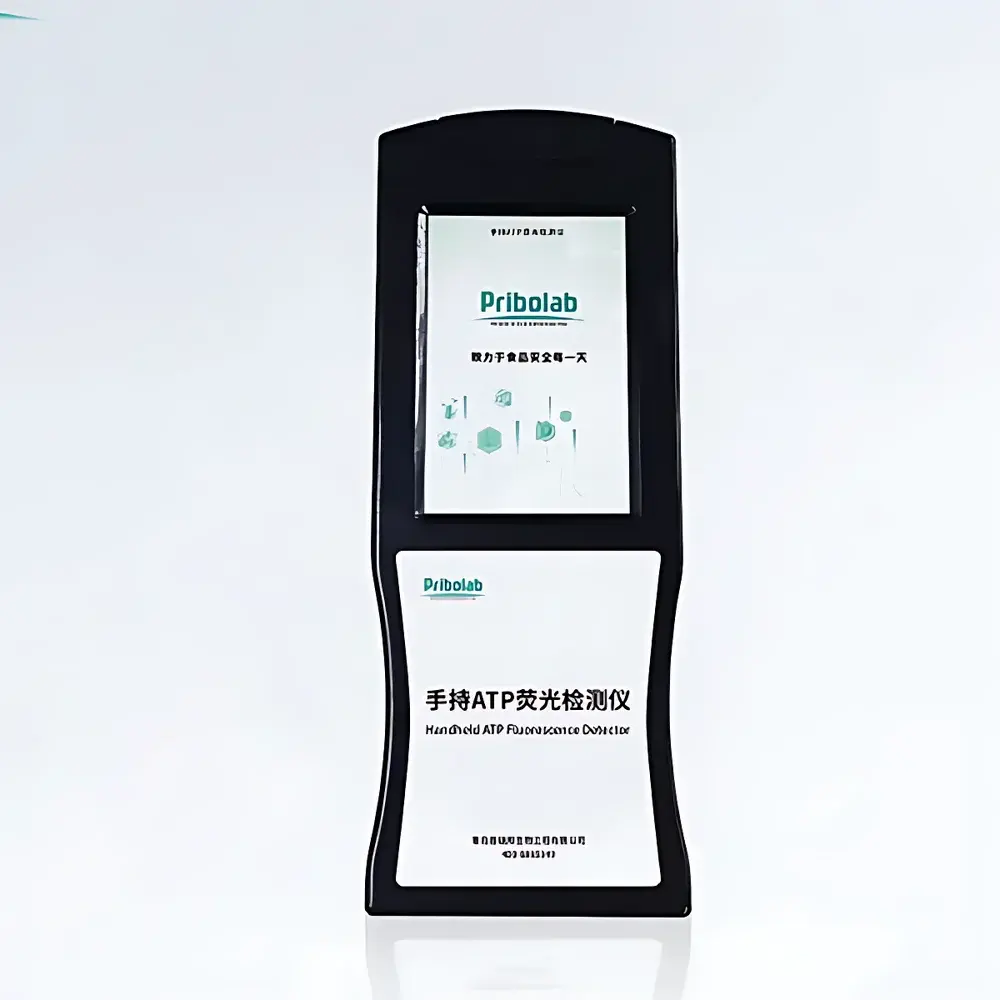
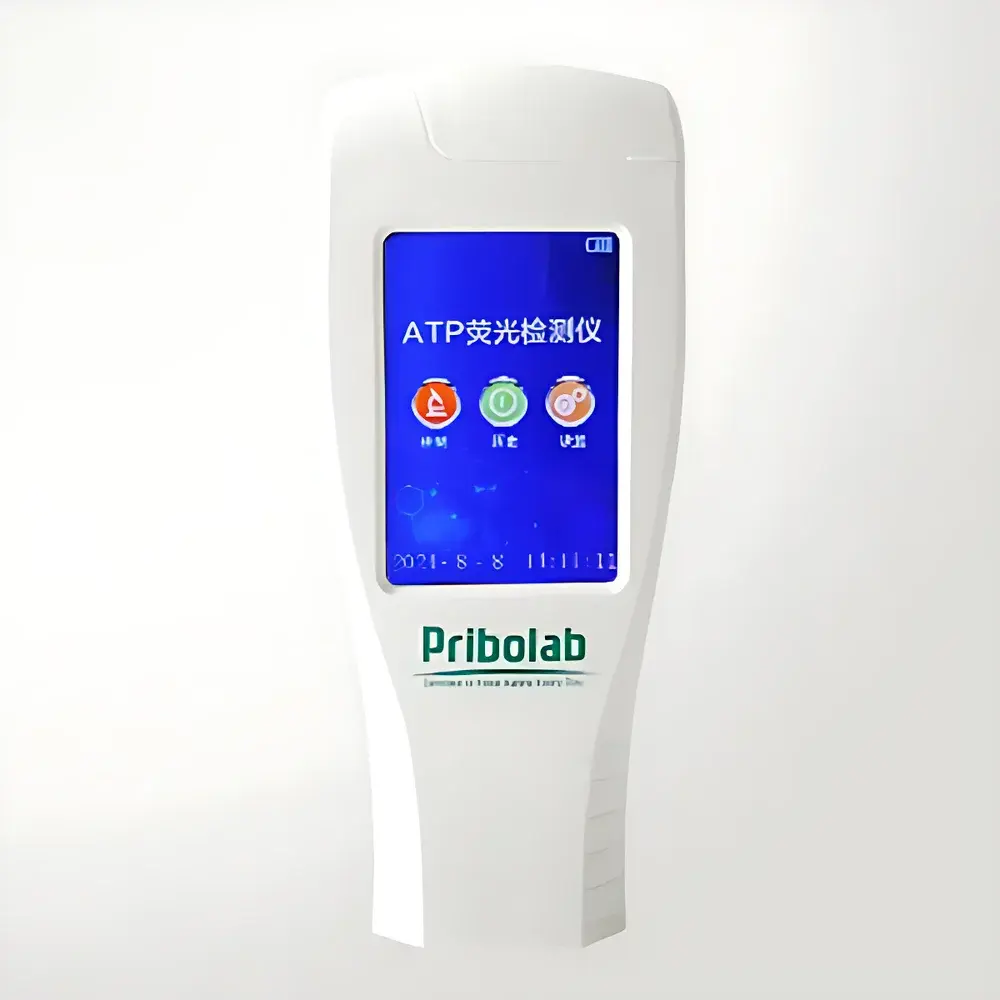
Pribolab® EQ-ATP01 Handheld ATP Bioluminescence Detector
| Brand | Pribolab |
|---|---|
| Origin | Shandong, China |
| Model | EQ-ATP01 |
| Type | Portable ATP Bioluminescence Analyzer |
| Detection Principle | Firefly Luciferase–Luciferin Bioluminescent Reaction |
| Measurement Range | 0–99999 RLU (Relative Light Units) |
| Detection Time | ≤15 seconds per sample |
| Sample Volume | 10–100 µL |
| Power Source | Rechargeable Li-ion battery (≥8 hours continuous operation) |
| Interface | USB-C & Bluetooth 5.0 |
| Compliance | ISO 22000, HACCP, FDA Food Code Annex 3, EN 13697 (for surface hygiene validation) |
Overview
The Pribolab® EQ-ATP01 Handheld ATP Bioluminescence Detector is a field-deployable, quantitative instrument engineered for rapid assessment of biological contamination on surfaces and in liquids. It operates on the well-established firefly luciferase–luciferin bioluminescent reaction: in the presence of adenosine triphosphate (ATP), luciferase catalyzes the oxidation of luciferin, emitting photons proportional to ATP concentration. Since viable microbial cells maintain tightly regulated intracellular ATP pools—and residual ATP from dead cells, food debris, or organic matter contributes to total signal—the EQ-ATP01 delivers a robust, real-time proxy for total bioburden. Unlike culture-based methods requiring 24–72 hours, this device provides quantitative results in under 15 seconds per test, enabling immediate corrective action in high-risk environments such as food processing lines, clean-in-place (CIP) verification points, hospital operating rooms, and retail foodservice facilities.
Key Features
- Compact, ergonomic handheld design with IP65-rated enclosure for resistance to dust, splashes, and disinfectant exposure.
- High-sensitivity photomultiplier tube (PMT) detector calibrated to measure 0–99,999 RLU with <±5% inter-unit reproducibility at 1,000 RLU (per ISO 21528-2 reference protocol).
- Integrated swab reader cavity with automatic gain control—eliminates manual calibration drift between samples.
- On-device data logging (≥10,000 test records) with time/date stamp, operator ID, and location tagging via optional GPS module.
- Pre-loaded pass/fail thresholds aligned with industry benchmarks: e.g., ≤10 RLU for stainless steel food contact surfaces (per NSF/ANSI 151), ≤50 RLU for non-food-contact zones (per EC 852/2004 guidance).
- Bluetooth 5.0 and USB-C connectivity for seamless synchronization with Pribolab’s CloudSync™ Data Manager software—supporting audit-ready PDF reports and Excel export.
Sample Compatibility & Compliance
The EQ-ATP01 accepts standardized ATP swabs (e.g., 3M Clean-Trace™, Hygiena UltraSnap™, or Pribolab-certified EQ-Swab™) for surface sampling, and liquid-phase testing via direct pipette delivery into the assay chamber. It supports routine verification of cleaning efficacy across stainless steel, polypropylene, glass, ceramic, and silicone surfaces. All assays comply with the fundamental principles of ISO 22000:2018 (Clause 8.2.3 on verification of cleaning procedures), HACCP prerequisite programs, and FDA Food Code §3-302.11 (requiring “objective evidence” of sanitation effectiveness). For regulated environments, the system supports 21 CFR Part 11-compliant electronic signatures and full audit trails when used with validated software configurations.
Software & Data Management
Pribolab CloudSync™ Data Manager (v3.2+) provides centralized management of multi-site ATP data. It enables role-based access control, automated threshold-based alerting (email/SMS), trend analysis by shift/line/zone, and generation of GLP-compliant certificates of analysis (CoA). Raw RLU values are stored with immutable metadata—including swab lot number, reagent expiration, ambient temperature, and user credentials—to satisfy internal quality audits and third-party certification bodies (e.g., BRCGS, SQF, ISO 13485 for medical device manufacturing support).
Applications
- Routine hygiene monitoring of food contact surfaces pre- and post-sanitization in meat, dairy, bakery, and ready-to-eat production lines.
- Validation of CIP cycle efficacy in beverage and pharmaceutical filling systems.
- Real-time assessment of endoscope reprocessing compliance in clinical settings.
- Verification of environmental cleanliness in cleanrooms (ISO Class 5–8) and pharmaceutical manufacturing suites.
- Training and competency evaluation for sanitation staff using objective, numerical feedback instead of subjective visual inspection.
- Third-party food safety auditing—providing auditors with traceable, timestamped digital records.
FAQ
What does RLU stand for, and how is it related to microbial load?
RLU stands for Relative Light Units—a dimensionless output generated by the photodetector in response to bioluminescent photon emission. While not directly convertible to CFU/mL without empirical correlation curves, RLU correlates strongly with total ATP concentration (pico- to nanomolar range), which itself reflects combined contributions from viable microbes, residual organic matter, and cellular debris.
Can the EQ-ATP01 differentiate between bacterial and fungal ATP?
No. The assay detects total ATP regardless of origin. However, consistent baseline RLU profiles—established during validation—enable discrimination between acceptable cleaning outcomes and deviations requiring investigation.
Is swab recovery efficiency validated for this instrument?
Yes. Pribolab provides an independent validation report (per ASTM E2871-19) demonstrating ≥85% ATP recovery from stainless steel, polyethylene, and ceramic surfaces using EQ-Swab™ swabs under controlled humidity and pressure conditions.
How often does the instrument require recalibration?
The EQ-ATP01 employs factory-calibrated photometric referencing and requires no user-performed optical recalibration. Annual performance verification using NIST-traceable ATP standards is recommended per ISO/IEC 17025 guidelines.
Does the device meet regulatory requirements for use in FDA-regulated facilities?
Yes—when deployed within a documented ATP monitoring program that includes defined sampling plans, acceptance criteria, corrective action triggers, and record retention per 21 CFR Part 11 (with appropriate software configuration) and FDA Guidance for Industry: Environmental Monitoring in Pharmaceutical Manufacturing Facilities (2022).






