
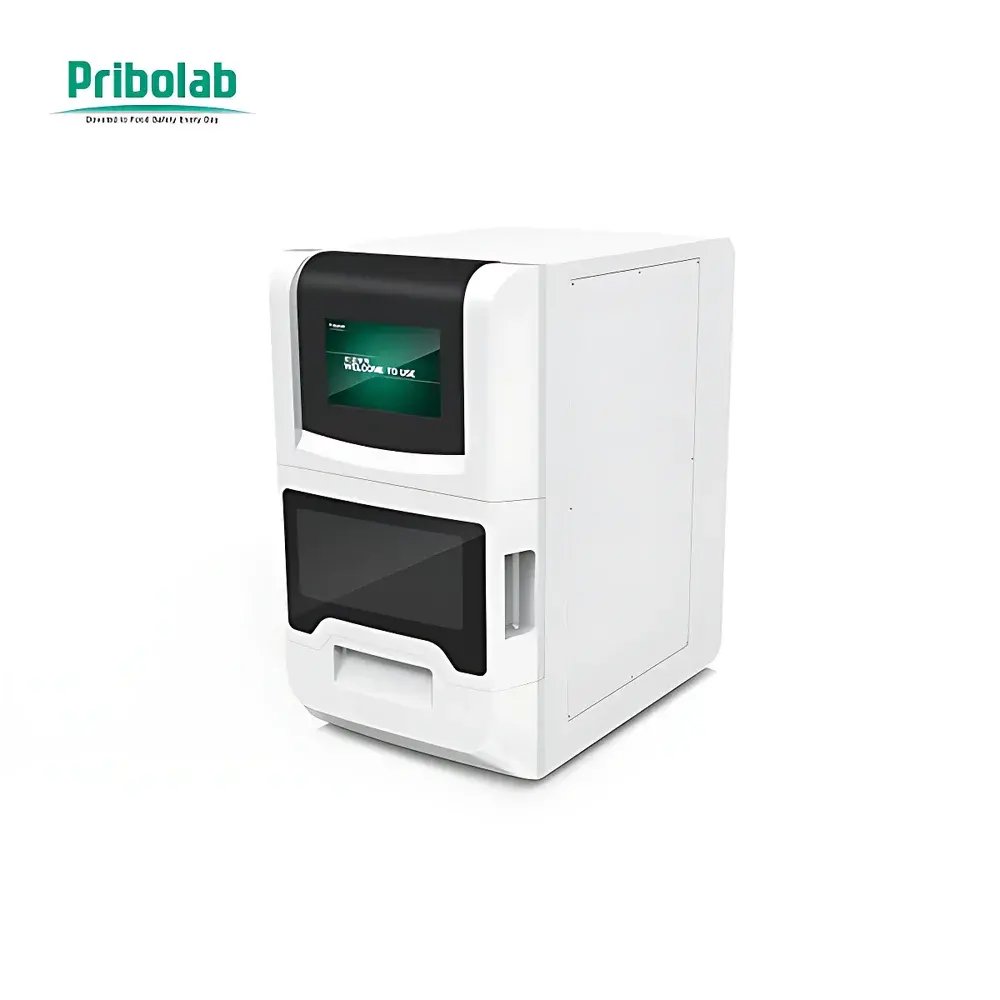
Pribolab MP2000S Automated Multi-Channel Sample Homogenizer
| Brand | Pribolab |
|---|---|
| Model | MP2000S |
| Origin | Shandong, China |
| Construction | Aluminum oxide sample tray, food-grade stainless steel homogenizing probe |
| Dimensions (H×W×D) | 550 × 360 × 630 mm |
| Weight | 33 kg |
| Standard Tray Capacity | 6-position (compatible with 100 mL and 300 mL sample bottles) |
| Optional Trays | 10-position and custom configurations |
| Probe Speed Range | 0–25,000 rpm (10-step BLDC motor control) |
| Positioning Accuracy | < 0.5 mm (mechanical arm), repeatability < 0.1 mm |
| Cleaning System | Multi-solvent rinse + ultrasonic cleaning + reverse-rotation probe cleaning |
| Control Interface | Touchscreen with editable, savable homogenization methods |
| Homogenization Motion | Vertical amplitude adjustment during operation |
| Enclosure | Powder-coated steel housing with ergonomic 3D panel design |
Overview
The Pribolab MP2000S Automated Multi-Channel Sample Homogenizer is an engineered solution for high-throughput, reproducible sample disruption in analytical laboratories performing food safety testing, feed quality control, environmental monitoring, and life science research. Based on high-shear rotor-stator homogenization principles, the system applies intense mechanical forces—including laminar shear, turbulent cavitation, centrifugal extrusion, and interfacial fluid collision—within a precisely controlled gap between rotating and stationary elements. This enables efficient cell lysis, particle size reduction, emulsification, and suspension homogenization across heterogeneous matrices such as meat tissue, cereal grains, leafy biomass, dairy products, and viscous biological suspensions. Designed to comply with national standard requirements for homogenization in residue analysis (e.g., GB/T 20770–2006, GB/T 23200.113–2018), the MP2000S integrates mechanical precision, programmable flexibility, and process traceability into a single platform.
Key Features
- Automated multi-sample processing: Supports sequential homogenization of up to 6 samples per run using standardized or custom-configured trays (6-, 10-, or user-defined positions).
- Intelligent tray recognition: Automatically detects tray type and adjusts operational parameters accordingly, minimizing manual configuration errors.
- High-performance homogenization probe: Constructed from food-grade stainless steel (AISI 316 equivalent), resistant to organic solvents, acids, and alkaline media; fully disassemblable for sterilization and deep cleaning.
- Variable-speed BLDC motor: Ten discrete speed settings (0–25,000 rpm) with torque stability across load variations, enabling optimization for soft tissues, fibrous plant material, or dense animal organs.
- 3D motion control: Programmable vertical amplitude modulation ensures full immersion coverage within sample containers (100–300 mL), enhancing homogeneity and reducing residual stratification.
- Integrated cleaning subsystem: Combines solvent-based rinsing, ultrasonic decontamination (40 kHz), and reverse-direction probe rotation to eliminate cross-contamination risks between runs.
- Ergonomic human-machine interface: 7-inch capacitive touchscreen with intuitive method editor, password-protected user profiles, and onboard storage for ≥100 preconfigured protocols.
Sample Compatibility & Compliance
The MP2000S accommodates a broad spectrum of sample types relevant to regulatory and routine laboratory workflows—including raw and processed foods (fruits, vegetables, meats, seafood), compound feeds and premixes, soil extracts, microbial cultures, and clinical biospecimens (blood, feces, tissue biopsies). Its mechanical architecture meets structural safety standards for Class II laboratory equipment (IEC 61010-1:2010). While not certified under ISO/IEC 17025 for accredited testing, the system supports GLP-compliant operation through method versioning, operator audit logs, and electronic record retention. It aligns with common method validation criteria outlined in AOAC Official Methods of Analysis® and EU Commission Regulation (EU) No 519/2014 for pesticide residue extraction.
Software & Data Management
The embedded control firmware provides full method lifecycle management: creation, editing, duplication, and archival of homogenization protocols—including speed, duration, amplitude, pause intervals, and cleaning cycles. All executed runs are timestamped and logged with operator ID, tray ID, probe serial number, and real-time motor performance metrics. Export options include CSV-formatted reports compatible with LIMS integration. The system does not require external software installation and operates independently of Windows or macOS environments. For laboratories subject to FDA 21 CFR Part 11 compliance, optional firmware upgrades support electronic signatures, audit trail encryption, and role-based access control—subject to site-specific validation documentation.
Applications
- Routine preparation of samples for pesticide residue analysis (GC-MS/MS, LC-MS/MS)
- Homogenization of feed matrices prior to mycotoxin quantification (e.g., aflatoxins, deoxynivalenol)
- Cell lysis and nucleic acid extraction workflows in molecular diagnostics labs
- Standardized dispersion of particulate contaminants in environmental sediment or sludge
- Pre-analytical processing for heavy metal determination (ICP-MS, AAS) in food and agricultural commodities
- QC/QA batch homogenization in contract testing laboratories serving ISO/IEC 17025-accredited clients
FAQ
Does the MP2000S support validation documentation for regulated environments?
Yes—while the base unit is supplied without formal IQ/OQ documentation, Pribolab provides protocol templates, calibration checklists, and traceable performance verification procedures suitable for internal validation under GLP or GMP frameworks.
Can the homogenization probe be autoclaved?
No—the probe assembly is not autoclavable due to integrated electrical contacts and sealing materials; however, it is compatible with ethanol, sodium hypochlorite (≤5%), and alkaline detergent washes followed by ultrasonic cleaning.
Is remote monitoring or network connectivity available?
The standard configuration lacks Ethernet or Wi-Fi interfaces; however, USB export of run logs enables offline integration with centralized data repositories.
What maintenance intervals are recommended?
Lubrication of the mechanical arm lead screw and inspection of probe O-rings are advised every 500 operating hours; BLDC motor service life exceeds 15,000 hours under typical usage conditions.
Are replacement trays and probes supplied with serialized traceability?
Yes—all consumable and modular components carry unique identifiers linked to manufacturing lot numbers and material certifications (RoHS, REACH, FDA 21 CFR 170–189 compliant materials).



