
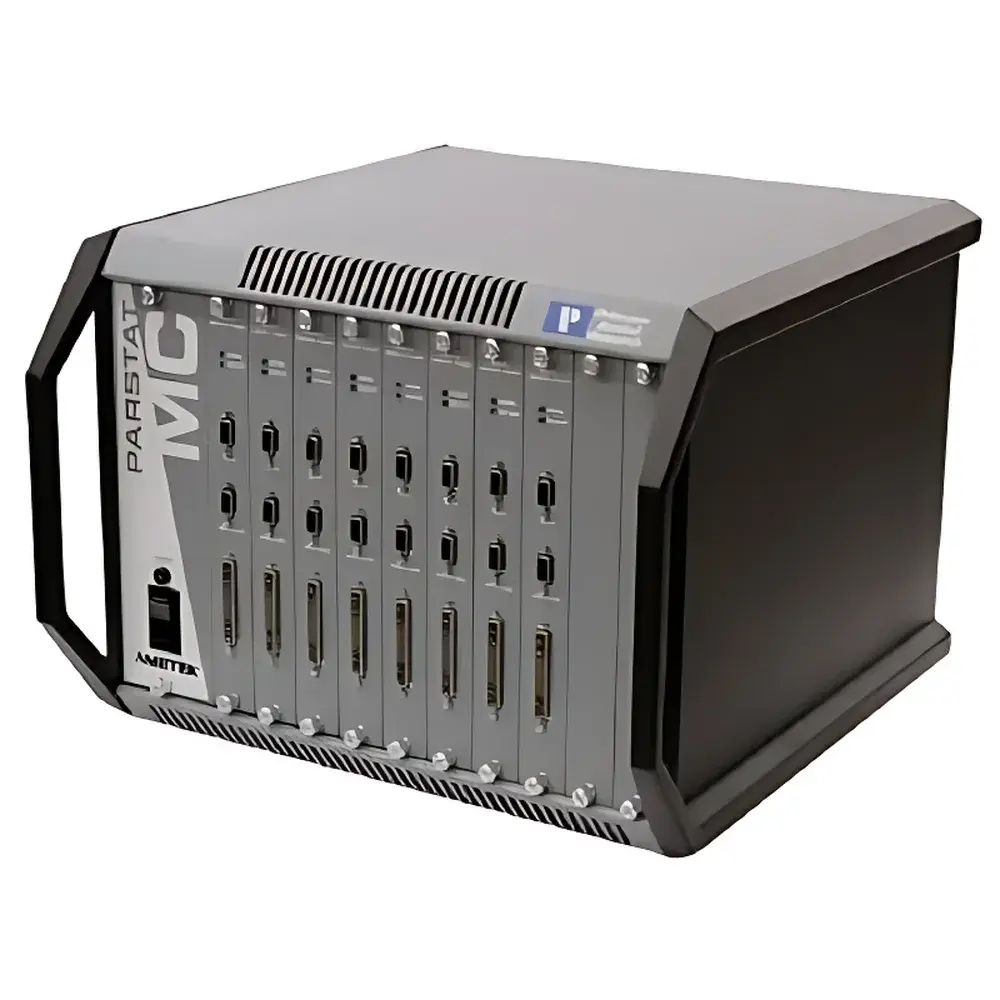
Princeton Applied Research PAR STAT MC Multi-Channel Electrochemical Workstation
| Brand | Princeton Applied Research |
|---|---|
| Origin | USA |
| Manufacturer Type | Authorized Distributor |
| Product Origin | Imported |
| Model | PAR STAT MC |
| Instrument Type | Electrochemical Workstation |
| Current Range | 4 nA – 2 A |
| Current Accuracy | ±0.2% of full scale |
| Potential Accuracy | ±0.2% of full scale |
| Potentiostatic Range | ±30 V |
| EIS Frequency Range | 10 µHz – 7 MHz |
Overview
The Princeton Applied Research PAR STAT MC Multi-Channel Electrochemical Workstation is a high-performance, modular electrochemical measurement platform engineered for precision, scalability, and experimental flexibility in advanced research and industrial quality control environments. Built upon over five decades of electrochemical instrumentation expertise, the PAR STAT MC employs true independent-channel architecture—each channel operates with fully isolated potentiostat/galvanostat circuitry, enabling simultaneous, non-interfering electrochemical experiments across up to eight physical channels within a single chassis. Its core measurement principle is based on bipotentiostatic control with real-time digital feedback, supporting potentiodynamic, potentiostatic, galvanostatic, and impedance-based techniques—including cyclic voltammetry (CV), linear sweep voltammetry (LSV), chronoamperometry (CA), chronopotentiometry (CP), open-circuit potential (OCP) monitoring, and electrochemical impedance spectroscopy (EIS). Designed for rigorous laboratory use, the system meets fundamental requirements for trace-level current resolution (down to 120 fA in the PMC-1000 module), wide dynamic potential range (±30 V), and ultra-low-frequency EIS capability (10 µHz), making it suitable for corrosion studies, battery electrode characterization, sensor development, and fundamental interfacial kinetics analysis.
Key Features
- Modular 8-channel architecture: Each channel functions as an independent workstation with dedicated analog front-end, ADC/DAC, and control logic—no shared resources or timing bottlenecks.
- Hot-swappable channel modules: Individual PMC modules (e.g., PMC-500, PMC-1000, PMC-2000) can be inserted or removed during active operation without interrupting other channels’ experiments.
- High-resolution current measurement: PMC-1000 module delivers 120 fA current resolution across its 4 nA–2 A range, enabling sub-picoampere detection in ultra-low-current applications such as single-molecule electrochemistry or passive film growth monitoring.
- Broad EIS capability: 10 µHz–7 MHz frequency coverage with 1 MS/s data acquisition rate supports both slow diffusion-controlled processes and fast double-layer charging dynamics.
- True floating design: Standard isolation allows multi-electrode measurements in the same electrochemical cell—critical for comparative studies of catalyst arrays, differential pulse configurations, or localized corrosion monitoring.
- Real-time synchronization: All channels share a common master clock, enabling precisely time-aligned multi-electrode transient experiments with sub-microsecond inter-channel timing jitter.
Sample Compatibility & Compliance
The PAR STAT MC accommodates standard three-electrode electrochemical cells (working, counter, reference), microelectrode arrays, rotating disk electrodes (RDE), and custom flow cells. It supports aqueous and non-aqueous electrolytes, high-resistivity solvents, and aggressive media (e.g., concentrated acids or molten salts) when paired with appropriate cell hardware and reference electrodes. The system complies with IEC 61010-1 for electrical safety in laboratory equipment and meets electromagnetic compatibility (EMC) requirements per EN 61326-1. Its software architecture supports audit trails, user access levels, and electronic signatures in accordance with FDA 21 CFR Part 11 for regulated environments. Data integrity and instrument calibration records are maintained per GLP/GMP documentation standards.
Software & Data Management
VersaStudio™ software serves as the native control and analysis environment for the PAR STAT MC. It provides intuitive experiment sequencing, real-time visualization of multi-channel data streams, automated parameter optimization (e.g., EIS amplitude sweep, CV scan rate ramping), and post-acquisition fitting using embedded equivalent circuit models (e.g., Randles, transmission line, constant phase elements). Raw data are stored in vendor-neutral binary format (.par) with embedded metadata (timestamp, operator ID, instrument configuration, calibration history). Export options include CSV, MATLAB (.mat), and ASCII formats compatible with third-party analysis tools (e.g., Python SciPy, OriginLab, Thermo Fisher Avantage). Version-controlled script automation via VersaStudio’s built-in macro language enables reproducible method deployment across multiple instruments and users.
Applications
- Battery R&D: Parallel testing of cathode/anode materials under identical cycling conditions; differential capacity analysis (dQ/dV) across multiple cells.
- Corrosion science: Simultaneous monitoring of localized pitting initiation on alloy microstructures using multi-electrode sensor arrays.
- Electrocatalysis: High-throughput screening of catalyst libraries via identical CV protocols applied across eight working electrodes in one cell.
- Biosensor development: Real-time amperometric detection of enzymatic reactions with statistical validation through replicate channel measurements.
- Fuel cell membrane evaluation: In-situ EIS mapping of proton conductivity gradients under variable humidity and temperature profiles.
- Electroplating process control: Closed-loop current density regulation across multiple deposition zones using synchronized galvanostatic control.
FAQ
Can all eight channels operate independently with different experimental protocols simultaneously?
Yes—each channel runs its own experiment sequence, including distinct technique selection, parameter sets, and sampling rates, without cross-channel interference.
Is the system compatible with third-party electrochemical cells and accessories?
Yes—the PAR STAT MC uses standard BNC and banana-jack interfaces and supports industry-standard cell geometries and connectors.
What calibration procedures are required before first use?
Factory calibration is performed prior to shipment; users perform routine verification using certified reference resistors and voltage sources per ASTM E2913-21 guidelines.
Does VersaStudio support automated reporting for regulatory submissions?
Yes—custom report templates can be configured to include instrument logs, raw data plots, fitted parameters, and electronic signatures compliant with 21 CFR Part 11.
How is thermal drift managed during long-duration EIS measurements?
The PMC-2000 module incorporates active temperature compensation and low-drift op-amp topology, ensuring <0.5 µV/°C offset stability over 24-hour acquisitions.
Related Products





