
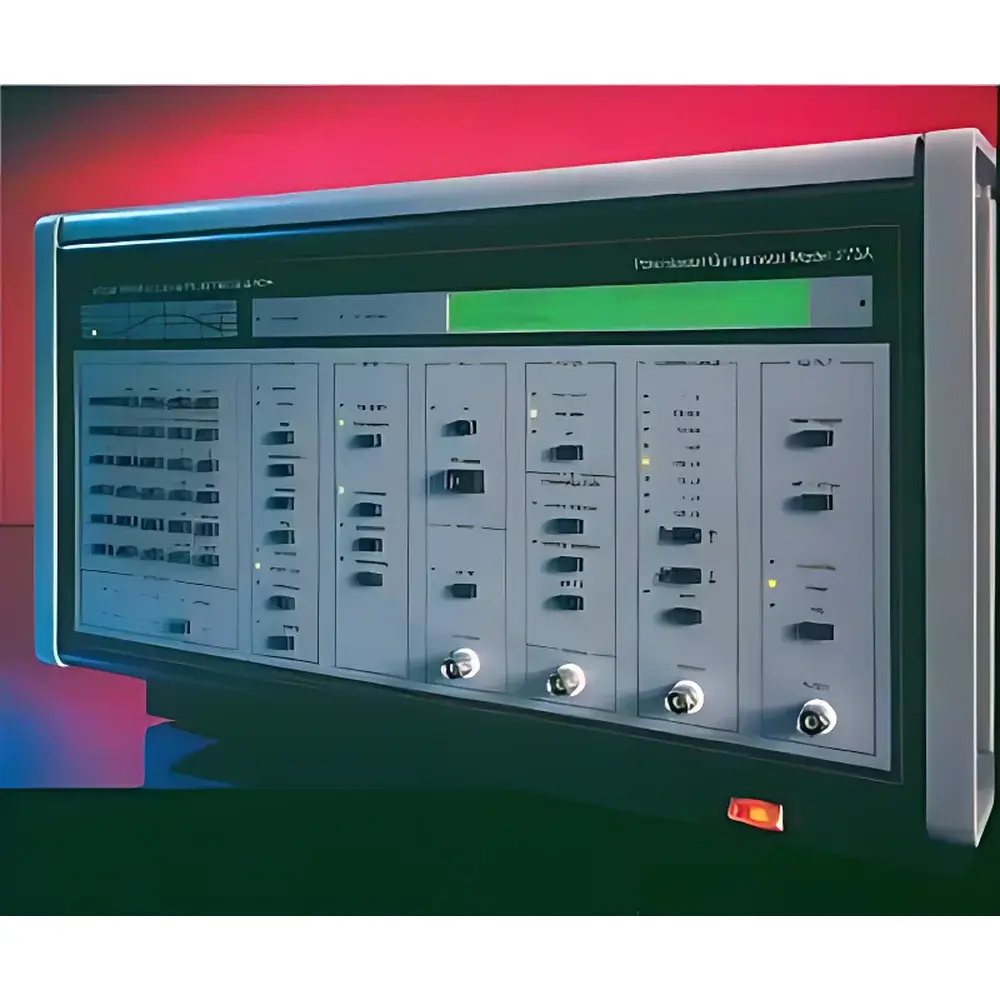
Princeton Applied Research PAR273A Electrochemical Workstation (Potentiostat/Galvanostat)
| [Brand | Princeton Applied Research |
|---|---|
| Origin | USA |
| Model | PAR 273A |
| Maximum Output Voltage | >±100 V |
| Maximum Output Current | >±1.0 A |
| Slew Rate | 10 V/µs |
| Open-Loop Bandwidth (Unity Gain) | >2.5 MHz |
| Electrometer Input Impedance | >10¹² Ω |
| Input Bias Current | <20 pA at 25°C |
| Differential Input Range | ±10 V |
| Reference Input Range | ±11 V |
| Small-Signal Bandwidth | >8 MHz |
| Full-Signal Bandwidth | >400 kHz |
| IR Compensation Range | 2 Ω to 20 MΩ |
| Current Ranges | 1 A to 100 nA (8 decades) |
| Current Measurement Accuracy | 0.2% (10 µA–1 A), 0.5% (100 nA–1 µA) |
| Potentiostatic Control Resolution | 14-bit DAC, ±8 V range |
| Galvanostatic Control Resolution | 14-bit DAC, ±200% of full scale |
| Rise Time (High-Speed Mode) | <750 ns (no load), <3 µs (1 Ω, 1 A) |
| Noise | <25 µV rms (with external input) |
| Interfaces | RS-232C, IEEE-488 (GPIB) |
| Dimensions | 48 cm W × 30 cm H × 51 cm D |
| Weight | 31 kg |
| Power | 100–260 V AC, 50–60 Hz, max 350 W] |
Overview
The Princeton Applied Research PAR273A Electrochemical Workstation is a high-performance, dual-mode potentiostat/galvanostat engineered for rigorous electrochemical research and industrial corrosion analysis. Based on classic analog feedback architecture with embedded microprocessor-controlled digital signal generation, the PAR273A implements true current-source and voltage-source control with exceptional stability, linearity, and temporal fidelity. Its design adheres to fundamental electrochemical instrumentation principles—employing a high-impedance differential electrometer, low-noise transimpedance amplification, and precision analog-to-digital conversion—to ensure accurate measurement of current response under controlled potential or current stimuli. The system supports classical techniques including cyclic voltammetry (CV), chronoamperometry (CA), chronopotentiometry (CP), Tafel analysis, polarization resistance, and linear sweep voltammetry (LSV), while also enabling advanced applications such as pulse techniques, coulometric integration, and impedance spectroscopy when paired with the optional Model 273A/92 EIS interface. As a legacy platform developed during the transition from benchtop analog instrumentation to computer-integrated electrochemistry, the PAR273A remains widely cited in peer-reviewed literature and referenced in ASTM G5, G59, G102, and ISO 17475 standards for corrosion testing and electrode kinetics evaluation.
Key Features
- High-fidelity analog control core with >2.5 MHz open-loop bandwidth and <750 ns rise time (no load), ensuring minimal phase lag in fast-scan experiments.
- Dual independent DACs for simultaneous waveform generation and real-time parameter modulation—supporting custom pulse, staircase, and ramp profiles via front-panel or GPIB/RS-232 commands.
- Integrated digital coulometer with continuous charge integration and display; no external hardware required for quantitative electrolysis or transient charge analysis.
- Eight-decade automatic current ranging (1 A to 100 nA), extendable to 10 nA and 1 nA via computer command; effective current resolution down to 2 pA enables microelectrode and ultramicroelectrode characterization.
- Dual iR compensation modes: positive-feedback (for rapid scanning) and current-interrupt (for precise solution resistance correction), both programmable across 2 Ω to 20 MΩ range with 0.05% step resolution.
- Configurable low-pass filtering (two selectable cutoff frequencies) to suppress high-frequency noise without compromising dynamic response in low-current measurements.
- Safety-critical CELL ON/OFF toggle switch and hardware interlock circuitry compliant with IEC 61010-1 for operator and instrument protection during cell connection/disconnection.
Sample Compatibility & Compliance
The PAR273A accommodates a broad spectrum of electrochemical cells—from standard three-electrode corrosion cells (e.g., ASTM G59-compliant setups) to rotating disk electrodes (RDE), rotating ring-disk electrodes (RRDE), mercury drop electrodes (via Model 303A/307A interfaces), and microelectrode arrays. Its wide compliance voltage (>±100 V) and current output (>±1.0 A) support high-resistance media, coated substrates, and battery electrode testing under realistic load conditions. The instrument meets essential safety and electromagnetic compatibility requirements per UL 61010-1 and CE marking directives. While not inherently 21 CFR Part 11–compliant due to its pre-digital-era architecture, audit-ready data acquisition is achievable when used with validated third-party software (e.g., PowerCV, PowerCORR) running on locked-down Windows environments under GLP/GMP-aligned SOPs. Documentation packages—including calibration certificates traceable to NIST standards and factory test reports—are available upon request for regulated laboratory use.
Software & Data Management
The PAR273A operates natively via its intuitive front-panel interface, but full experimental automation, data logging, and post-processing are realized through its IEEE-488 (GPIB) and RS-232C interfaces. It executes over 100 proprietary PAR command-set instructions—covering initialization, technique selection, parameter definition, start/stop control, and binary data streaming—enabling complete script-driven experiment orchestration. Precompiled application software packages (PowerCV, PowerSTEP, PowerCORR, PowerSINE) provide turnkey implementation of standardized methods, including ASTM G102-based corrosion rate calculation and EIS Kramers-Kronig validation routines. All software supports ASCII and binary export formats compatible with MATLAB, OriginLab, and Python-based analysis pipelines. Raw current/voltage/time datasets are timestamped and stored with metadata (technique ID, parameter set, user tag), facilitating traceability in multi-user lab environments. No cloud connectivity or remote access capabilities are included—data residency remains fully under local IT control.
Applications
- Corrosion science: Tafel extrapolation, electrochemical impedance spectroscopy (EIS), polarization resistance (Rp), and zero-resistance ammeter (ZRA) coupling for galvanic corrosion studies.
- Battery and fuel cell R&D: Charge/discharge profiling, cyclic stability assessment, and interfacial impedance mapping of Li-ion, PEMFC, and solid-state electrolyte systems.
- Electrocatalysis: Kinetic analysis of oxygen reduction (ORR), hydrogen evolution (HER), and CO₂ reduction reactions using rotating electrode hydrodynamics.
- Electroanalytical chemistry: Quantitative detection and speciation using stripping voltammetry, adsorptive stripping, and pulsed techniques on mercury or solid electrodes.
- Materials characterization: Passivation behavior of stainless steels, aluminum alloys, and conductive polymers; coating delamination monitoring via EIS time-series.
- Education and method development: Platform for teaching fundamental electrochemical concepts, validating new pulse protocols, and benchmarking novel sensor architectures.
FAQ
Is the PAR273A compatible with modern Windows operating systems?
Yes—officially supported on Windows 95 through Windows XP; operation on Windows 10/11 is possible via legacy driver emulation or virtual machine environments, though GPIB interface cards may require updated NI-VISA or Prologix adapters.
Can the PAR273A perform electrochemical impedance spectroscopy (EIS) without add-on hardware?
No—the base unit lacks built-in AC excitation capability; EIS requires the optional Model 273A/92 impedance interface module, which provides DC bias superposition, AC signal injection, and harmonic rejection filtering.
What is the minimum detectable current with optimal shielding and filtering?
Under Faraday cage conditions, with 100 nA range selected and low-pass filter engaged, RMS current noise is typically ≤5 pA, permitting reliable detection of sub-picoampere faradaic processes.
Does the PAR273A support four-electrode (Kelvin) configuration for high-resistance measurements?
No—it is a conventional three-electrode potentiostat; four-terminal sensing requires external instrumentation or custom cabling modifications not covered by factory warranty or calibration.
Are calibration files and service manuals available for in-house maintenance?
Yes—Princeton Applied Research provides comprehensive service documentation, schematics, and factory calibration procedures under NDA; annual recalibration services are offered through authorized service centers in North America and Europe.
Related Products





