
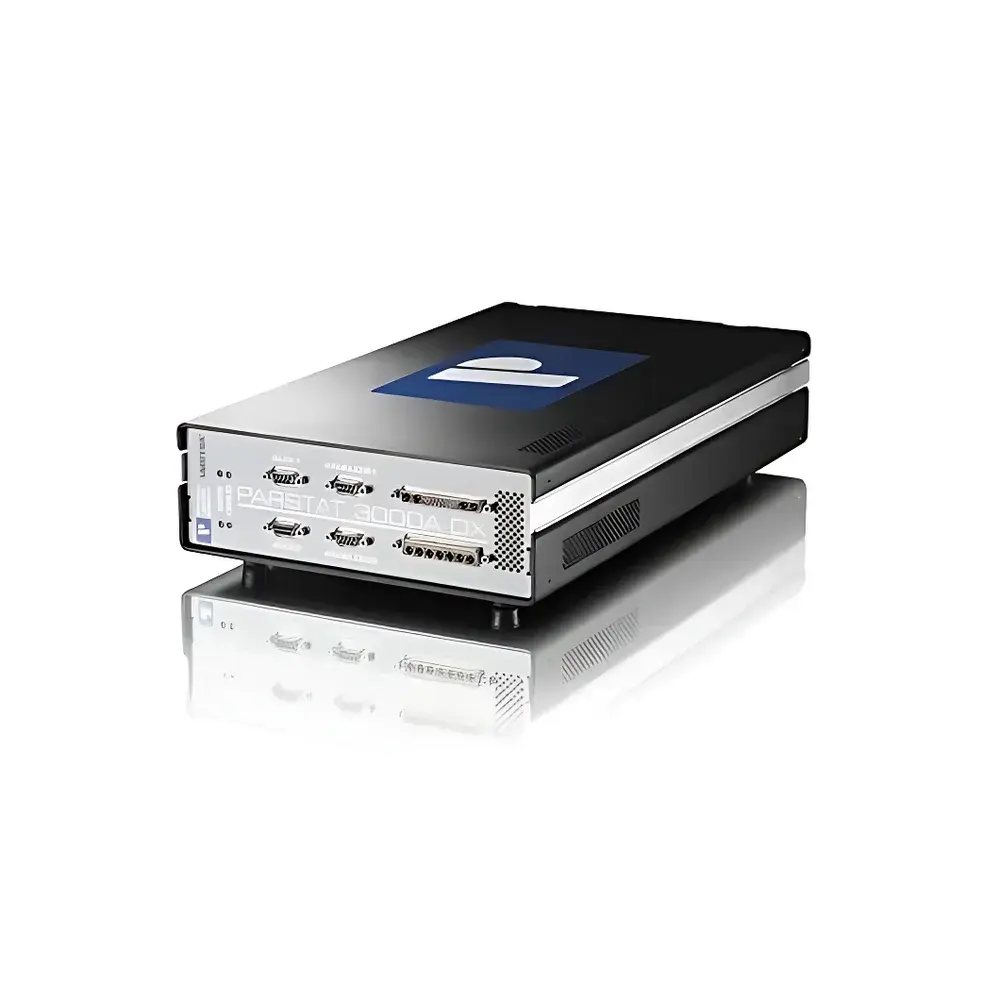
Princeton Applied Research PARSTAT 3000A Electrochemical Workstation
| Brand | Princeton Applied Research |
|---|---|
| Origin | USA |
| Model | P3000A |
| Channel Configuration | Single-Channel |
| Current Range | ±1 A |
| Current Accuracy | ±0.2% of reading |
| Potential Accuracy | ±0.2% of reading |
| Potentiostatic Range | ±30 V |
| EIS Frequency Range | 10 µHz to 10 MHz |
Overview
The Princeton Applied Research PARSTAT 3000A is a high-performance, single-channel electrochemical workstation engineered for precision potentiostatic, galvanostatic, and electrochemical impedance spectroscopy (EIS) measurements across demanding research and industrial applications. Built upon over five decades of expertise in electrochemical instrumentation design, the PARSTAT platform embodies rigorous engineering standards for stability, low-noise signal acquisition, and wide dynamic range. The P3000A implements a true analog feedback architecture with digitally controlled analog front-end circuitry, enabling accurate control and measurement under both high-current (±1 A) and ultra-low-current (sub-nA) conditions. Its ±30 V compliance voltage supports high-voltage systems including multistage battery stacks (e.g., up to 20 NiMH or 6 Li-ion cells), solid-state electrolytes, and high-impedance media such as concrete or organic solvents. With an EIS frequency bandwidth spanning from 10 µHz to 10 MHz — among the widest available in benchtop workstations — the system delivers exceptional resolution for interfacial kinetics, charge-transfer resistance, diffusion-limited processes, and dielectric characterization of coatings and thin films.
Key Features
- True single-channel potentiostat/galvanostat with ±1 A current output and ±30 V compliance voltage
- High-fidelity EIS capability: 10 µHz–10 MHz frequency sweep with <±0.2% accuracy in both potential and current measurement
- 6-wire auxiliary voltage sensing for precise, simultaneous cathode/anode or cell-level DC and AC impedance monitoring in battery packs
- 1 MS/s (1,000 kS/s) real-time data acquisition rate, supporting transient analysis of supercapacitor discharge, pulse testing, and fast-scan cyclic voltammetry
- Low-noise design optimized for high-impedance systems: compatible with sintered glass frits, non-aqueous electrolytes, pH electrodes, and low-conductivity media (e.g., polymers, ceramics, concrete)
- Compact footprint suitable for integration into gloveboxes, environmental chambers, or space-constrained lab setups
- IR drop compensation via current-interrupt, positive-feedback, or EIS-based uncompensated resistance (Ru) estimation
Sample Compatibility & Compliance
The PARSTAT 3000A accommodates diverse electrochemical configurations including three-electrode cells, two-electrode battery testing, coated metal substrates, microelectrodes, and multi-electrode sensor arrays. It supports standard reference electrodes (Ag/AgCl, SCE, Hg/HgO), inert counter electrodes (Pt mesh, graphite rods), and working electrodes ranging from bulk metals to nanostructured thin films. The instrument meets essential electrical safety and electromagnetic compatibility requirements per IEC 61010-1 and CE directives. While not pre-certified for GMP/GLP environments, its architecture supports audit-ready operation when integrated with compliant software (e.g., PowerCV or VersaStudio with 21 CFR Part 11-compliant modules). Data integrity protocols—including timestamped raw data logging, user-access controls, and electronic signature options—are configurable to align with ISO/IEC 17025, ASTM G59, G102, and USP guidelines for analytical instrument qualification.
Software & Data Management
Controlled via VersaStudio software (Windows OS), the PARSTAT 3000A provides intuitive experiment setup, real-time visualization, and post-acquisition analysis tools including Kramers-Kronig validation, equivalent circuit modeling (ZView® integration), Tafel extrapolation, and derivative CV analysis. All experiments are saved in vendor-neutral binary format (.par) with embedded metadata (user ID, timestamp, method parameters, calibration history). Export options include CSV, TXT, and MATLAB-compatible .mat files. For regulated environments, optional VersaStudio IQ/OQ/PQ packages support installation and operational qualification, while audit-trail-enabled versions provide full traceability of method changes, data exports, and user logins—meeting FDA 21 CFR Part 11 and EU Annex 11 expectations where deployed with validated IT infrastructure.
Applications
- Energy storage R&D: EIS of solid-state batteries, Li-S cells, and redox flow systems; pulse testing of supercapacitors; degradation mapping of electrode interfaces
- Corrosion science: Electrochemical noise monitoring, polarization resistance (LPR), and localized corrosion assessment in reinforced concrete or marine alloys
- Materials electrochemistry: Growth kinetics of passive oxide layers on Ti, Al, or stainless steel; electrophoretic deposition (EPD) process optimization
- Sensor development: Multi-frequency impedance readout for label-free biosensors; stability evaluation of conducting polymer transducers
- Fundamental kinetics: Fast-scan CV for adsorption-controlled reactions; rotating disk electrode (RDE) studies with ohmic drop correction
- Coating & surface engineering: Dielectric spectroscopy of polymer films; defect quantification in anodized or plasma-sprayed layers
FAQ
What is the maximum number of electrodes supported in a single experiment?
The PARSTAT 3000A is a single-channel workstation; it controls one working electrode at a time but supports full 3-electrode configuration (WE, CE, RE) plus optional auxiliary voltage sensing lines.
Can the P3000A perform galvanostatic EIS?
Yes — it supports both potentiostatic and galvanostatic EIS modes, with automatic switching between control modes during hybrid experiments.
Is external triggering or synchronization with other instruments possible?
Yes — TTL-compatible trigger I/O ports enable hardware synchronization with potentiostats, source-measure units, or optical spectrometers for operando studies.
Does the system include built-in Faradaic efficiency measurement capability?
No — Faradaic efficiency requires integration with gas chromatography or mass spectrometry; however, the P3000A’s high-speed current sampling enables accurate charge integration for coulombic calculations.
How is IR compensation implemented?
Through multiple methods: current-interrupt (CI), positive-feedback (PF), and EIS-derived uncompensated resistance (Ru) estimation — all adjustable in real time during acquisition.




