
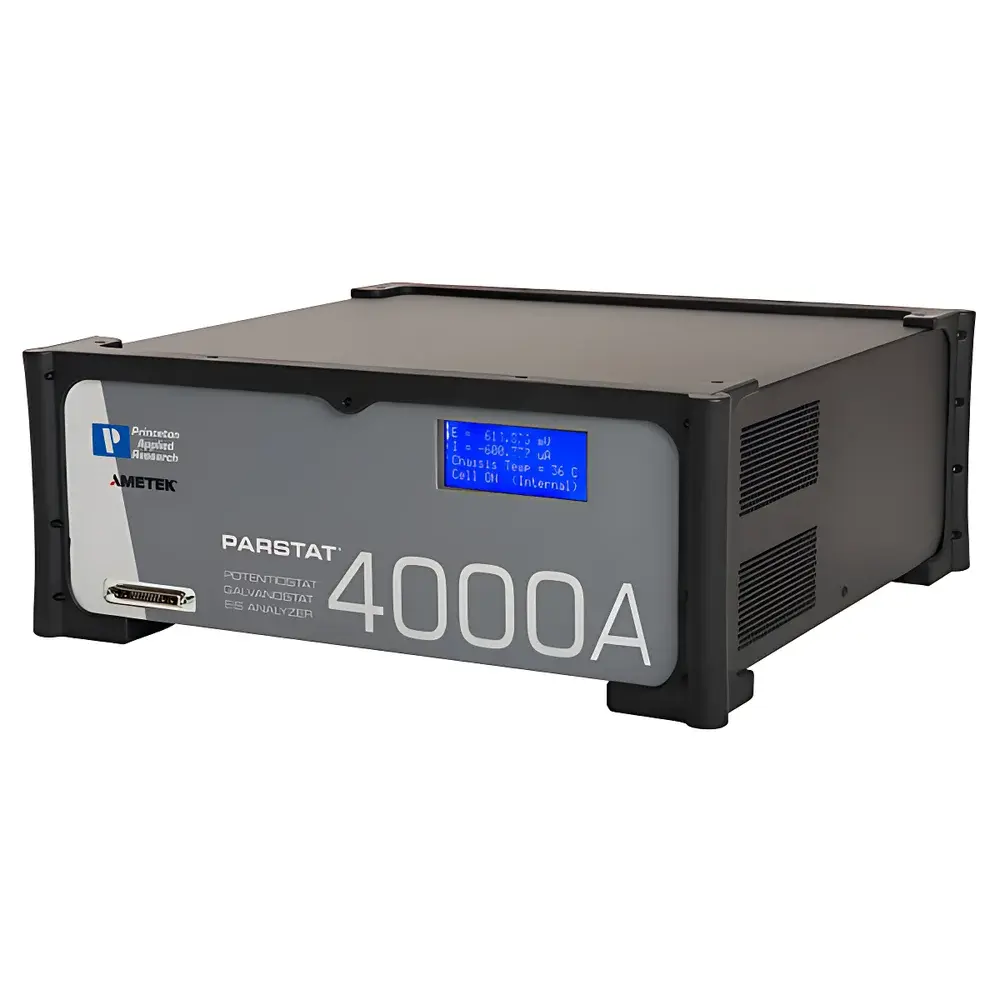
Princeton Applied Research PARSTAT 4000A Electrochemical Workstation
| Brand | Princeton Applied Research |
|---|---|
| Origin | USA |
| Model | PARSTAT 4000A |
| Channel Count | Single-Channel |
| Current Range | ±4 A (expandable to ±20 A) |
| Current Resolution | 1.2 fA (standard), 2.5 aA (with low-current option) |
| Current Accuracy | ±0.2% of reading + ±0.2% of range |
| Potential Accuracy | ±0.2% of value ± 2 mV |
| Potentiostatic Range | ±10 V |
| Galvanostatic Range | ±4 A |
| Compliance Voltage | ±48 V |
| EIS Frequency Range | 10 µHz – 10 MHz |
| Sampling Rate | 1 µs |
| Onboard Memory | 4 MB |
| Input Impedance | >10¹³ Ω |
| Grounding Mode | Floating (isolated ground) |
Overview
The Princeton Applied Research PARSTAT 4000A Electrochemical Workstation is a research-grade, single-channel potentiostat/galvanostat/FRA system engineered for precision, stability, and broad-spectrum electrochemical characterization. Built upon five decades of expertise in electrochemical instrumentation design, the PARSTAT 4000A implements a true analog front-end architecture with ultra-low-noise current measurement circuitry, high-voltage compliance, and real-time digital signal processing. Its core measurement principle relies on controlled-potential (potentiostatic) and controlled-current (galvanostatic) excitation combined with high-fidelity current and voltage sensing—enabling quantitative analysis of interfacial charge transfer kinetics, mass transport, double-layer capacitance, and distributed impedance across solid–liquid, solid–gas, and biological interfaces. The system supports fundamental techniques including cyclic voltammetry (CV), linear sweep voltammetry (LSV), chronoamperometry (CA), chronopotentiometry (CP), electrochemical impedance spectroscopy (EIS), and corrosion-specific protocols such as linear polarization resistance (LPR), Tafel analysis, and electrochemical noise measurement (ENM). Designed for laboratories requiring trace-level current resolution, high-voltage operation, and robust data integrity under demanding experimental conditions, the PARSTAT 4000A meets the technical demands of modern electrochemistry—from battery electrode screening to nanoscale deposition and bioelectrochemical sensor development.
Key Features
- ±48 V compliance voltage enables stable operation with high-impedance systems, including coated metals, concrete, soil, polymer electrolytes, and fuel cell membranes.
- Standard ±4 A current output (expandable to ±20 A via external amplifier) accommodates both microscale and macroscale electrochemical processes—from nanoelectrode studies to industrial-scale battery cycling.
- Ultra-low current detection: 40 pA full-scale range with 1.2 fA resolution; optional low-current module extends resolution to 2.5 aA and minimum range to 80 fA.
- Integrated frequency response analyzer (FRA) supporting EIS over 10 µHz–10 MHz with phase accuracy <0.1° and magnitude accuracy <0.02 dB.
- 1 µs per-point sampling rate with 4 MB onboard memory buffer ensures no data loss during communication latency or PC interruptions.
- Floating (isolated) ground architecture eliminates ground loops when measuring grounded samples—e.g., reinforced concrete rebar, autoclaved reactors, or pipeline sections.
- Front-panel LCD display allows real-time monitoring of key parameters—including applied potential, measured current, impedance modulus/phase, and experiment status—without host PC dependency.
Sample Compatibility & Compliance
The PARSTAT 4000A is compatible with three-electrode electrochemical cells (working, reference, counter), two-electrode configurations (e.g., symmetric supercapacitors), and multi-electrode arrays via auxiliary I/O ports. It supports aqueous, non-aqueous, ionic liquid, and solid-state electrolyte systems. The instrument complies with international standards relevant to electrochemical testing, including ASTM G5, G102, G106 (corrosion), ASTM F2942 (battery impedance), ISO 17025 (testing laboratory competence), and USP (particulate matter in injectables, where electrochemical sensors are deployed). Its hardware architecture and Studio software support audit trails, user access control, electronic signatures, and data integrity features aligned with FDA 21 CFR Part 11 requirements for regulated environments. Input impedance exceeds 10¹³ Ω, ensuring minimal loading error during high-resistance measurements such as thin-film coatings or insulating biomaterials.
Software & Data Management
Controlled by the proprietary Studio software suite (v3.2+), the PARSTAT 4000A provides a modular, experiment-driven interface with preconfigured methods for corrosion, batteries, sensors, and fundamental electrochemistry. Studio supports sequence-based experimentation, time-delayed start, external trigger synchronization (TTL/Analog), and real-time parameter feedback loops. All raw data—including voltage, current, phase, and magnitude—are stored in open-format binary files (.PAR) with embedded metadata (timestamp, technique, settings, calibration history). Export options include CSV, ASCII, and IMP (ZView-compatible) formats. EIS data can be directly fitted using built-in equivalent circuit modeling (ECM) tools with nonlinear least-squares regression and statistical error estimation. Software updates, firmware patches, and method libraries are distributed via secure Princeton Applied Research customer portal—ensuring long-term maintainability and regulatory traceability.
Applications
- Corrosion Science: Quantitative assessment of corrosion rate, polarization resistance (Rp), breakdown potential, and coating defect density via LPR, Tafel extrapolation, EIS, and electrochemical noise.
- Battery & Energy Storage: Cycle life testing, rate capability evaluation, SEI formation analysis, and impedance mapping across state-of-charge (SOC) using hybrid pulse power characterization (HPPC) and multi-frequency EIS.
- Fuel Cells & Solar Cells: I–V curve acquisition under variable illumination/humidity, membrane resistance profiling (PEMFC), and degradation monitoring of catalyst layers via accelerated stress tests (AST).
- Sensors & Biosensors: Amperometric detection of neurotransmitters, glucose, H₂O₂, and heavy metals using modified electrodes; low-noise current integration for ion-selective and enzymatic transducers.
- Nanomaterials & Electrodeposition: Controlled nucleation and growth of metal nanostructures, graphene oxide reduction, carbon nanotube functionalization, and atomic-layer deposition (ALD)-assisted electroplating.
FAQ
What is the maximum EIS frequency resolution achievable with the PARSTAT 4000A?
The system achieves 0.001% frequency resolution across its full 10 µHz–10 MHz range, enabled by direct digital synthesis (DDS) and adaptive averaging algorithms.
Can the PARSTAT 4000A perform simultaneous multi-technique experiments (e.g., CV + EIS)?
Yes—Studio software supports synchronized technique sequencing, including potentiostatic EIS during open-circuit relaxation or galvanostatic hold steps.
Is the floating ground function hardware-based or software-configurable?
It is a hardware-isolated design with optically coupled signal paths and transformer-coupled power supply, eliminating reliance on software toggling.
Does the system support third-party scripting (e.g., Python or MATLAB APIs)?
Yes—Princeton provides COM-based ActiveX and .NET SDKs for programmatic control, enabling integration into automated test benches and custom data pipelines.
How is current calibration traceability maintained?
Factory calibration uses NIST-traceable shunt resistors and metrology-grade references; users may perform in-field verification using certified calibrators per ISO/IEC 17025 procedures.






