
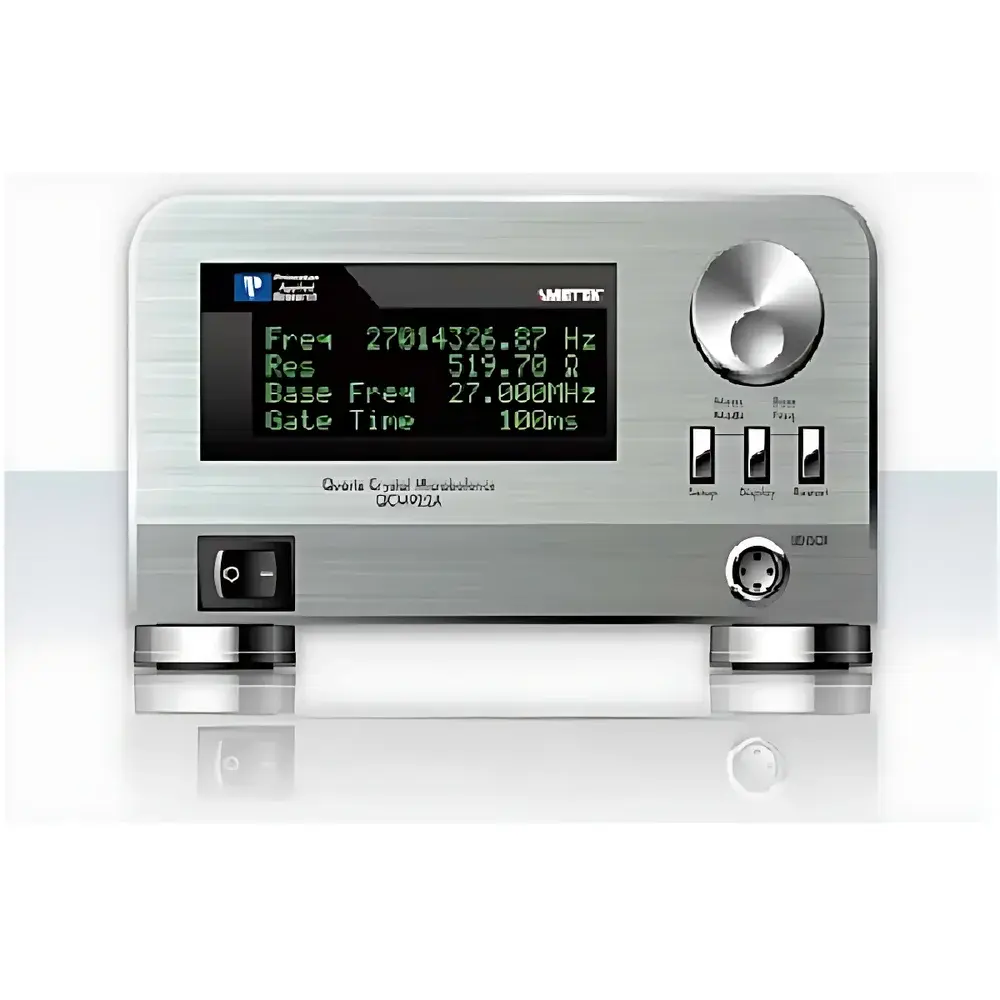
Princeton Applied Research QCM922A Quartz Crystal Microbalance
| Brand | Princeton Applied Research |
|---|---|
| Origin | USA |
| Model | QCM922A |
| Frequency Range | 5–30 MHz |
| Frequency Resolution | 0.01 Hz |
| Resistance Range | 1 Ω – 10 kΩ |
| Resistance Resolution | 0.01 Ω |
| Conductance Frequency Characterization Range | 4–30 MHz |
| Δf Analog Output | ±10 V (14-bit), selectable ranges from ±100 Hz to ±500 kHz |
| ΔR Analog Output | ±10 V (14-bit), selectable ranges from ±10 Ω to ±10 kΩ |
| Analog Inputs | 2 channels, ±3/6/12 V (14-bit) |
| Minimum Control Interval | 10 ms |
| Display | 20-character 4-line OLED |
| Interface | USB 2.0 |
| Power Supply | AC 100–240 V, 50/60 Hz |
| Dimensions (L×W×H) | 162 × 160 × 95 mm |
| Weight | 1.3 kg |
| Operating Temperature | 5–40 °C, non-condensing |
| Certification | CE |
| Compatible Crystals | 9 MHz AT-cut quartz sensors (QA-A9M and QA-A30M series) with electrode materials including Au, Pt, Ag, Al, C, Cu, ITO, Mo, Ni, Si, SiO₂, SUS304, Ti |
| standard electrode diameter | 5 mm |
Overview
The Princeton Applied Research QCM922A Quartz Crystal Microbalance is a high-performance electrochemical microgravimetric instrument engineered for real-time, in situ monitoring of nanogram-scale mass changes at solid–liquid or solid–gas interfaces. Based on the piezoelectric resonance principle—where frequency shift (Δf) of an AT-cut quartz crystal is linearly proportional to mass change per the Sauerbrey equation—the QCM922A extends classical QCM functionality by simultaneously measuring both resonant frequency and motional resistance (ΔR), enabling quantitative differentiation between rigid mass loading and viscoelastic film formation. When coupled with electrochemical control (e.g., potentiostatic or galvanostatic modes), it operates as an Electrochemical Quartz Crystal Microbalance (EQCM), supporting dual-parameter analysis critical for battery interface studies, polymer electrodeposition, biomolecular binding kinetics, and thin-film sensor development. Its 30 MHz maximum operating frequency enhances mass sensitivity over conventional 5–10 MHz systems, while sub-10-ms temporal resolution permits capture of rapid interfacial processes such as ion insertion/extraction in Li-ion battery electrodes or fast protein adsorption events.
Key Features
- Simultaneous dual-parameter acquisition: real-time tracking of frequency (Δf) and motional resistance (ΔR) with independent 14-bit analog outputs for each channel
- Extended frequency range: 5–30 MHz operation with 0.01 Hz frequency resolution and 0.01 Ω resistance resolution
- High-speed data acquisition: minimum control interval of 10 ms, supporting transient kinetic analysis and time-resolved EQCM experiments
- Integrated conductance frequency characterization: 4–30 MHz sweep capability for evaluating structural relaxation and viscoelastic dispersion in soft films
- Modular crystal compatibility: fully backward-compatible with QCM922 sensors and expanded support for QA-A9M and QA-A30M series 9 MHz AT-cut crystals featuring customizable electrode materials (Au, Pt, ITO, Ti/Au, SiO₂, etc.) and standardized 5 mm active diameter
- Embedded OLED display and USB 2.0 interface for standalone operation or seamless integration into automated electrochemical workstations
Sample Compatibility & Compliance
The QCM922A accommodates standard 9 MHz AT-cut quartz crystals with interchangeable electrode configurations, enabling application-specific surface functionalization for biosensing (e.g., thiolated Au surfaces for antibody immobilization), corrosion studies (e.g., Pt or stainless steel electrodes), or battery research (e.g., carbon- or Ti-coated electrodes for Li-metal anode interfaces). All measurements comply with fundamental QCM theory under rigid-film assumptions (Sauerbrey regime) and support extended modeling via Voigt or Kanazawa–Gordon frameworks when combined with ΔR data. The system meets CE marking requirements for electromagnetic compatibility (EMC Directive 2014/30/EU) and low-voltage safety (LVD Directive 2014/35/EU). While not inherently GLP/GMP-certified, its deterministic analog output architecture, timestamped data streams, and USB-based traceability support audit-ready workflows in regulated environments—including FDA 21 CFR Part 11–compliant setups when integrated with validated third-party software and electronic lab notebooks.
Software & Data Management
The QCM922A communicates via USB 2.0 using a vendor-provided SDK (C/C++, Python, LabVIEW drivers included), allowing full programmatic control of acquisition parameters, output scaling, and trigger synchronization with external potentiostats or environmental chambers. Raw Δf and ΔR values are delivered as calibrated voltage signals (±10 V, 14-bit) compatible with standard DAQ systems (e.g., National Instruments, Keysight). For turnkey operation, Princeton Applied Research provides QCM Control Suite—a Windows-based application supporting real-time plotting, batch logging, baseline correction, and export to CSV or HDF5 formats. All data files include embedded metadata (timestamp, crystal ID, temperature, applied potential), facilitating traceability in ISO/IEC 17025-accredited laboratories. No cloud storage or proprietary file locking is implemented; users retain full ownership and control over raw measurement archives.
Applications
- Real-time quantification of Li⁺ intercalation/deintercalation kinetics in cathode/anode materials during cyclic voltammetry or galvanostatic charge–discharge
- In situ monitoring of polyaniline or PEDOT electropolymerization, including nucleation lag time and growth rate determination
- Label-free affinity analysis of protein–ligand interactions (e.g., antigen–antibody, receptor–drug) under physiological buffer conditions
- Dynamic assessment of hydrogel swelling/deswelling responses to pH, ionic strength, or temperature stimuli
- Quantitative evaluation of surface cleanliness via adsorbed contaminant mass detection down to ~0.1 ng/cm²
- Thickness calibration of ultrathin films (e.g., ALD layers, SAMs) using Sauerbrey-derived mass-to-thickness conversion with known density
- Viscoelastic fingerprinting of biofilms or polymer brushes via coupled Δf/ΔR trajectories and conductance dispersion analysis
FAQ
What crystal types are supported by the QCM922A?
The instrument supports all 9 MHz AT-cut quartz crystals compatible with the QCM922 platform, including the QA-A9M series (bare or metallized electrodes) and QA-A30M series (Ti adhesion layer + 100 nm Au). Standard electrode diameter is 5 mm.
Can the QCM922A be used without an electrochemical workstation?
Yes—it operates autonomously for gravimetric gas-phase sensing or passive liquid-phase monitoring. However, EQCM functionality requires synchronization with an external potentiostat via TTL triggers or analog voltage inputs.
Is temperature control integrated into the QCM922A?
No. The unit does not include built-in thermostating; ambient temperature must be maintained between 5–40 °C. For isothermal experiments, users integrate commercial crystal holders with Peltier elements or water-jacketed cells.
How is mass sensitivity calculated for the QCM922A?
Using the Sauerbrey equation: Δm = −Cf·Δf, where Cf (sensitivity constant) depends on crystal fundamental frequency and density. For a 9 MHz crystal with 5 mm electrode area, Cf ≈ 0.081 ng·cm⁻²·Hz⁻¹; higher-frequency crystals yield proportionally greater sensitivity.
Does the QCM922A support multi-harmonic or impedance spectroscopy modes?
No. It performs fundamental-mode resonance tracking only. Impedance analysis (e.g., QCM-D) requires dedicated instrumentation with broadband excitation and phase-sensitive detection capabilities.





