
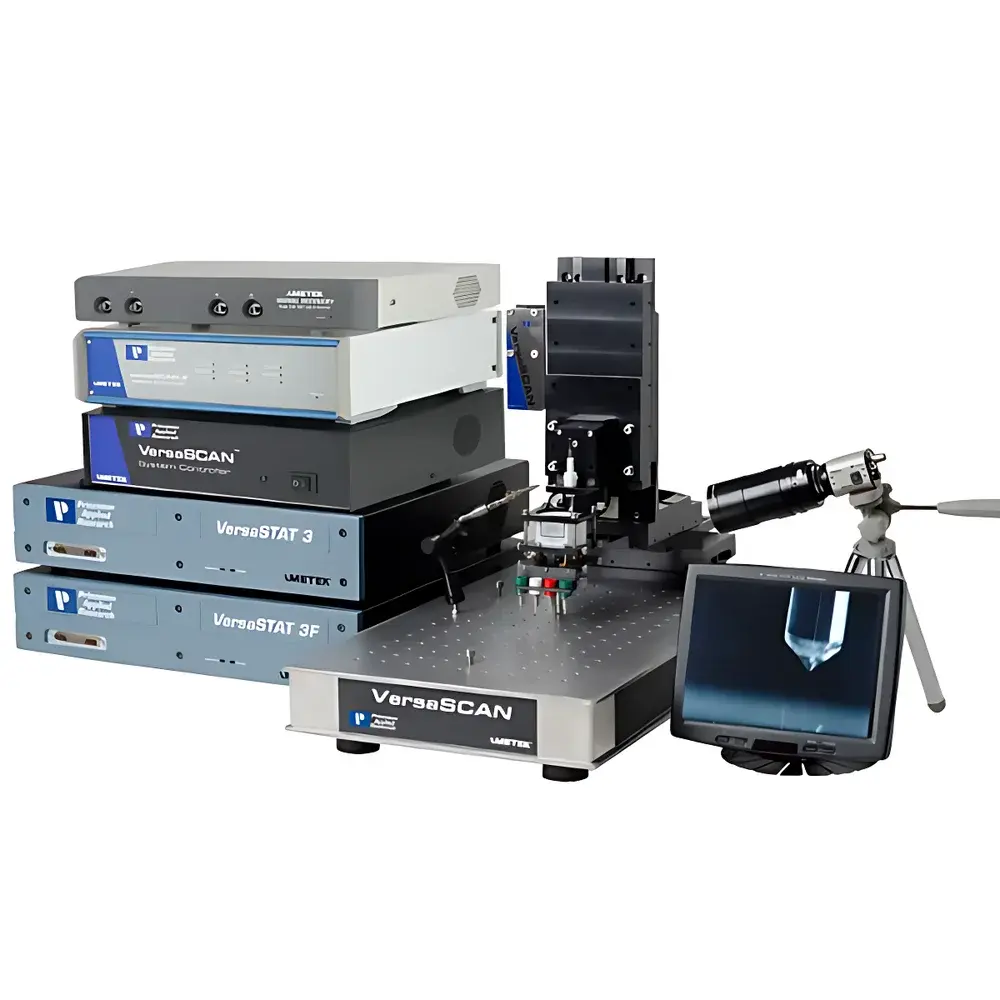
Princeton Applied Research VersaScan Micro-Region Scanning Electrochemical Workstation
| Brand | Princeton Applied Research |
|---|---|
| Origin | United Kingdom |
| Distributor Type | General Distributor |
| Import Status | Imported |
| Model | VersaScan |
| Instrument Type | Electrochemical Workstation |
| Current Range | 4 nA – 2 A |
| Current Accuracy | ±0.2% of reading |
| Potential Accuracy | ±0.2% of reading ± 2 mV |
| Potentiostatic Range | ±10 V |
| EIS Frequency Range | 10 µHz – 1 MHz |
Overview
The Princeton Applied Research VersaScan Micro-Region Scanning Electrochemical Workstation is a high-precision, modular platform engineered for spatially resolved electrochemical characterization at the microscale. Built upon scanning probe electrochemistry principles, it enables non-contact, localized measurements of electrochemical activity, surface potential, interfacial impedance, and topography—without physical contact between probe and sample. The system integrates a closed-loop, high-resolution XYZ positioning stage with long working distance optics, mounted on a vibration-isolated optical table to ensure mechanical stability during sub-micron spatial scans. Core instrumentation includes the VersaSTAT potentiostat/galvanostat, Signal Recovery 7230 lock-in amplifier, and Ethernet-based real-time control architecture optimized for low-noise signal acquisition. Its design adheres to fundamental electrochemical measurement standards—including controlled-current and controlled-potential modes, frequency-domain impedance analysis, and time-resolved transient response capture—making it suitable for rigorous academic research and industrial R&D in corrosion science, energy materials, and interfacial electrochemistry.
Key Features
- Modular architecture supporting multiple scanning probe techniques: Scanning Electrochemical Microscopy (SECM), Scanning Vibrating Electrode Technique (SVET), Scanning Kelvin Probe (SKP), Localized Electrochemical Impedance Spectroscopy (LEIS), Scanning Droplet Cell (SDC), and Non-Contact Optical Surface Profiling (OSP).
- Closed-loop nanopositioning stage with 25 mm travel range in X, Y, and Z axes—calibrated and traceable to NIST-traceable standards.
- Ultra-low current measurement capability down to 4 nA with ±0.2% reading accuracy—critical for detecting localized anodic/cathodic currents in early-stage corrosion or catalytic activity mapping.
- Broad electrochemical bandwidth: DC to 1 MHz AC impedance, enabling kinetic and mechanistic studies from charge-transfer-limited to diffusion-controlled regimes.
- Integrated lock-in detection (via Signal Recovery 7230) for phase-sensitive measurement of weak faradaic signals under noisy environmental conditions—essential for atmospheric thin-film corrosion or buried interface analysis.
- Ethernet-controlled synchronization between positioning, data acquisition, and stimulus generation ensures temporal coherence across multi-parameter datasets.
Sample Compatibility & Compliance
The VersaScan accommodates solid conductive and semiconductive samples—including metals (e.g., stainless steel, aluminum alloys, zinc-coated steels), coated substrates (epoxy, polyurethane, silane-modified surfaces), battery electrode composites, catalyst layers, and semiconductor wafers—without requiring conductive backing or vacuum environments. Sample dimensions up to 150 × 150 mm are supported with optional stage extensions. All electrochemical measurements comply with ASTM G102 (standard practice for calculation of corrosion rates), ASTM G59 (DC polarization resistance), ASTM G106 (electrochemical impedance spectroscopy), and ISO 16773 (localized corrosion testing). Data integrity meets GLP/GMP-aligned requirements through audit-trail-enabled software logging, user-access controls, and timestamped metadata embedding—fully compatible with FDA 21 CFR Part 11–compliant electronic record workflows when deployed with validated software configurations.
Software & Data Management
VersaStudio software provides unified control of hardware modules, scan parameter definition (grid size, step resolution, dwell time, feedback mode), and real-time visualization of 2D/3D electrochemical maps. Raw data are stored in HDF5 format with embedded metadata (instrument configuration, calibration history, environmental conditions), ensuring FAIR (Findable, Accessible, Interoperable, Reusable) compliance. Batch processing supports automated baseline correction, noise filtering (wavelet denoising), and quantitative extraction of local current density, phase angle, or work function gradients. Export options include CSV, MATLAB .mat, and image formats (TIFF, PNG) with pixel-registered coordinate metadata. Integration with Python via PyVersa API enables custom algorithm development for machine learning–based defect classification or kinetic modeling of SEI growth dynamics.
Applications
- In-situ monitoring of pitting initiation and propagation on stainless steel and aluminum under simulated atmospheric conditions (e.g., NaCl aerosol, wet-dry cycling).
- Quantitative assessment of coating barrier properties, defect density, and delamination kinetics at metal/polymer interfaces.
- Mechanistic investigation of filiform corrosion pathways and oxygen reduction reaction (ORR) distribution beneath organic films.
- Mapping of galvanic coupling potentials at Zn–Fe interfaces and stress-corrosion cracking susceptibility zones in welded heat-affected zones.
- Localized impedance spectroscopy of solid-electrolyte interphases (SEI) on Li-ion battery anodes during cycling—correlating impedance modulus with lithiation state and dendrite nucleation sites.
- Electrocatalyst activity mapping for hydrogen evolution (HER), oxygen reduction (ORR), and CO2 reduction reactions (CO2RR) on nanostructured electrodes.
- Surface cleanliness evaluation of semiconductor wafers and microelectronics packaging via work function contrast imaging (SKP mode).
- Performance screening of vapor-phase corrosion inhibitors on ferrous and non-ferrous substrates under variable RH and pollutant exposure.
FAQ
What scanning probe techniques does the VersaScan support out-of-the-box?
SECM, SVET, SKP, LEIS, SDC, and OSP—all enabled by interchangeable probe mounts and firmware-selectable operational modes.
Can the system operate in ambient air or only in liquid electrolytes?
Yes—it supports both aqueous and non-aqueous electrolytes, as well as ambient-air SKP and OSP measurements without electrolyte confinement.
Is the VersaScan compatible with third-party potentiostats or lock-in amplifiers?
No—the system is designed as an integrated platform; VersaSTAT and Signal Recovery 7230 are tightly synchronized via proprietary timing protocols and cannot be substituted.
What is the minimum detectable current resolution in SECM feedback mode?
At 4 nA full scale with 16-bit ADC and lock-in averaging, the effective current resolution is ≤20 pA RMS under optimal shielding and grounding conditions.
Does the software provide automated data analysis for corrosion rate calculation?
Yes—built-in modules compute localized corrosion rates from SVET current density integrals and Tafel extrapolation from polarization curves per scan location.




