
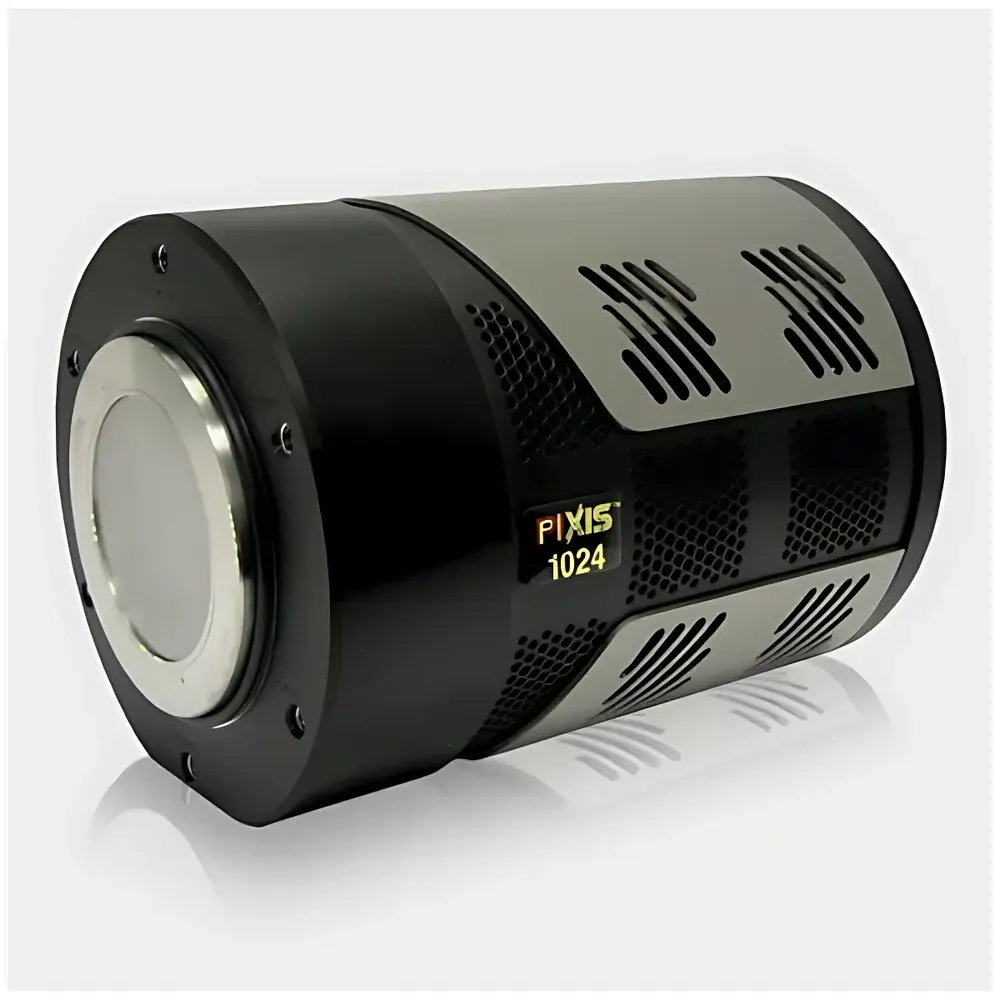
Princeton Instruments PIXIS-XB High-Performance Low-Noise Direct-Detection X-ray Camera
| Brand | Princeton Instruments |
|---|---|
| Sensor Type | Back-illuminated or front-illuminated deep-depletion CCD |
| Energy Range | 3–20 keV |
| Window Material | Vacuum-integrated beryllium (Be) |
| Cooling | Thermoelectric (TE) cooling to –70 °C |
| Readout Architecture | Dual-amplifier selectable for low-noise or high-dynamic-range mode |
| Software Support | LightField v8.x, PICAM SDK, LabVIEW® and MATLAB® integration |
| Compliance | ASTM E1316, ISO/IEC 17025-compatible operation, FDA 21 CFR Part 11-ready audit trail (via LightField) |
Overview
The Princeton Instruments PIXIS-XB is a thermoelectrically cooled, direct-detection X-ray camera engineered for quantitative imaging and spectroscopy in the soft-to-hard X-ray regime (3–20 keV). It employs a deep-depletion, back-illuminated (or optionally front-illuminated) CCD sensor housed within a sealed vacuum chamber featuring a thin, transmission-optimized beryllium entrance window. This architecture eliminates atmospheric absorption and minimizes low-energy X-ray background while preserving quantum efficiency across the operational energy band. Unlike scintillator-coupled detectors, the PIXIS-XB enables photon-counting-capable, single-photon-resolving detection with intrinsic spatial resolution defined by pixel pitch—not optical coupling losses—making it suitable for coherent X-ray techniques including X-ray photon correlation spectroscopy (XPCS), X-ray intensity fluctuation spectroscopy (XIFS), and synchrotron-based micro-tomography. Its vacuum-integrated design ensures long-term sensor stability without requiring external vacuum pumping, enabling turnkey deployment in university labs, industrial QA facilities, and national user facilities.
Key Features
- Thermoelectric cooling to –70 °C: Achieves sub-electron read noise (<3 e⁻ rms) and dark current <0.001 e⁻/pixel/s, critical for long-exposure X-ray imaging and low-flux experiments.
- Vacuum-sealed beryllium window (≤25 µm thickness): Blocks visible light and <2 keV photons while transmitting >90% of 5–20 keV X-rays; prevents sensor contamination and eliminates need for external vacuum interfacing.
- Dual-gain amplifier architecture: Selectable readout modes—low-noise mode (for maximum sensitivity) and high-dynamic-range mode (for linearity up to 100,000 e⁻/pixel)—configured via software without hardware reconfiguration.
- Multiple sensor formats available: 1024 × 1024, 1340 × 1300, and 2048 × 2048 pixel arrays, all with 13.5 µm or 27 µm pixel pitch options, supporting trade-offs between field-of-view, resolution, and frame rate.
- Deep-depletion silicon substrate: Provides extended red/NIR response and enhanced quantum efficiency at 10–20 keV compared to standard CCDs, validated per ASTM F2230 calibration protocols.
Sample Compatibility & Compliance
The PIXIS-XB operates as a stand-alone detector or integrates directly into beamlines, X-ray diffractometers, or tabletop plasma sources. Its Be window allows compatibility with ambient-pressure sample environments—including liquid cells, gas-filled reaction chambers, and in situ electrochemical cells—without compromising vacuum integrity. The system meets mechanical and electrical safety requirements per IEC 61010-1 and supports GLP/GMP workflows through LightField’s 21 CFR Part 11-compliant audit trail, electronic signatures, and secure user access control. Calibration traceability follows NIST-traceable X-ray reference sources (e.g., Mn Kα, Cu Kα), and spectral linearity is verified per ISO 15739:2013 for digital imaging systems.
Software & Data Management
LightField v8.x provides unified control of acquisition parameters, real-time image processing (flat-field correction, background subtraction, region-of-interest binning), and spectral analysis (peak fitting, centroid tracking, autocorrelation). Its embedded math engine supports custom Python- and MATLAB-compatible scripts for on-the-fly data reduction. Native LabVIEW VIs and MATLAB toolboxes enable seamless integration into automated test sequences. For custom application development, the cross-platform PICAM SDK offers low-level access to all hardware registers, bypassing abstraction layers to minimize latency—essential for time-resolved XPCS or pump-probe experiments requiring sub-millisecond synchronization.
Applications
- X-ray photon correlation spectroscopy (XPCS) for nanoscale dynamics in soft matter and colloidal systems
- X-ray diffraction (XRD) and small-angle X-ray scattering (SAXS) on laboratory-scale rotating anode or microfocus sources
- In-line X-ray inspection of additive-manufactured components and battery electrode microstructures
- Time-resolved studies of phase transitions using pulsed X-ray sources (e.g., laser-driven plasma or XFEL harmonics)
- Quantitative radiography for material thickness mapping and defect detection in aerospace composites
FAQ
What is the typical detective quantum efficiency (DQE) at 8 keV?
DQE(0) exceeds 0.75 at 8 keV for the back-illuminated deep-depletion configuration, measured per IEC 62220-1-2 using calibrated Si photodiode reference standards.
Can the PIXIS-XB be used in air without vacuum pumping?
Yes—the integrated Be window and hermetically sealed vacuum chamber eliminate the need for external vacuum connections, enabling benchtop operation in standard laboratory environments.
Is remote triggering supported for synchronization with external events?
Yes—TTL-compatible input/output triggers support hardware-synchronized acquisition with lasers, choppers, or motion stages, with jitter <100 ns. Does LightField support automated calibration routines for energy dispersion?
Yes—IntelliCal performs fully automated wavelength and intensity calibration using built-in reference lines and certified X-ray emission sources, generating ISO 17025-compliant calibration reports.
What is the maximum sustained frame rate at full resolution?
Up to 5.2 fps at 1340 × 1300 pixels in low-noise mode; higher rates achievable via ROI readout or binning, with full metadata tagging per frame.





