
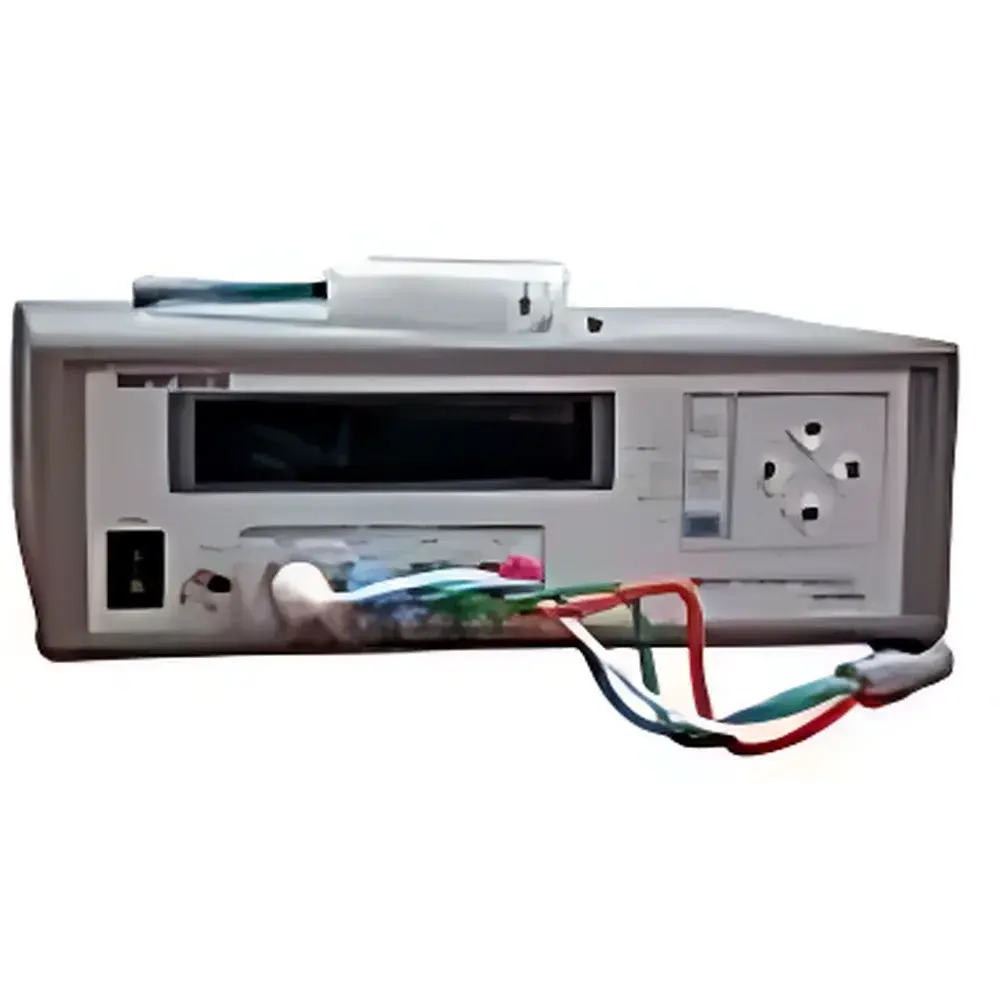
Princeton Instruments QCM 922 Quartz Crystal Microbalance
| Brand | Princeton Instruments |
|---|---|
| Origin | USA |
| Model | QCM 922 |
| Frequency Range | 1–10 MHz |
| Frequency Resolution | 0.1 Hz |
| Resonance Resistance Range | 10–16 kΩ (0.1 Ω resolution) |
| Electrode Area | 0.2 cm² |
| Electrode Material | Sputtered Au or Pt (300 nm thickness) |
| Crystal Fundamental Frequency | 9 MHz |
| Operating Temperature | 0–40 °C |
| Power Supply | 100–120 VAC / 230–240 VAC, 50–60 Hz, 15 W |
| Interface | IEEE-488 (GPIB), RS-232 |
| Analog Output | ±10 V (12-bit), selectable impedance scaling (1/2/4/8/16 kΩ) |
| Display | 40-character × 2-line LCD |
| Dimensions | 26 × 88 × 230 mm |
| Weight | 3.3 kg |
| Software Compatibility | Windows 95/98, ≥100 MHz CPU, 32 MB RAM, 10 MB HDD, GPIB interface card required |
Overview
The Princeton Instruments QCM 922 Quartz Crystal Microbalance is a precision electrochemical mass-sensing instrument engineered for real-time, label-free quantification of nanogram-level mass changes at solid–liquid or solid–gas interfaces. It operates on the principle of piezoelectric resonance: when a thin quartz crystal disk (typically cut at the AT-cut orientation with a nominal fundamental frequency of 9 MHz) is excited in its thickness-shear mode, its resonant frequency shifts linearly in response to mass loading on its electrode surfaces—governed by the Sauerbrey equation: ΔF = −2.6 × 10⁶ × F₀² × ΔM / A, where ΔF (in Hz) is the frequency shift, F₀ (in MHz) is the fundamental resonance frequency, ΔM (in g) is the adsorbed or desorbed mass, and A (in cm²) is the active electrode area. Unlike optical or gravimetric methods, QCM 922 delivers sub-nanogram sensitivity without requiring vacuum conditions or radiolabeling, making it indispensable for in situ electrochemical studies including electrodeposition, intercalation/deintercalation, polymer film growth, and biomolecular binding kinetics.
Key Features
- Simultaneous dual-parameter measurement: real-time tracking of both resonance frequency (ΔF) and motional resistance (R₁), enabling discrimination between purely mass-driven shifts and viscoelastic contributions from soft or hydrated layers.
- High-resolution frequency detection (0.1 Hz) across a configurable 1–10 MHz range, factory-calibrated at 9 MHz for optimal signal-to-noise ratio and stability.
- Dual analog outputs (±10 V, 12-bit): one proportional to ΔF, the other to R₁—fully compatible with external data acquisition systems, potentiostats, or lock-in amplifiers.
- Front-panel LCD display (40 × 2 characters) provides immediate readout of frequency, resistance, and system status—no host PC required for basic operation.
- Robust mechanical architecture: compact benchtop form factor (26 × 88 × 230 mm), low-power consumption (15 W), and wide-input AC power supply (100–240 VAC, 50–60 Hz) for global laboratory deployment.
- Modular integration capability: designed for seamless coupling with potentiostats (e.g., PAR VersaSTAT series) via GPIB or RS-232, supporting synchronized electrochemical control and QCM monitoring within a single experimental protocol.
Sample Compatibility & Compliance
The QCM 922 accommodates standard 9 MHz AT-cut quartz crystals with sputtered gold or platinum electrodes (300 nm thickness, 0.2 cm² active area), available in both standard and mirror-polished finishes to minimize surface scattering and enhance reproducibility. Its acid- and alkali-resistant crystal holder enables stable operation in aggressive electrolytes (e.g., H₂SO₄, KOH, LiPF₆-based battery electrolytes) and organic solvents (acetonitrile, DMF). While the instrument itself does not carry CE or FDA certification as a standalone device, its hardware and software architecture support compliance with GLP and GMP environments when integrated into validated workflows—including audit-trail-capable data logging, user-access controls (via WinEchem), and traceable calibration records. All electrical interfaces conform to IEEE-488.2 and EIA/TIA-232-F standards; analog output circuits meet IEC 61000-4-5 surge immunity requirements for laboratory instrumentation.
Software & Data Management
Two dedicated software packages are provided for full instrument control and data interpretation. WinEchem offers standalone QCM operation—including time-resolved ΔF/R₁ acquisition, baseline correction, Sauerbrey mass conversion, and export to CSV or ASCII formats—and supports hybrid experiments when interfaced with compatible potentiostats. PowerSuite software extends functionality by embedding QCM 922 as a synchronized peripheral within broader electrochemical test sequences (e.g., cyclic voltammetry coupled with mass change monitoring). Both applications run on Windows 95/98 platforms (minimum: 100 MHz CPU, 32 MB RAM, 10 MB free HDD space) and require an NI GPIB interface card. Raw data files include timestamped metadata (date, time, operator ID, instrument serial number), facilitating traceability in regulated research settings. No cloud connectivity or remote access features are implemented—ensuring data sovereignty and alignment with institutional IT security policies.
Applications
- Electrodeposition & corrosion science: Quantifying metal ion reduction kinetics, nucleation overpotential, and passive film formation in real time.
- Battery materials research: Monitoring lithium insertion/extraction in cathode/anode films (e.g., LiCoO₂, silicon anodes) under potentiodynamic control.
- Conducting polymer electrosynthesis: Correlating charge passed during electropolymerization with mass gain to determine doping efficiency and swelling behavior.
- Biosensor development: Detecting antigen–antibody binding, DNA hybridization, or enzyme–substrate interactions on functionalized Au/QCM surfaces.
- Interfacial rheology: Using resistance changes alongside frequency shifts to extract shear modulus and viscosity of adsorbed hydrogels or lipid bilayers.
- Catalyst characterization: Tracking mass changes during electrocatalytic CO₂ reduction or oxygen evolution reactions to identify intermediate adsorption/desorption steps.
FAQ
What is the minimum detectable mass change using the QCM 922?
Under optimal conditions (9 MHz crystal, 0.2 cm² electrode, low-noise environment), the theoretical mass resolution is approximately 0.7 ng/cm² per 1 Hz frequency shift—translating to sub-nanogram total sensitivity for typical configurations.
Can the QCM 922 operate in air or only in liquid?
It functions reliably in gaseous, vacuum, and liquid-phase environments; however, liquid measurements require appropriate flow cells or sealed electrochemical cells to maintain thermal and acoustic stability.
Is temperature control supported natively?
The QCM 922 does not include integrated temperature regulation; users must employ external thermostatted cells or environmental chambers if temperature-dependent studies are required.
How is calibration performed?
Frequency calibration is factory-set using NIST-traceable reference oscillators; resistance calibration is verified against precision decade resistors. End-users may perform periodic verification using known mass standards (e.g., evaporated metal films of defined thickness).
Does the instrument comply with FDA 21 CFR Part 11?
While the QCM 922 hardware and WinEchem/PowerSuite software do not provide built-in electronic signatures or audit trails required for Part 11 compliance, raw data files and experimental logs can be incorporated into validated LIMS or ELN systems that meet those requirements.
Related Products





