
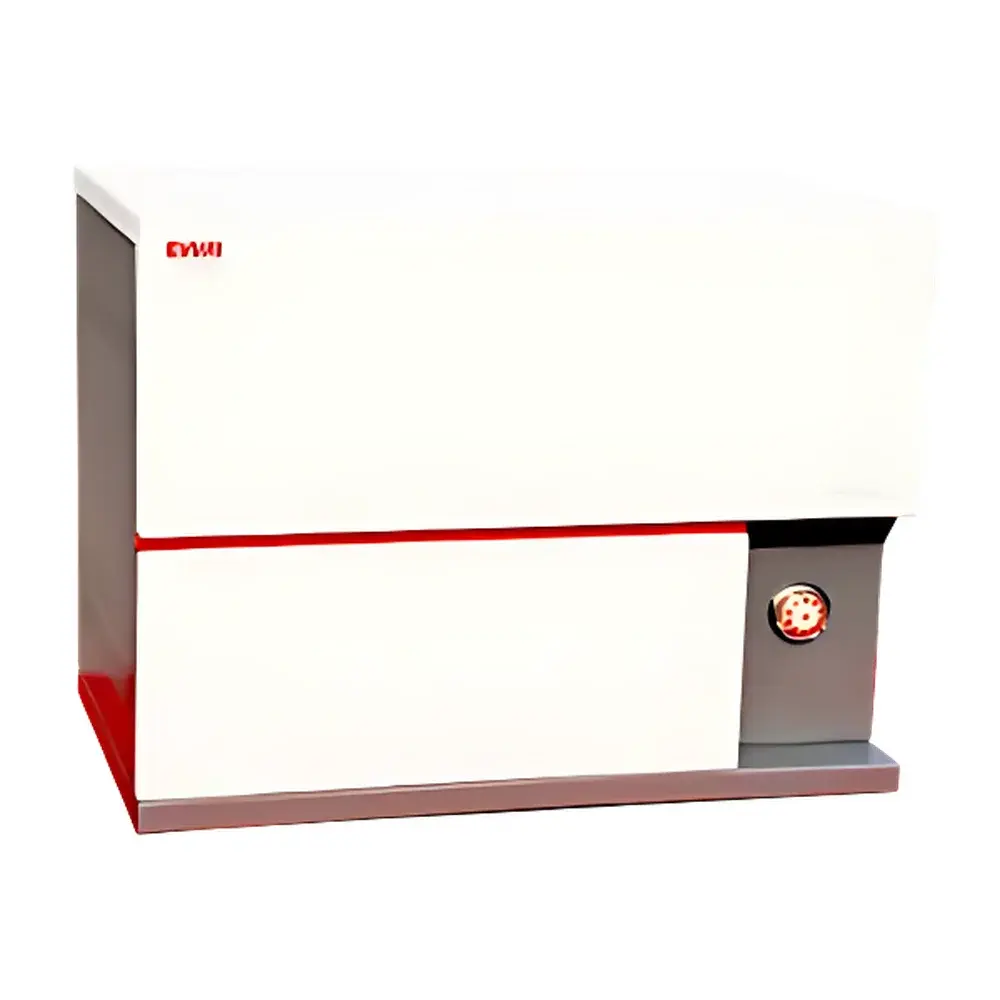
PRO-MS 3600 Process Mass Spectrometer
| Brand | East & West Analytical Instruments |
|---|---|
| Origin | Beijing, China |
| Manufacturer Type | OEM Manufacturer |
| Model | PRO-MS 3600 |
| Detection Range | ppb to 100% (v/v) |
| Detection Principle | Quadrupole Mass Spectrometry |
| Response Time | < 1.5 s (typical for single-point analysis) |
| Ion Source | High-efficiency inertized electron ionization source |
| Quadrupole Material | Passivated stainless steel |
| Inlet System | Multi-stage differential pumping with low-dead-volume valving |
| Software | Real-time spectral acquisition and quantitative analysis suite compliant with GLP data integrity requirements |
Overview
The PRO-MS 3600 Process Mass Spectrometer is an industrial-grade online quadrupole mass spectrometer engineered for continuous, real-time gas-phase compositional analysis in demanding production and research environments. Operating on the principle of mass-to-charge ratio (m/z) separation within a radiofrequency-driven quadrupole filter, the system delivers high-fidelity detection across a mass range of 1–100 u (extendable to 300 u upon configuration), enabling simultaneous quantification of permanent gases (e.g., H₂, O₂, N₂, CO, CO₂), light hydrocarbons (C₁–C₄), sulfur compounds (H₂S, SO₂), halogenated species, and volatile organic compounds (VOCs). Its design centers on robustness under variable process conditions—featuring differential pumping architecture that maintains ultra-high vacuum (<1×10⁻⁶ mbar) in the analyzer region while accommodating inlet pressures up to 100 kPa (absolute) via staged pressure reduction. This ensures stable ion transmission, minimal background interference, and long-term signal reproducibility without recalibration drift.
Key Features
- Multi-stage differential inlet system with integrated heated capillary and cryo-cooled foreline trap, minimizing condensable carryover and achieving sub-second sample transport latency
- Multi-port selection valve manifold supporting up to 8 independent sampling points with programmable sequence control and automated leak-check routines
- Inertized electron ionization (EI) source constructed from electropolished, silanized stainless steel and ceramic insulators—resistant to oxidation, corrosion, and carbon buildup in humid or oxygen-rich streams
- High-transmission quadrupole mass filter fabricated from passivated 316L stainless steel rods, thermally stabilized to ±0.1 °C to suppress mass shift under ambient temperature fluctuations
- Dynamic linear response spanning nine orders of magnitude—from low-ppb (sub-ppt for select ions with integration) to 100% volume fraction—validated per ISO 17025 traceable calibration protocols
- Integrated bake-out capability (up to 150 °C) for rapid recovery after exposure to high-moisture or high-particulate streams
Sample Compatibility & Compliance
The PRO-MS 3600 accommodates a broad spectrum of process gas matrices, including but not limited to refinery off-gases, fermentation headspace, semiconductor purge streams, flue gas effluents, and biogas upgrading lines. All wetted surfaces—including transfer lines, valves, and ion optics—are chemically passivated to prevent catalytic decomposition or adsorption of reactive analytes (e.g., NH₃, Cl₂, NOₓ). The system meets mechanical and electrical safety requirements per IEC 61000-6-2/6-4 (EMC) and UL 61010-1. Data acquisition and reporting functions support audit-trail-enabled operation in accordance with FDA 21 CFR Part 11 and EU Annex 11 for computerized systems used in GMP environments. Calibration records, method parameters, and raw spectral files are stored with immutable timestamps and user authentication logs.
Software & Data Management
The proprietary MS-ProcessControl software provides a modular, Windows-based interface for instrument control, real-time spectral visualization, multi-component quantitation, and alarm management. It supports ASTM D7901-compliant peak deconvolution algorithms for overlapping m/z signals (e.g., Ar⁺ at 40 u vs. CH₃CH₂⁺ at 40 u), isotopic ratio correction, and matrix-matched internal standardization. Raw .RAW data files are structured in HDF5 format for long-term archival and third-party interoperability (e.g., with MATLAB, Python pandas, or LIMS platforms via OPC UA or RESTful API). Batch export options include CSV, Excel, and PDF reports with embedded chromatograms, calibration curves, and QC summary statistics—all retaining full metadata per ISO/IEC 17025 clause 7.7.
Applications
- Petrochemical refining: Real-time monitoring of FCC unit regenerator flue gas, hydrogen purity in hydrotreater loops, and sulfur speciation in amine scrubber overheads
- Steelmaking: In-situ analysis of BOF off-gas for CO/CO₂ ratio trending and endpoint prediction
- Biopharmaceutical fermentation: Quantitative tracking of dissolved O₂, CO₂, ethanol, and acetate in aerobic and anaerobic bioreactor headspace
- Environmental emission monitoring: Continuous measurement of VOCs (BTEX, chlorinated solvents) and greenhouse gases (CH₄, N₂O) at stack outlets per EPA Method 25A and EN 15267
- Hydrogen energy infrastructure: Purity verification of green H₂ (≥99.999%) and detection of critical impurities (CO, H₂S, NH₃) below ISO 8573-8 Class 1 limits
FAQ
What is the typical maintenance interval for the ion source and quadrupole assembly?
Under normal operation with clean, filtered gas streams, the inertized ion source requires cleaning every 6–12 months; the quadrupole typically remains stable for >24 months without performance degradation.
Can the PRO-MS 3600 be integrated into a DCS or PLC environment?
Yes—it supports Modbus TCP, OPC UA, and analog 4–20 mA output modules for seamless integration with distributed control systems and safety instrumented systems (SIS).
Does the system comply with hazardous area classifications?
Optional ATEX Zone 1 / IECEx Ex d IIB+H₂ T4 certification is available for field-mounted configurations; standard units are rated for Class 1, Division 2 (NEC) or Zone 2 environments.
How is calibration performed, and what standards are supported?
Calibration uses certified gas mixtures traceable to NIST SRMs; the software supports multi-point linear and quadratic fitting, bracketing, and dynamic range extension via internal dilution control.
Is remote diagnostics and firmware update capability included?
Yes—secure SSH and TLS-encrypted web interface enable remote health monitoring, log retrieval, and over-the-air updates with version-controlled rollback functionality.



