
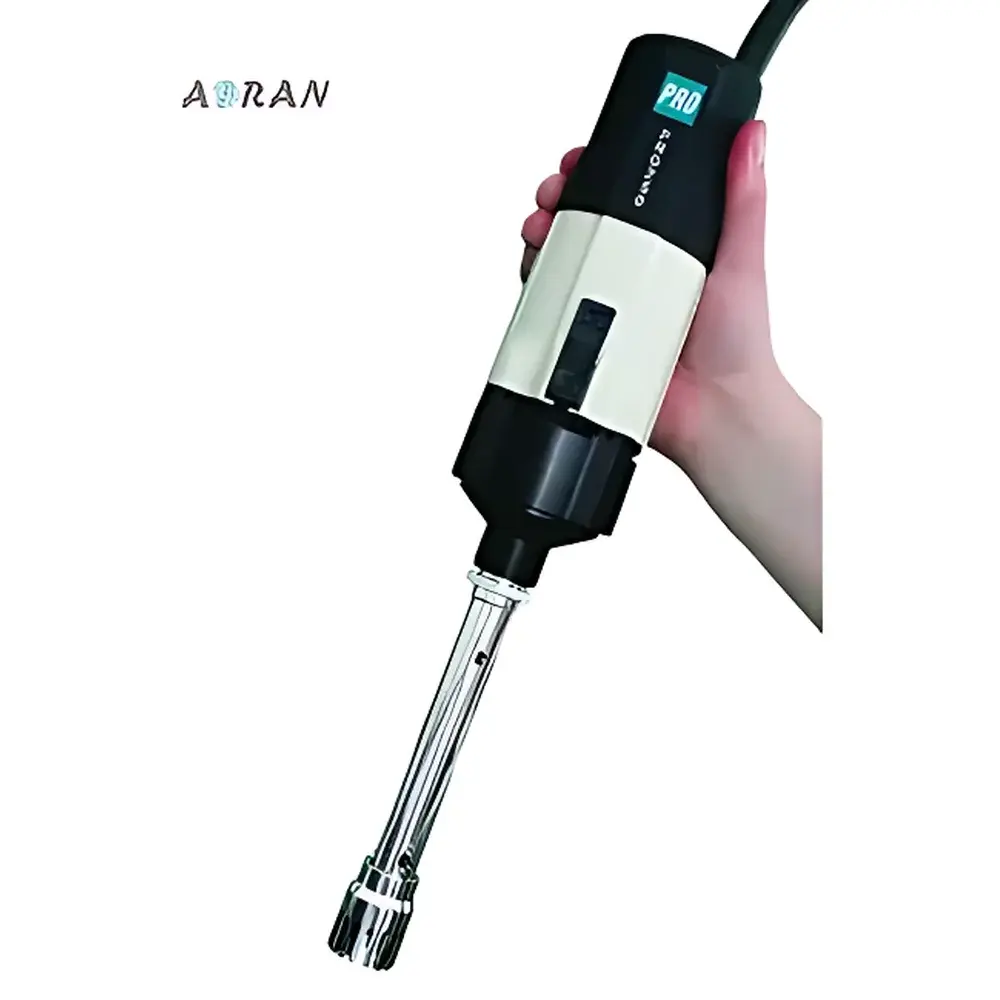
PRO PRO250 High-Power Handheld & Benchtop Homogenizer
| Brand | PRO |
|---|---|
| Origin | USA |
| Model | PRO250 |
| Instrument Type | Handheld Homogenizer |
| Instrument Category | Adjustable High-Speed Disperser |
| Sample Volume Range | 0.03–5000 mL |
| Output Power | 576 W |
| Speed Range | 10,000–30,000 rpm |
| Dimensions (W×H×D) | 6.9 × 22.8 × 6.9 cm |
| Weight | 1.4 kg |
| Rotor Diameter Options | 5 mm, 7 mm, 10 mm, 20 mm, 30 mm, Cryo-Freeze Grinding Rotor |
| Rotor Material | High-Grade Stainless Steel |
| Compliance | Suitable for Autoclaving (121°C, 20 min), Dry Heat Sterilization, Flame Sterilization, and Chemical Decontamination |
Overview
The PRO PRO250 High-Power Handheld & Benchtop Homogenizer is an engineered solution for high-shear mechanical homogenization in life science, pharmaceutical, food, and environmental laboratories. Based on the principle of rotor-stator shear dispersion, the device generates intense hydrodynamic cavitation and turbulent flow to disrupt cellular structures, emulsify viscous suspensions, and disperse nanoparticles or aggregates with reproducible efficiency. Its dual-mode design—supporting both handheld precision operation and stable benchtop use via optional mechanical lift stands—enables flexibility across workflow stages: from rapid small-volume lysate preparation to scalable processing of up to 5 L samples using large-diameter rotors. The 576 W brushless motor delivers consistent torque across the full speed range (10,000–30,000 rpm), minimizing thermal drift and ensuring mechanical stability during extended runs. Designed and assembled in the United States, the PRO250 meets international expectations for build integrity, electromagnetic compatibility (EMC), and operator safety under IEC 61010-1.
Key Features
- High-power 576 W brushless motor with active thermal management, enabling sustained operation at maximum speed without duty-cycle limitations
- Ergonomic handheld form factor (6.9 × 22.8 × 6.9 cm; 1.4 kg) optimized for single-hand control and fatigue-resistant handling during repetitive tasks
- Modular rotor-stator system with rapid-swap interface supporting seven standardized rotor diameters (5–30 mm) and application-specific geometries—including serrated, tapered, and cryo-optimized configurations
- Rotors fabricated from ASTM F138-certified surgical-grade stainless steel (316L equivalent), validated for repeated sterilization cycles including autoclaving (121°C, 20 min), dry heat (160°C, 2 h), flame, and ethanol/isopropanol immersion
- Benchtop adaptability via optional mechanical lift stand (Order No. 80-25000) with micrometer-adjustable height control and container clamping assembly (Order No. 80-00102)
- Integrated safety interlock system compatible with optional stainless steel or borosilicate glass sealed homogenization chambers, reducing aerosol generation and cross-contamination risk per ISO 22174 and CLSI M29-A3 guidelines
Sample Compatibility & Compliance
The PRO250 accommodates a broad spectrum of sample matrices—from soft mammalian tissues and bacterial pellets to fibrous plant material, yeast cell walls, and polymer dispersions—across volumes spanning 30 µL to 5000 mL. Rotor selection directly governs shear intensity and volumetric throughput: smaller-diameter rotors (5–10 mm) deliver localized high-shear for micro-scale lysis, while larger rotors (20–30 mm) provide bulk mixing efficiency for suspension homogenization and emulsion stabilization. All wetted components comply with USP Class VI biocompatibility standards and FDA 21 CFR 177.2400 for repeated food-contact use. The system supports GLP/GMP-aligned workflows through traceable rotor calibration logs and documented sterilization validation protocols.
Software & Data Management
While the PRO250 operates as a standalone analog-controlled instrument, its speed and runtime parameters are fully compatible with external digital logging systems via optional analog voltage output (0–10 V DC proportional to rpm). When integrated into automated lab environments, it interfaces seamlessly with LabVantage, STARLIMS, or custom SCADA platforms for electronic batch record (EBR) capture. Audit trails for rotor usage, sterilization cycles, and maintenance intervals can be maintained in accordance with 21 CFR Part 11 requirements when paired with validated electronic lab notebooks (ELN) and access-controlled user authentication.
Applications
- Molecular biology: Nuclear and mitochondrial isolation, genomic DNA shearing prior to NGS library prep, RNA extraction from tough tissues
- Pharmaceutical development: Nanoemulsion formulation, liposome extrusion support, excipient dispersion in semi-solid dosage forms
- Microbiology: Total viable count (TVC) sample homogenization per ISO 6887-1 and AOAC 990.12
- Food safety testing: Pathogen enrichment homogenization for Salmonella and Listeria detection per FDA Bacteriological Analytical Manual (BAM) Chapter 4
- Materials science: Carbon nanotube dispersion in polymer matrices, graphene oxide exfoliation in aqueous media
FAQ
Is the PRO250 suitable for sterile processing under ISO 5 (Class 100) laminar flow hoods?
Yes—the compact footprint, low particulate shedding design, and autoclavable rotor sets allow full integration into aseptic workflows when used with sealed homogenization chambers.
Can the PRO250 be used for cryogenic homogenization?
Yes—when equipped with the optional Cryo-Freeze Grinding Rotor (PK-02250MXD accessory), the unit supports sub-zero temperature operation down to –80°C with compatible chilled jackets and dry ice/ethanol baths.
What maintenance is required to sustain long-term torque accuracy?
Annual verification of motor commutation timing and rotor concentricity is recommended; no routine lubrication is needed due to the sealed brushless motor architecture.
Does the PRO250 meet CE marking requirements for export to the European Union?
Yes—it carries CE marking under the Machinery Directive 2006/42/EC and EMC Directive 2014/30/EU, with technical documentation available upon request.
How does rotor selection affect shear rate and sample temperature rise?
Shear rate scales linearly with tip speed (rpm × rotor diameter × π); therefore, higher rpm and larger rotors increase both mechanical energy input and adiabatic heating—sample temperature monitoring is advised for thermolabile analytes.



