
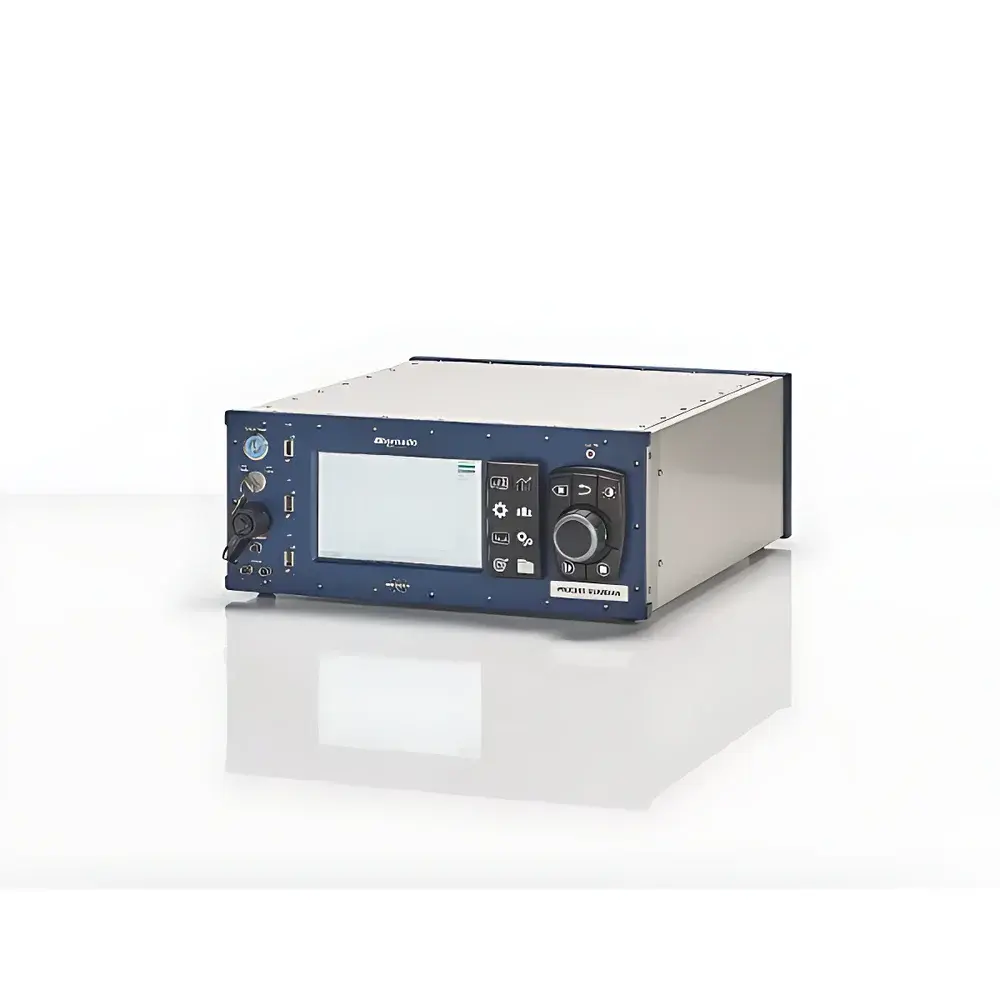
Process Guardian™ Raman Spectrometer by Bruker
| Brand | Bruker |
|---|---|
| Origin | Germany |
| Model | Process Guardian™ |
| Instrument Type | In-line Raman Spectrometer |
| Laser Wavelength | 785 nm |
| Enclosure | 19-inch rack-mount industrial chassis |
| Control Architecture | Embedded real-time system with integrated display and HMI |
| Fiber Interface | FC/PC dual-fiber connector |
| Channel Expansion | Up to 8 channels via multiplexer integration |
| Safety Features | Laser fiber break detection, emergency stop interface |
| Optical Technology | HTVS™ (High-Throughput Virtual Slit) spectrograph |
| Regulatory Compliance | FDA 21 CFR Part 11 compliant data handling, ATEX/IECEx-certified options available for hazardous areas |
Overview
The Process Guardian™ Raman Spectrometer (PGR) is a purpose-engineered in-line analytical instrument designed for continuous, non-invasive molecular monitoring of chemical processes in real time. Based on confocal Raman scattering principles, the PGR delivers quantitative compositional data without sample extraction or reagent consumption. Its core optical architecture employs Bruker’s proprietary HTVS™ (High-Throughput Virtual Slit) spectrograph—replacing conventional physical slits with a dynamically optimized virtual aperture that simultaneously maximizes photon throughput and spectral resolution. This design enables >10× higher signal intensity compared to traditional Czerny–Turner spectrometers while preserving <1 cm⁻¹ spectral fidelity across the 200–3200 cm⁻¹ Raman shift range. The system operates autonomously via an embedded Linux-based control unit, eliminating dependency on external PCs and reducing long-term IT overhead. Housed in a ruggedized 19-inch rack-mount enclosure rated IP65, the PGR is qualified for deployment in demanding industrial environments—including classified hazardous zones when configured with ATEX/IECEx-compliant optics and safety interlocks.
Key Features
- Self-contained operation: Integrated touchscreen HMI, embedded processor, and real-time OS enable full instrument control without external computing hardware.
- Field-serviceable 785 nm diode laser module: Designed for rapid replacement during scheduled maintenance with no optical realignment required.
- FC/PC dual-fiber interface: Simplifies probe integration with mechanical locking mechanism and built-in fiber continuity monitoring.
- HTVS™ spectrograph: Delivers high photometric sensitivity (>10× gain vs. slit-limited systems) while maintaining resolution stability under thermal and mechanical stress.
- Multi-channel scalability: Supports up to eight process streams via optional optical multiplexer—each channel independently calibrated and time-synchronized.
- Inherent safety architecture: Includes laser fiber break detection, hardware-enforced emission cutoff, and dedicated emergency stop input compatible with plant-wide safety systems.
Sample Compatibility & Compliance
The PGR accommodates diverse sampling configurations through interchangeable probe options—including immersion, flow-cell, backscatter, and remote standoff probes—with fiber lengths up to 100 m. It supports measurements in gas, liquid, slurry, and solid-phase systems across temperatures from −40 °C to +150 °C and pressures up to 20 bar (dependent on probe selection). All firmware and data acquisition modules comply with FDA 21 CFR Part 11 requirements for electronic records and signatures, including audit trail logging, user role-based access control, and secure data encryption. Optional configurations meet ATEX Zone 1/21 and IECEx Ex ib IIC T4 Gb/Da standards for installation in explosive atmospheres. The system adheres to ISO/IEC 17025 traceability frameworks for calibration verification and supports GLP/GMP documentation workflows.
Software & Data Management
Bruker’s OPUS® PGR Edition provides a validated software suite for method development, multivariate calibration (PLS, PCA), real-time concentration trending, and alarm-driven process feedback. Calibration models are fully transferable between PGR units using Bruker’s standardized model portability protocol—ensuring consistency across manufacturing sites and instrument generations. Raw spectra and processed results are stored in HDF5 format with embedded metadata (timestamp, instrument ID, operator, environmental conditions). Data export supports ASTM E1382-compliant CSV, OPC UA, and Modbus TCP protocols for seamless integration into DCS, MES, and PAT platforms. Audit trails record all user actions, parameter changes, and calibration events with immutable timestamps and digital signatures.
Applications
- Real-time reaction endpoint detection in API synthesis and fine chemical manufacturing.
- Continuous monitoring of polymerization kinetics and monomer conversion in extrusion and batch reactors.
- In-line quantification of active pharmaceutical ingredients (APIs), excipients, and residual solvents in fluidized bed dryers and granulators.
- Gas composition analysis in syngas, biogas, and hydrogen purification streams.
- Quality assurance of incoming raw materials via automated identity verification against reference spectral libraries.
- Support for Quality by Design (QbD) initiatives and Process Analytical Technology (PAT) frameworks per ICH Q8–Q10 guidelines.
FAQ
Does the Process Guardian™ require external cooling or air conditioning?
No—the PGR uses thermoelectrically stabilized optics and fanless convection cooling, enabling operation in ambient temperatures from 0 °C to 45 °C without auxiliary HVAC support.
Can existing Raman calibration models be migrated to the PGR platform?
Yes—Bruker’s cross-platform model portability framework ensures backward compatibility with legacy Tornado and MATRIX-F spectrometers when using OPUS® v8.5 or later.
Is remote diagnostics supported for troubleshooting?
Yes—the embedded system includes secure SSH access and VNC-enabled remote desktop functionality, subject to customer network security policies and firewall configuration.
What validation documentation is provided with the instrument?
Each unit ships with Factory Acceptance Test (FAT) reports, IQ/OQ templates aligned with ASTM E2500, and a Certificate of Conformance traceable to NIST standards.






